
NerdWallet’s Accelerated Profitability Growth Highlights Strength and Monetization Efforts Against Regulatory and Competitive Challenges
NerdWallet expanded its digital financial guidance platform with significant revenue growth and rising net income in 2025 supported by technology and marketplace integration but faces margin pressures, partner dependency, and regulatory risks.
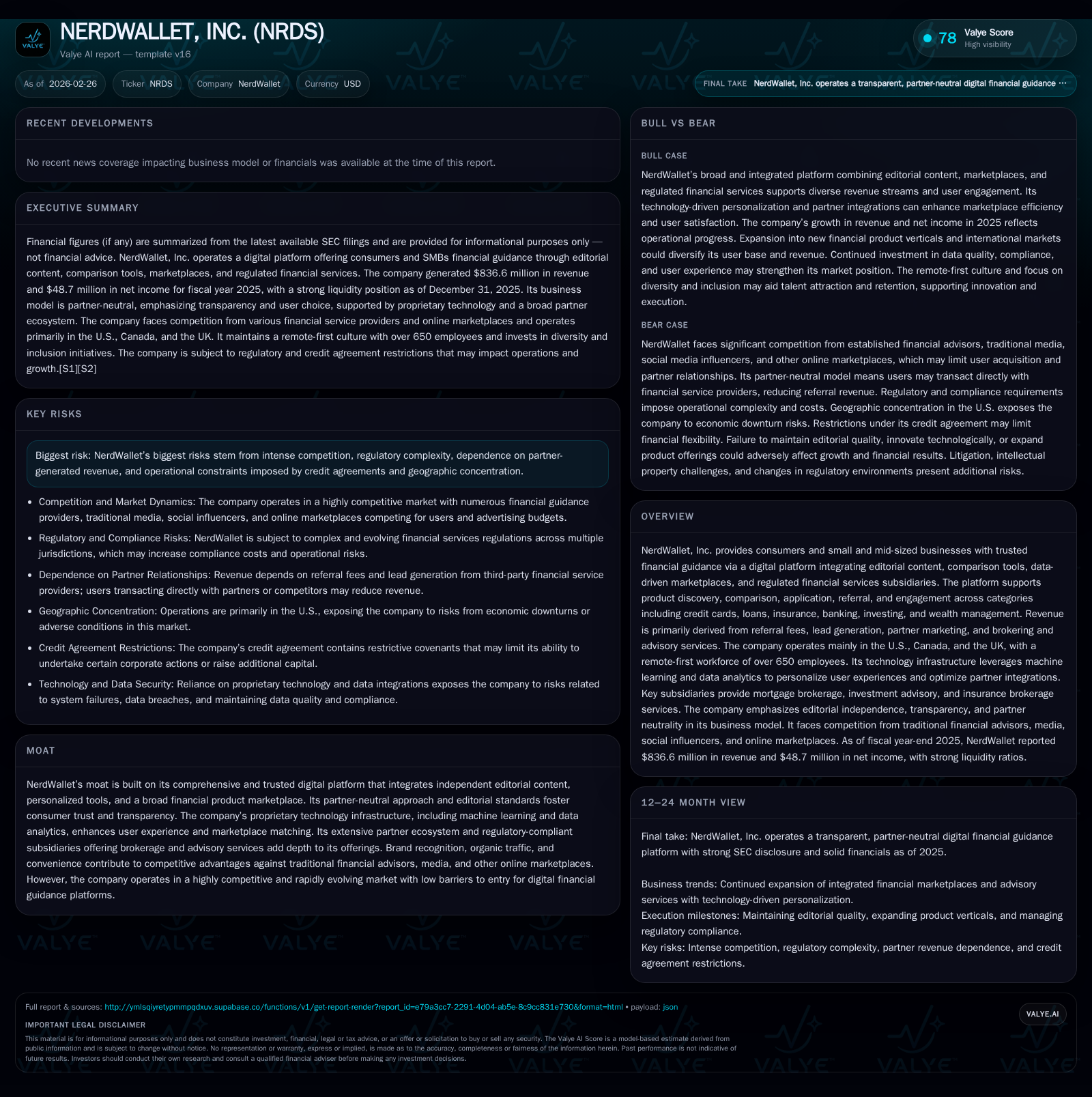
NerdWallet, Inc. delivered robust top-line growth in 2025, with a 22% revenue increase alongside a substantial improvement in profitability, posting a net income growth of over 60%. The company’s strength lies in its integrated digital platform combining editorial content, personalized tools, and regulated financial services brokers, which drive user engagement and monetization through referral fees and brokerage activities. However, continued reliance on partner-generated revenues, intensifying competition, evolving regulations across multiple jurisdictions, and operational complexities—especially following its mortgage brokerage expansion—pose challenges to sustaining momentum. Capital allocation favors organic growth investments complemented by opportunistic share repurchases, while the firm maintains a healthy liquidity position enabling flexibility amid industry uncertainties.
Company Overview and Business Model
NerdWallet, Inc. operates as a leading digital financial guidance platform serving consumers and small to mid-sized businesses primarily within the United States, Canada, and the United Kingdom [S7]. The company's core mission is facilitating confident financial decision-making by integrating high-quality editorial content with interactive comparison tools and an extensive marketplace of financial products spanning credit cards, loans, insurance, banking, investing, wealth management, mortgages, and advisory services.
The platform leverages machine learning algorithms and sophisticated data analytics to personalize user experience—delivering relevant product recommendations based on refined user segmentation and predictive modelling. This infrastructure supports a partner-neutral stance aimed at fostering trust through transparent side-by-side comparisons devoid of overt product bias [S12][S15].
Primary revenue streams include referral fees earned from directing traffic or leads to third-party financial institutions (including credit card issuers, lenders, insurers), partner marketing incentives linked to user acquisition metrics, as well as direct brokerage commissions via subsidiaries engaged in mortgage brokering (Next Door Lending LLC), insurance agency services (NerdWallet Insurance Experts), and investment advisory operations (NerdWallet Wealth Partners) [S13][S16].
Historical Financial Performance
NerdWallet’s financial trajectory over recent years reflects remarkable improvement in profitability coupled with consistent top-line growth. Revenue rose from approximately $688 million in fiscal year 2024 to around $837 million in fiscal year 2025—a compound annual growth rate reflecting strong traction in lead generation marketplaces enriched by cross-selling into regulated subsidiary offerings.
Operating income demonstrated exceptional acceleration: after modest gains in prior years ($3.6M in FY23 to $9.4M in FY24), operating profit exploded to $65.2 million by FY25—a nearly seven-fold increase year-over-year—driven by scale efficiencies as well as enhanced monetization initiatives including increased conversion rates on referrals and expanded advisory revenues [F1].
Net income turned decisively positive following losses in FY22–23 (-$10.2M and -$11.8M respectively) scaling to $30.4 million in FY24 then rising by an additional 60% to reach $48.7 million in FY25 [F1]. Operating cash flow also saw robust growth from $71.8 million in FY24 to $131.6 million in FY25.[F1] Capital expenditures remain modest relative to cash flows ($1.3M capex for FY25), indicating lean operating leverage.
Historical performance (annual)
| FY | Net ($mm) | CFO ($mm) | OpInc ($mm) | Capex ($mm) | Net YoY |
|---|---|---|---|---|---|
| 2025 | 49 | 132 | 65 | 1 | +60.2% |
| 2024 | 30 | 72 | 9 | 1 | +357.6% |
| 2023 | -12 | 72 | 4 | 1 | -15.7% |
| 2022 | -10 | 25 | -19 | 5 |
Source: SEC companyfacts cache [F1].
Capital returns and efficiency (annual)
| FY | FCF ($mm) | ROE% |
|---|---|---|
| 2025 | 130 | 13.0 |
| 2024 | 71 | 8.3 |
| 2023 | 71 | -3.2 |
| 2022 | 20 | -3.0 |
Source: SEC companyfacts cache [F1].
Note: Dividends are not reported; share repurchase programs have been active but dollar amounts vary
Growth Drivers and Future Opportunities
Several factors underpin NerdWallet’s future growth prospects:
Marketplace Expansion: Deepening penetration across verticals like insurance brokerage, small business lending (via Fundera), mortgages through Next Door Lending LLC subsidiary expands addressable market while enabling higher-value referrals.
User Engagement via Proprietary Tech: Continued investment into machine learning-driven personalization enhances lead quality and conversion efficiency benefiting both users and partners.
International Growth: Although currently U.S.-centric for majority revenue (~80%+), incremental progress into Canada and U.K markets diversifies revenue sources albeit currently limited scale [S25].
Monetization Enhancements: Strategic pivot efforts focus on diversifying traffic acquisition beyond reliance on Google search rankings towards social media channels, influencer partnerships, email marketing campaigns further optimizing cost-effective customer acquisition [N4].
Regulated Financial Services Growth: Brokering mortgage loans and wealth management advisory services offer relatively steadier revenue streams less dependent on purely digital referral models.
Data Analytics Offerings: Sell-side analytic tools provided to partners support underwriting decisions boosting partner appeal.
However growth is moderated by several constraints:
- Competition: Intense rivalry from other online marketplaces such as Bankrate, Credit Karma (now part of Intuit), LendingTree alongside direct-to-consumer fintechs raises CAC pressure.
- Regulatory Complexity: Operating under multiple regulatory regimes imposes compliance costs especially post entry into mortgage brokerage requiring licensing adherence per state laws as well as federal norms under agencies like CFPB complicates scaling.
- Partner Reliance Risk: Revenue heavily tied to partner underwriting policies; tightening credit standards or reduced marketing spends during economic downturns could suppress volumes.
- Search Engine Algorithm Dependence: Traffic volatility due to unanticipated changes in Google’s SEO algorithms remains an inherent risk.[S1]
Milestones & Outlook Metrics
Though no explicit consensus guidance is provided for upcoming quarters or years from NerdWallet’s filings up through early Q1/26 disclosures ([S3],[N1]), key indicators for investors and stakeholders include:
- Sustaining high double-digit revenue growth rate while improving margins driven by marketplace scale effects;
- Progress on international expansion reflecting non-U.S.% revenue uplift;
- Execution on capital deployment strategy balancing investments against shareholder return programs;
- Regulatory audit outcomes particularly for mortgage brokering units;
- User engagement metrics related to new traffic diversification channels;
- Partner retention rates amid evolving fintech competitive dynamics.
Monitoring quarterly earnings releases will be critical to assess how these variables unfold amidst shifting macroeconomic conditions impacting consumer credit markets.
Returns & Capital Allocation Strategy
NerdWallet posted a healthy approximate return on equity around 13% for FY25 computed from net income of $48.7 million over equity base near $374 million at year-end [F1]. This reflects effective profit generation compared against capital invested despite recent prior years of operating losses.
Free cash flow stands out as robust at roughly $130 million after deducting capex from CFO [F1], indicating lucrative operating economics suitable for strategic capital deployment.
To date there are no dividends declared; however management has actively authorized share repurchase programs increasing maximum authorization from initial $25 million in early-mid 2025 first raised progressively to the current $125 million ceiling as of December last year ([S19],[S26],[S14]). This signals confidence in intrinsic valuation while preserving flexibility for acquisitions or reinvestments given competitive intensity.
On leverage front NerdWallet maintains a conservative balance sheet with no material outstanding debt reported as of latest filings but retains access via credit facility secured principally by company assets ([S4],[S9]). Covenants impose financial discipline but also limit aggressive external funding risks.
Competitive Positioning & Moat Analysis
NerdWallet commands distinctive advantages:
- Brand reputation built on editorial integrity supporting consumer trust essential for sensitive financial decisions.
- Comprehensive multi-category product coverage offering one-stop holistic finance navigation comparative to fragmented alternatives.
- Proprietary technology infrastructure including ML-powered recommendations allowing tailored user journeys increasing match success rates with providers.
- Integrated regulated entities affording control over downstream transactions beyond simple lead conduit which can provide higher margin capture points.
- Remote-first operational model enabling recruitment of skilled talent dispersed across geographies enhancing innovation pipeline.[S28]
Nevertheless the moat remains narrow given relatively low technological barriers replicable by better-capitalized tech giants or niche fintech disruptors leveraging advanced AI or proprietary customer data platforms more aggressively.
Industry Risks & Regulatory Environment
The evolving regulatory frameworks governing consumer finance information dissemination warrant ongoing vigilance:
- Compliance must navigate overlapping rules from CFPB mandates (e.g., consumer protection laws), GLBA privacy requirements for data handling,[...] CCPA/CPRA protections along with emerging UK GDPR modifications following post-Brexit legislation updates.[S18][S24]
- Advertising disclosures including compensated endorsements require strict adherence avoiding pitfalls that might invite FTC enforcement actions.
- Mortgage brokering operations debuted only recently face acute licensing scrutiny per state-by-state SAFE Act standards mandating rigorous personnel certification alongside continuous compliance monitoring.[S16]
- Cybersecurity protection remains paramount given exposure of sensitive personal data handled through high volume digital workflows.
- Shifts in macroeconomic interest rates impact loan origination volume directly affecting certain revenue pools.
Conclusion — Points to Monitor Going Forward (Analysis)
Several key areas warrant close attention over the next reporting cycles:
- Evolution of traffic acquisition mix—will reliance on Google search reduce materially?
- Earnings trajectory sustaining margin improvement amid increased investments?
- Integration performance of mortgage brokerage subsidiary next-door lending including regulatory adherence?
- Partner portfolio health—any meaningful shifts away from dependent institutions?
- International revenue mix development impacting geographical risk concentration?
- Management’s execution on share repurchases balanced with strategic M&A?
- Responses to emerging AI governance regulations impacting product personalization?
- Consumer retention metrics amidst broader fintech competitive disruptions?
This nuanced assessment highlights NerdWallet's progression into steady profitability backed by scalable technology-assisted marketplaces tightly interwoven with regulated financial service delivery but tempered by notable operational risks inherent in the sector's regulatory complexity and partner dependencies.
Disclaimer: This report is for informational purposes only regarding NerdWallet Inc.’s business operations and industry context based strictly on publicly available filings and news as of February 26, 2026.
Disclaimer: This is research-only, informational analysis and not investment advice. It may include AI-generated interpretation and general industry context. Always verify important details using primary sources.

Comments