
NRG Energy’s Asset Sale and Diversification: Strategic Reset or Liquidity Gambit?
NRG Energy reported Q3 2026 revenue of $9.47 billion and $561 million in net income, but faces a tight liquidity position with a current ratio of 0.99.
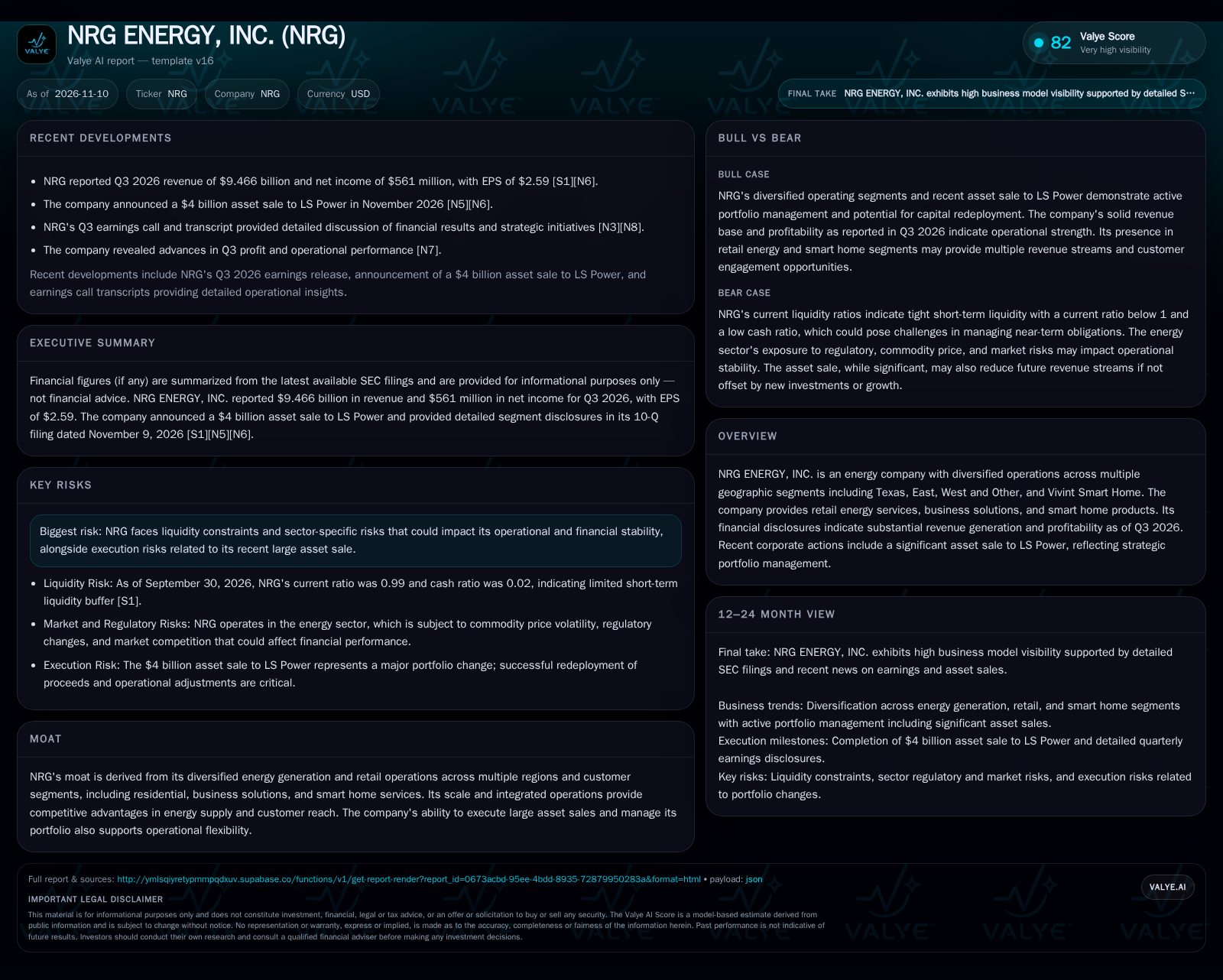
NRG Energy reported Q3 2026 revenue of $9.47 billion and $561 million in net income, but faces a tight liquidity position with a current ratio of 0.99. The $4 billion asset sale to LS Power could reshape its portfolio, but execution risk and capital allocation decisions will determine whether this move strengthens or weakens its long-term business model. Diversification across retail energy and smart home segments could provide new growth avenues, but sector volatility and short-term financial constraints remain key watchpoints. [S1] [N5] [N6]
NRG Energy’s latest quarter underscores both the strength and vulnerability of its business model. While posting strong top-line and bottom-line results, the company’s asset sale to LS Power and thin liquidity ratios signal a business at an inflection point. The question is whether NRG can leverage its diversified operations and new capital to offset the revenue and earnings power lost with the asset sale—or whether execution and market risks will expose underlying fragility. The answer will hinge on how adeptly NRG redeploys proceeds and manages its evolving portfolio amid sector volatility. [S1] [N5] [N6]
NRG’s Q3 2026 Results Mark a Turning Point in Asset Sales and Earnings
NRG Energy reported $9.466 billion in revenue and $561 million in net income for the quarter ended September 30, 2026, with basic and diluted EPS of $2.59. These figures reflect a profitable core business despite sector headwinds. However, the company’s balance sheet shows a current ratio of 0.99 and a cash ratio of just 0.02, highlighting tight short-term liquidity. Most notably, NRG announced a $4 billion asset sale to LS Power in November 2026, a move that will materially reshape its asset base and cash position. This transaction provides a substantial influx of capital but also raises questions about future earnings power and the need for effective redeployment of proceeds. [S1] [N5] [N6]
Profitability and Complexity Stem from NRG’s Diverse Business Mix
NRG’s revenue and profit engine spans retail energy supply, business solutions, and the Vivint Smart Home segment, each with distinct economics. Retail energy typically operates on thin margins, with profitability driven by scale, customer retention, and efficient hedging against volatile wholesale prices. Business solutions may offer higher margins via tailored services, but face competitive bidding and customer churn risks. The smart home segment could provide recurring revenue streams if structured as subscriptions or services, but the economics depend heavily on hardware costs, customer acquisition, and upsell potential.
Fixed costs are significant in energy generation and infrastructure, so operating leverage is high: incremental volume can drive outsized profit gains, but downturns or customer loss can quickly erode margins. The $4 billion asset sale could reduce fixed-cost burden and generate cash for reinvestment or debt reduction, but unless proceeds are channeled into high-return opportunities, there’s a risk of earnings dilution. Capital needs remain substantial, especially if NRG pursues further technology upgrades, customer acquisition, or expansion in the smart home space.
NRG’s Strategic Position Reflects Diversification, Scale, and Sector Challenges
NRG’s competitive position is built on its scale, geographic reach, and multi-segment business model. By operating in Texas, East, West, and smart home markets, NRG can diversify both revenue and risk profiles. This breadth can provide cross-selling opportunities, customer stickiness, and some insulation from regional shocks. However, the retail energy market remains highly competitive, with low switching costs for customers and ongoing price pressure from both regulated utilities and aggressive new entrants, including digital-first providers and distributed energy solutions.
The Vivint Smart Home segment positions NRG to capture value from the convergence of energy management and home automation—a space where data, integration, and customer experience will be key differentiators. Yet, this segment brings its own category of competitors, from established home security brands to technology giants and IoT-focused startups. Sector headwinds—including regulatory unpredictability, commodity price swings, and evolving consumer preferences—could undermine even a well-diversified strategy if not managed proactively.
Growth and Margin Gains Could Follow Asset Sale Proceeds Redeployment
If NRG swiftly and strategically redeploys the $4 billion from the LS Power asset sale into higher-return opportunities, it could offset lost earnings and potentially improve margins. Capital could be used to accelerate smart home customer acquisition, invest in digital platforms, or expand value-added services in retail energy and business solutions. Success here would likely be evidenced by rising revenue per customer, improved segment EBIT margins, and growth in recurring or subscription-based revenue streams.
A confirming signal would be clear disclosure of new investments, partnerships, or acquisitions that enhance NRG’s earnings power. Additional evidence might include improved guidance, upward revisions to medium-term earnings targets, or commentary on successful integration of new business lines. Conversely, if proceeds are used primarily for debt paydown without a clear growth plan, or if subsequent earnings and margin trends stagnate, this would challenge the upside thesis.
Portfolio Optimization May Stabilize Results with Limited Growth Upside
The most plausible scenario is that NRG uses the asset sale proceeds to shore up its balance sheet, selectively invest in core business lines, and maintain its diversified revenue base. The company may prioritize debt reduction to address liquidity constraints and improve credit metrics, while making measured investments in technology upgrades or customer experience initiatives. Revenue growth would likely track sector averages, with profitability fluctuating based on commodity prices and customer churn.
This scenario would be confirmed by steady—but not transformative—earnings trends, moderate capital expenditure, and cautious guidance on future growth. Evidence of disciplined capital allocation, such as transparency around investment returns and operating cost controls, would support this outcome. Conversely, persistent liquidity tightness, unexpected cost overruns, or failure to stabilize revenue after the asset sale would undermine this base case.
Value Creation Risks Arise from Liquidity Pressures and Execution Challenges
Delays or missteps in redeploying capital may result in lower earnings, margin compression, and potential asset write-downs. Regulatory or market shocks—such as adverse commodity price movements or new competitive threats—could exacerbate the situation, especially given NRG’s high fixed-cost base.
Confirmation of this scenario would come from persistent or worsening liquidity ratios, negative free cash flow, unplanned asset disposals, or downward revisions to earnings guidance. Additional warning signs would include customer attrition, loss of market share, or public acknowledgment of execution challenges by management. Conversely, visible improvement in working capital management or successful stabilization of post-sale earnings would weaken the downside case.
Factors Shaping NRG’s Trajectory After the Asset Sale
Disclosure of how the $4 billion in asset sale proceeds will be allocated—between debt repayment, reinvestment, or shareholder returns—will clarify the company’s strategic priorities and risk profile.
Trends in segment-level revenue and margin, especially in the Vivint Smart Home business, would help test whether diversification is translating into sustainable growth.
If disclosed, changes in customer churn, retention rates, and average revenue per user (ARPU) across retail and smart home segments would provide insight into competitive positioning and customer loyalty.
Guidance or commentary on new investments, technology upgrades, or expansion initiatives that could drive future earnings growth.
Regulatory developments or market shocks that could affect commodity prices, competitive dynamics, or cost structures across NRG’s core markets.
Management’s ability to deliver on stated operational or financial milestones post-asset sale, including integration of new business lines or achievement of stated cost synergies.
Disclaimer: This is research-only, informational analysis and not investment advice. It may include AI-generated interpretation and general industry context. Always verify important details using primary sources.

Comments