
Energy Vault Advances Own & Operate Strategy with Key Project Expansion and Software Edge
Energy Vault strengthens its integrated energy storage platform through a major Japan BESS portfolio acquisition and expanded Asset Vault deployments underpinned by its software-driven approach.
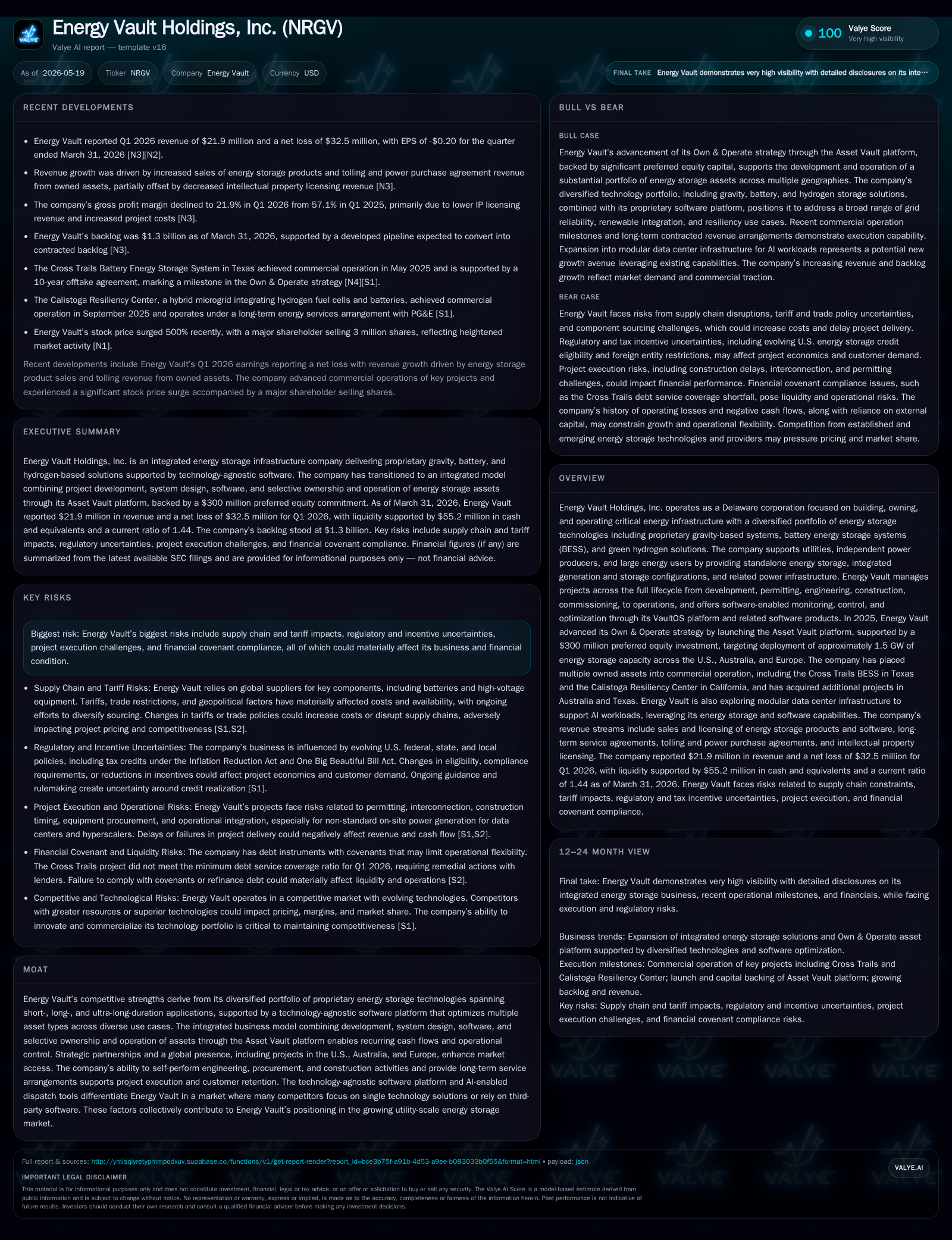
In its latest quarterly filing dated May 19, 2026, Energy Vault announced the planned acquisition of an 850 MW Battery Energy Storage System (BESS) portfolio in Japan to expand its Own & Operate asset base. This deal complements the company’s 2025 launch of the Asset Vault platform, enabling it to develop, own, and operate energy storage projects globally with recurring revenue streams supported by proprietary software. The company’s diversified technology stack spans gravity-based systems, batteries, and green hydrogen, integrated via a technology-agnostic software platform optimized for multiple durations and use cases. While tariff-induced raw material cost pressures and intense competition from both equipment and software vendors impose near-term risks, Energy Vault is positioned to capitalize on fast-growing demand from AI data centers and geographic expansion in key regions like Australia, Europe, and now Japan.
Latest Quarterly Developments Highlight Strategic Acquisitions
Energy Vault's May 19, 2026 10-Q filing reveals a significant leap in scale and geographic reach through its binding agreement to acquire an 850 MW Battery Energy Storage System (BESS) portfolio in Japan from a domestic developer. This acquisition includes 350 MW of advanced-stage projects along with an additional 500 MW at earlier stages of development [S2]. Expected to close subject to conditions, this deal advances Energy Vault’s Own & Operate strategy by adding a material footprint in the Asia-Pacific region—a market characterized by robust decarbonization policies and grid modernization efforts.
This move reflects a broader shift from pure EPC or licensing contracts toward owning operational assets delivering recurring revenue. The transaction also supports the company’s strategic pivot begun in 2024–2025 to vertically integrate project delivery with ownership. Alongside expansion plans, Energy Vault continues to navigate tariff impacts on raw materials: since early 2025, U.S. tariffs on various metal imports used in grid infrastructure have risen but are set to expire or be paused mid-2026. These import surcharges affect project cost structures and compel close supplier management [S2]. Meanwhile, competition intensifies not only from traditional EPC contractors but also from software providers offering modular asset management solutions—pressures that require continual innovation in both hardware and software layers [S2].
Integrated Business Model Driving Recurring Cash Flows and Operational Control
Energy Vault has transitioned to a fully integrated business model centered around its proprietary Asset Vault platform launched in 2025 with substantial backing from Orion Infrastructure Capital ($300 million preferred equity commitment) [S1][S2]. This structure enables the full lifecycle management of energy storage projects—from development through commissioning to ongoing operations—while selectively owning assets to capture long-term cash flows
The company’s ability to self-perform engineering, procurement, and construction combined with operations services reduces counterparty dependencies that traditionally extend project timelines or dilute margins. Asset Vault subsidiary entities raise project-level secured debt matched by contracted revenues under long-term offtake agreements providing strong coverage covenants typical for energy infrastructure financing [S4][S16][S23]. For instance, the Cross Trails BESS in Texas—Energy Vault’s initial Own & Operate asset deployed in mid-2025—features a structured senior secured term loan facility backed by project assets with scheduled amortization through 2032 [S23]. Despite some recent shortfalls against minimum debt service coverage ratios at Cross Trails due to ramp-up timing in ERCOT market revenues, management plans remedial actions including waivers or equity injections [S16].
This integrated approach also extends into proprietary software offerings. The VaultOS Energy Management System optimizes dispatch decisions across diverse technologies while enabling real-time operational visibility and predictive maintenance. Such a technology-agnostic platform supports multi-user scenarios ranging from utilities needing grid-scale flexibility to commercial customers demanding resilience—creating switching costs based on data-driven operational efficiency improvements [S1].
Technology-Agnostic Portfolio Spanning Gravity, Battery, and Green Hydrogen Storage
Energy Vault's product suite uniquely combines gravity-based energy storage (B-VAULT systems), lithium-ion battery assets (BESS), and emerging green hydrogen solutions (H-VAULT) into an offering designed for short-, long-, and ultra-long-duration applications [S1]. This breadth enables deployment tailored to diverse customer needs including grid balancing services, peak shaving for industrial users, or firm power delivery alongside renewables integration
For example, the company’s Calistoga Resiliency Center integrates batteries with hydrogen fuel cells creating hybrid microgrid capabilities targeted at customers requiring both reliability and sustainability credits. Similarly, the Australian Ebor BESS (100 MW / 870 MWh) promised under a recent Long-Term Energy Service Agreement exemplifies multi-day duration storage with eight hours dispatchable capacity planned for commercial operation in 2028 [S1][S12]
Complementary energy management software harmonizes these disparate technologies under common controls allowing portfolio dispatch optimization that maximizes revenue across wholesale markets while maintaining asset health.
Industry Context: Competitors, Supply Chain Dynamics, and Regulatory Headwinds
The competitive landscape is intensifying as legacy OEMs expand vertically into software-enabled asset management domains while new entrants offer cloud-native control platforms targeting distributed energy resources integration. This dynamic creates margin pressures and requires investments not only in hardware innovation but also robust embedded intelligence for asset optimization [S2][S18]. Additionally, supply chain fragilities linger despite easing tariff tensions; tariffs on core metals surged through much of 2025 impacting B-VAULT input costs directly connected to imported components from China [S2][S15]. The impending July 2026 expiration of key import surcharges presents uncertainty whether these will be renewed or replaced complicating forward pricing.
Moreover, regulatory policy continues shaping market access with permitting delays arising from evolving electricity codes related to safety standards for novel energy storage installations as well as interconnection queue backlogs affecting deployment timelines globally. These factors can hamper the pace of backlog conversion into revenue realized in given periods despite strong underlying bookings—the company discloses that its total sales backlog stood at approximately $1.3 billion as of March 31, 2026 with a developed pipeline representing substantial potential beyond currently contracted projects [S4][S19][S20].[Note: "Backlog" includes binding agreements; "developed pipeline" involves awarded or shortlisted projects yet not fully contracted.]
Growth Opportunities From AI Data Center Power Demand and Geographic Expansion
One of Energy Vault’s distinctive growth drivers lies in addressing the burgeoning power requirements of artificial intelligence (AI) hyperscale data centers whose unprecedented compute intensity demands highly reliable co-located power infrastructure. Traditional grids strain under such loads due to interconnection delays and transmission constraints while public sensitivity regarding resource consumption raises incentives for onsite clean generation paired with storage solutions under direct user control [S15].
Energy Vault targets this segment by deploying hybrid solutions that combine firm generation assets—natural gas fired or renewables—with proprietary storage technologies managed via AI-enabled Dispatch tools embedded within VaultOS. This orchestration allows meeting tight uptime SLAs demanded by hyperscaler tenants illustrating technological relevance beyond conventional grid-scale arbitrage-focused deployments.
Geographically, the company has built footholds spanning North America (e.g., Texas’s ERCOT market Cross Trails BESS), Australia (Ebor BESS supported by partner Bridge Energy Pty Ltd), Europe (project pipeline under active development), and now plans significant expansion into Asia through the announced Japan BESS acquisition portfolio—all regions where regulatory frameworks incentivize energy storage adoption aligning with net-zero objectives [S1][S2].
Risks from Tariffs, Project Execution Challenges, and Financial Covenants
Material risks revolve around evolving trade policies—tariffs on imported metals used in energy storage construction raise input costs unpredictably—and execution complexities inherent to permitting delays or supply chain bottlenecks potentially causing project timeline slippages which reduce near-term cash flows [S1][S2]
Further risk centers on financial covenant compliance; notably the Cross Trails Senior Note covenant breach risk evidences tight leverage utilization within owned projects requiring proactive lender engagement for waivers or additional equity support measures given initial operational ramp phases [S16]. Failure to comply could accelerate debt obligations materially affecting liquidity.
Competitive pressures also threaten margin compression where incumbent integrators or new software-centric entrants choose aggressive pricing strategies challenging Energy Vault’s positioned value proposition anchored on multi-technology integration coupled with recurring service contracts encompassing long-term maintenance and upgrades.
Key Milestones to Watch: Asset Vault Deployment and Contract Backlogs
Investors should monitor progress on multiple fronts including:
- Commercial operations at flagship owned assets such as Cross Trails BESS (Texas) achieving revenue stability post-May 2025 COD;
- Completion timeline for Calistoga Resiliency Center hybrid microgrid expected circa late next year;
- Advancement towards commissioning Australia’s Ebor BESS reliant upon regulatory approvals over next two years;
- Final closing on the Japan BESS portfolio acquisition subject to customary conditions anticipated later in fiscal year 2026;
- Contracted backlog conversion rates translating pending awards into recognized revenue amidst volatile supply conditions;
- Ramp-up of tolling service revenues under Power Purchase Agreements that underpin owned asset cash flows. Communication around these milestones during quarterly earnings calls as seen in Q1 transcripts will be pivotal indicators validating growth expectations [N1][N2][S19].[N3] indicates notable recent shareholder transactions reflecting market sentiment.
Financial Position: Strong Project-Level Capitalization Balancing Leverage
As of March 31, 2026, Energy Vault held $55.2 million in unrestricted cash balanced against $188.2 million total debt primarily associated with its consolidated Asset Vault projects leading to a net debt position roughly $133 million after cash offsets [F1][S4]. Corporate liquidity ratios exhibit a current ratio near 1.44 indicating manageable short-term obligations coverage [F1].
Capital structure includes recently issued $140 million Senior Convertible Notes due 2031 providing liquidity infusion albeit increasing interest expense obligations at ~9.5% annual coupon rate [S2][S7]
The combination of project-level non-recourse debt secured against underlying assets paired with limited recourse provisions mitigates parent company credit risk while sustaining asset-specific financial discipline—although careful covenant monitoring will remain essential given early operational results outpacing financial covenant thresholds only gradually.
In summary, Energy Vault's latest quarterly developments underscore meaningful progress executing an integrated Own & Operate model centered on proprietary multi-technology solutions enhanced by advanced software platforms capable of scaling globally amid an evolving competitive landscape complicated by tariff policies and project execution risk factors.
This analysis was prepared based solely on disclosed SEC filings dated up to May 19, 2026 () supported by current financial snapshots ([F1]) without any speculative assumptions or investment research views.
Disclaimer: This is research-only, informational analysis and not investment advice. It may include AI-generated interpretation and general industry context. Always verify important details using primary sources.

Comments