
NRX Pharmaceuticals Advances Ketamine-Based CNS Therapies While Managing Capital and Regulatory Challenges
The clinical-stage firm progresses key FDA submissions for novel neuroplastic drugs amid operational losses and strategic clinic expansion.
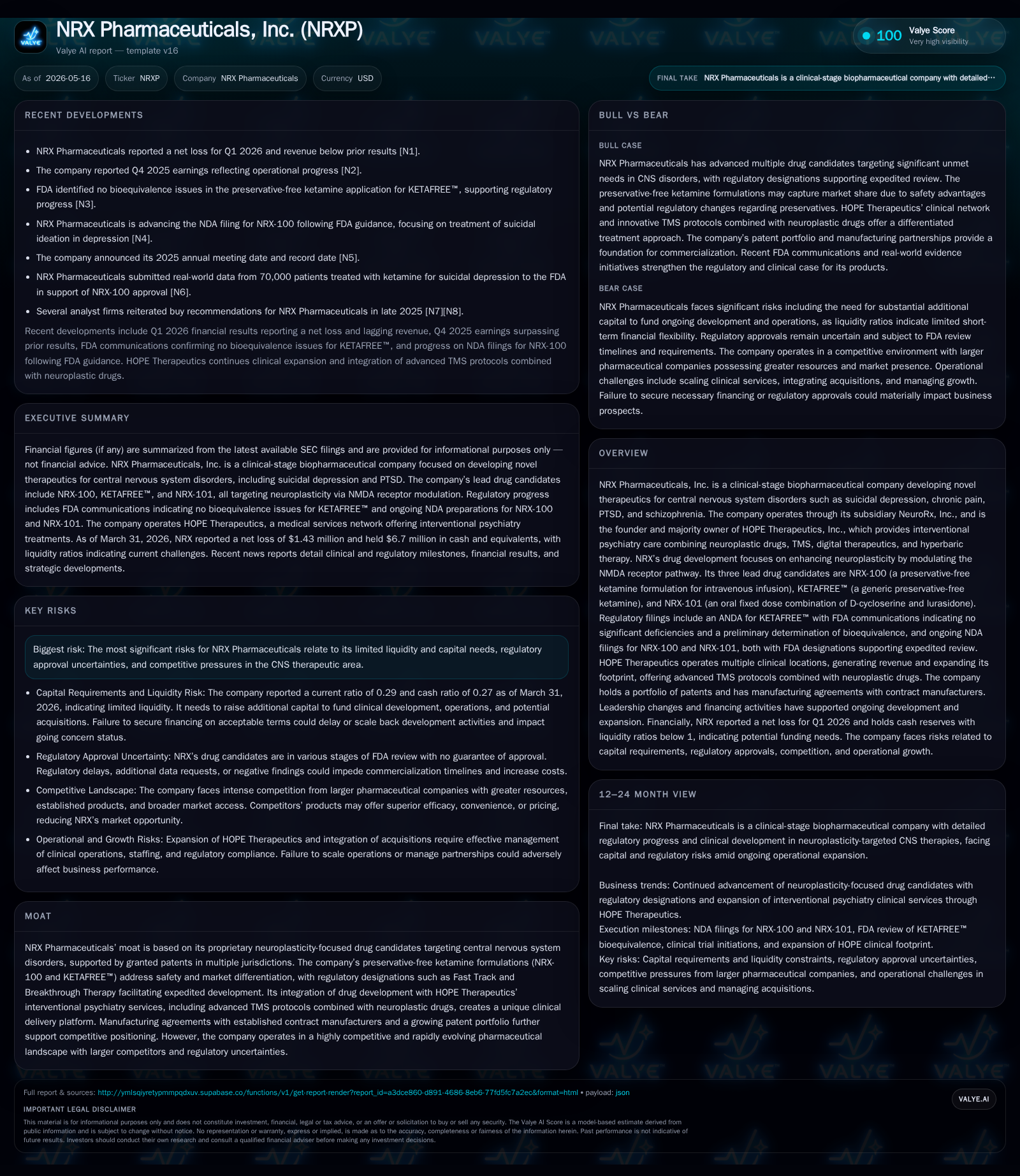
NRX Pharmaceuticals reported continued operating losses in Q1 2026 driven by clinical development and commercialization ramp-up within its CNS-focused portfolio. The company is advancing three main drug candidates—NRX-100, KETAFREE™, and NRX-101—targeting depression, bipolar disorder, and related neurological conditions through NMDA receptor modulation. Clinical milestones, including FDA communications on bioequivalence and Fast Track designations, underpin near-term growth expectations. Simultaneously, the firm is expanding its HOPE Therapeutics interventional psychiatry network integrating pharmacologic and device-based therapies, enhancing its differentiated care model. Funding constraints and regulatory uncertainties remain material risks to watch.
Recent Operating Update
NRX Pharmaceuticals' latest Form 10-Q filing dated May 15, 2026 ([S2]) reconfirms ongoing investment in clinical development activities for its portfolio of neuroplasticity-based CNS drug candidates without material changes to previously disclosed risk factors from the March 23 annual report ([S1], [S15]). Operating losses persist as expected in this clinical-stage phase of the company. According to Nasdaq reporting on May 15 ([N1]), Q1 results missed revenue estimates, reflecting the pre-commercial stage of lead products.
A crucial near-term milestone is the pending FDA approval of KETAFREE™, a generic preservative-free ketamine intravenous formulation. The company received favorable communications from the FDA in late 2025 and early 2026 confirming bioequivalence to the reference product KETALAR® without significant deficiencies identified ([S10], [S11]). This positions NRX for a commercial launch targeted in Q3 2026, capitalizing on an existing generic ketamine market exceeding $750 million annually.
Simultaneously, NRX anticipates filing the NDA for NRX-100 in Q2 2026—an intravenous preservative-free ketamine variant granted Fast Track designation based on unmet medical need across depressive disorders ([S12], [S23]). The expanded Fast Track status potentially increases patient addressable markets to about 13 million Americans. Meanwhile, NRX-101, an oral fixed-dose combination designed for severe bipolar depression patients with suicidal ideation who are unstable on current medications, is progressing through Phase 2/3 clinical trials and benefits from Breakthrough Therapy designation allowing rolling NDA submission. This underscores NRX's strategy to focus on neuroplasticity modulation via N-methyl-D-aspartate (NMDA) receptor pathways as its core scientific approach ([S10], [S23]).
Business Model and Strategic Position
NRX operates primarily as a biopharmaceutical innovator developing pharmacologic agents that enhance neural plasticity in central nervous system disorders including depression, PTSD, chronic pain, bipolar disorder, and schizophrenia ([S10]). Revenue generation depends on eventual FDA approvals followed by commercialization of proprietary formulations addressing safety (preservative-free ketamine), efficacy (oral fixed-dose combos), and ease of delivery (injectables). The company’s competitive edge lies in its proprietary compositions with granted patents validated across multiple jurisdictions ([S24]) and regulatory designations facilitating accelerated pathways.
Parallelly, through majority ownership of HOPE Therapeutics—a healthcare services platform—NRX integrates drug development objectives with actual patient care delivery. HOPE provides interventional psychiatry combining pharmacological treatment with noninvasive neuromodulation technologies such as transcranial magnetic stimulation (TMS), hyperbaric oxygen therapy, digital therapeutics, and psychotherapy ([S10], [S16]). The multi-modal approach attempts to augment therapeutic outcomes while potentially increasing patient retention and payer acceptance.
HOPE has rapidly scaled operations since late 2024 with five clinical sites in Florida fully operational by early 2026 alongside ongoing expansions into Massachusetts and Colorado ([S24]). Additionally, HOPE has established partnerships with device manufacturers like neurocare AG and Ampa Health to deploy cutting-edge TMS devices applying protocols such as ONE-D—a one-day treatment leveraging low-dose D-cycloserine (key component of NRX-101) that reportedly enhances antidepressant response rates dramatically ([S23], [S26]). These integrated technology-drug combinations signify a distinctive market positioning that differentiates NRX from traditional pharmaceutical-only developers.
Contract manufacturing partnerships have been secured for producing registration batches of KETAFREE™ and NRX-100 under cGMP conditions with demonstrated room temperature shelf stability suitable for commercial distribution ([S12]). However, large-scale manufacturing to meet sustained commercial demand remains unproven and will be critical post-approval.
Industry Structure and Competitive Position
The neuropsychiatric therapeutics sector is highly competitive featuring established pharmaceutical giants like Johnson & Johnson, Pfizer, Eli Lilly alongside emerging biotech firms focused on next-generation psychiatric treatments ([S20]). Competitors also include manufacturers marketing Spravato® (intranasal esketamine), which commands approximately $2 billion annually but differs mechanistically from NRX’s formulations.
Market dynamics emphasize rapid innovation cycles combined with stringent regulatory oversight. Approval timelines can be uncertain given the complex nature of CNS disorders and evolving guidance on trial endpoints. Access depends heavily on gaining support from key prescribers, payors’ reimbursement policies influenced by cost considerations, and navigating potential off-label use regulations.
NRX’s focus on patent-protected preservative-free ketamine formulations addresses safety concerns tied to benzethonium chloride preservatives common in existing products. Its regulatory Fast Track and Breakthrough Therapy recognitions substantiate unmet medical needs validation by FDA regulators—important moats against competing generics.
HOPE’s integrated clinical network aims to capitalize on rising demand for interventional psychiatry especially for treatment-resistant depressive disorders by combining pharmacotherapy with neuromodulatory devices—a niche differentiator that could foster stronger provider-payer relationships.
Growth Drivers
Key drivers include successful regulatory approvals leading to product launches: expected KETAFREE™ commercialization by Q3 2026 opens access to an established generics market segment. NDA filings for NRX-100 shortly thereafter expand inpatient intravenous application opportunities particularly targeting acute suicidal ideation indications benefiting from expanded Fast Track labels ([S11], [S12]).
Further upside stems from NRX-101’s differentiation as an oral combination therapy addressing bipolar depression characterized by suicidality who do not respond adequately to existing treatments. Its Breakthrough Therapy Designation supports expedited review potentially accelerating U.S. approval timelines ([S10], [S23]).
HOPE Therapeutics clinic rollout generates fee-for-service revenues beginning late 2025 with momentum through H1 2026 across multiple states leveraging innovative TMS protocols including ONE-D augmented by D-cycloserine—real-world evidence suggests significant clinical efficacy which could drive adoption beyond Florida clinics ([S16], [S24], [N1]).
Collaborations with governmental agencies including DARPA-backed initiatives target military applications of TMS combined with NRX-101 to improve force readiness—this could unlock non-traditional funding sources supporting R&D costs while diversifying future revenue streams ([S26]).
Strategic acquisitions within HOPE’s network expand geographic footprint rapidly creating a scalable MSO infrastructure that could bridge pharmacologic innovation directly into value-based psychiatric care models—a significant differentiation from typical pharma commercialization.
Risks and Constraints
Capital constraints pose the foremost threat: cash reserves stood at $6.7 million versus current liabilities over $25 million at quarter-end March 31, indicating a liquidity shortfall without additional financing or revenue ramps ([F1]). Absence of recent debt refinancing or new capital raises amplifies funding risk amidst ongoing operational losses.
Regulatory uncertainty persists; pivotal Phase 2/3 trials like those supporting NRX-101 remain underway or pending initiation ([S22]), while full-scale manufacturing capacity has not yet been realized limiting readiness for rapid commercialization upon approval.
Competitive pressures from larger pharma firms with broader resources present challenges both in R&D acceleration and market penetration; additionally intellectual property infringements or failure to maintain exclusivity may erode franchise value over time ([S20], [S25]).
Operational execution risks include scaling clinic operations effectively without overextending management resources amid ongoing acquisitions within HOPE network impacting integration capabilities ([S25], [N1]).
Potential legal exposures from past arbitration settlements create additional contingent liabilities though none judged materially adverse as per disclosures ([S5]). Compliance burdens related to healthcare fraud/abuse statutes may introduce administrative complexities affecting growth velocity ([S15]).
What To Watch Next
- FDA approval status updates on KETAFREE™ ahead of planned Q3 2026 launch.
- NDA submission timing confirmation for NRX-100 anticipated imminently (Q2 2026).
- Progression readouts or enrollment announcements regarding Phase 2/3 trial of NRX-101 targeting bipolar depression patients experiencing acute suicidality.
- Expansion pace of HOPE Therapeutics clinics beyond Florida including Boston and Denver openings expected mid-2026.
- Further real-world evidence publications validating ONE-D TMS plus NRX-101 synergy potentially broadening indication labeling.
- Additional financing rounds or equity/debt issuance disclosures which are critical given current liquidity metrics.
- Regulatory feedback or finalization of manufacturing inspections critical for commercial supply chain readiness.
Financial Profile Snapshot (as of Q1 2026)
Latest financial snapshot
| Metric | Value | Period |
|---|---|---|
| Cash & equivalents | $7mm | |
| 2026-03-31 | ||
| Current assets | $7mm | |
| 2026-03-31 | ||
| Current liabilities | $25mm | |
| 2026-03-31 | ||
| Current ratio | 0.29x | |
| 2026-03-31 |
Source: SEC companyfacts cache [F1].
- Net Debt approximated from total debt minus cash as no newer debt figures disclosed.[F1]
The substantial imbalance between current assets and liabilities along with continuing R&D expenses highlights ongoing cash burn typical for clinical-stage drug developers without approved marketed products yet generating meaningful revenue streams.
Disclaimer: This analysis is intended solely for informational purposes reflecting data available as of May-June 2026. It does not constitute investment advice or recommendations. Please conduct further due diligence before making any financial decisions involving this company.
Disclaimer: This is research-only, informational analysis and not investment advice. It may include AI-generated interpretation and general industry context. Always verify important details using primary sources.

Comments