
Nextpower Accelerates Solar Tech Leadership with Q4 Momentum
Nextpower's latest quarterly filing underscores operational strength and innovation leadership driving its expanding global solar tracking platform.
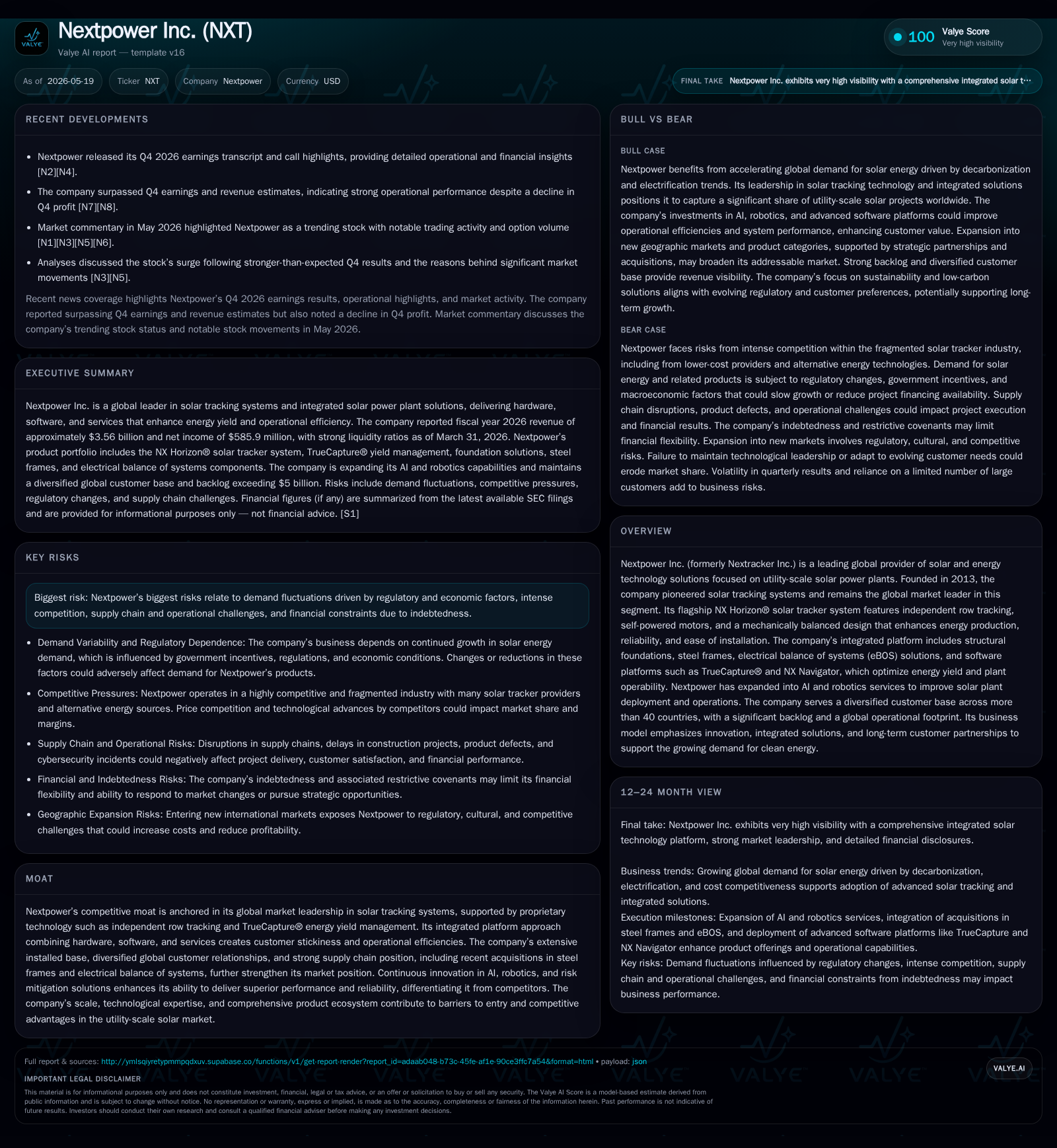
Nextpower Inc.’s Q4 results demonstrate robust execution of its integrated solar solutions platform, highlighted by sustained demand growth and technological advancement. The company leverages its proprietary NX Horizon® trackers alongside AI-driven software, reinforcing its competitive moat in utility-scale solar markets globally. While the business benefits from secular solar adoption trends and product differentiation, it faces risks from regulatory shifts, supply chain complexities, and indebtedness. Liquidity and capital structure remain solid to fund expansion as Nextpower scales into emerging markets with renewables demand accelerating.
Recent Operating Results: Q4 Highlights and Implications
Nextpower’s Q4 filing for the period ended March 31, 2026 ([S2]) reveals continued sales acceleration reflecting strong demand for its solar tracking systems across global markets. The subsequent May 8 event filing ([S3]) corroborates that the company surpassed revenue and earnings estimates, driven by favorable project execution trends and expanding service offerings. Operational commentary from the quarterly earnings call ([N1], [N3], [N4]) highlights healthy order backlog conversion rates despite some supply chain challenges typical of large-scale utility projects.
Revenue grew meaningfully in Q4, benefiting from both volume expansion and increased adoption of Nextpower’s integrated platform solutions. While installation cycles can fluctuate due to permitting or logistic frictions, management emphasized efficiency gains in deployment workflows through robotics integration. This Q4 performance reaffirms operational resilience as demand persists in core regions like the U.S., India, Latin America, and emerging Middle East and Africa markets.
Business Model and Product Excellence: Integrated Solar Solutions
Nextpower generates revenue predominantly by selling NX Horizon® independent row solar trackers designed to maximize photovoltaic energy harvest on utility-scale plants. These trackers feature self-powered motors that independently adjust each row’s tilt angle optimizing sun exposure — a technological edge over fixed-tilt or linked-row trackers ([S1]).
Beyond hardware, Nextpower offers comprehensive electrical balance-of-systems (eBOS) components such as steel mounting systems and power conversion equipment, allowing it to bundle hardware with critical infrastructure elements. Complementing physical products is a suite of proprietary software including TrueCapture®, which employs AI analytics to mitigate real-world factors like shading or soiling that degrade output.
This value-added stack caters primarily to engineering procurement construction (EPC) firms, project developers, and owners seeking improved ROI through higher system reliability, ease of installation, faster commissioning timelines, and enhanced energy yield. The deep ecosystem reinforces switching costs as customers integrate disparate but interdependent technologies under one platform.
Competitive Landscape and Industry Dynamics
Nextpower retains global leadership in solar tracking systems with shipments exceeding 160 GW deployed worldwide ([S1]). Its presence spans diverse regions characterized by varying regulatory regimes — mature markets where penetration rates are high versus developing areas where solar adoption is nascent but fast-growing.
The industry is fragmented with competitors offering either standalone hardware or partial solutions lacking robust software integration. Nextpower’s multi-product platform strategy coupled with scale advantages creates barriers to entry rooted in patented technology and extensive installed base size.
Demand dynamics continue to be shaped by rising electricity demand outpacing transmission capabilities ([S1]). This structural constraint drives utilities and developers towards scalable PV assets facilitated by advanced trackers that lower levelized cost of energy (LCOE). However, pricing power is moderated by competitive intensity from low-cost providers especially in price-sensitive emerging markets.
Platform Expansion and Technological Moats
A cornerstone of Nextpower’s moat is its next-generation NX Horizon® system featuring independent row motion for optimal tracking accuracy. Unlike linked-row designs that adjust panels uniformly, this innovation adapts dynamically to terrain variability bringing incremental energy gains.
Its TrueCapture® software platform deploys AI algorithms for real-time performance monitoring and proactive loss mitigation addressing environmental variables affecting output reliability. Integration across hardware-electrication-software layers creates a defensible technology ecosystem difficult for rivals to replicate.
Recent acquisitions expanding electrical balance-of-system capabilities further enhance end-to-end solution delivery reducing third-party dependencies. Robotics services introduced for installation automation underline potential cost savings enhancing project economics while shortening construction cycles.
Together these innovations translate into sustainable competitive advantages sustaining higher margins relative to commodity tracker manufacturers.
Growth Catalysts: Market Adoption and Innovation Levers
Growth drivers stem primarily from structural shifts favoring renewable generation amid escalating electrification trends globally ([S1]). Expanding data center deployments fueled by AI boom exert pressure on grids necessitating more clean capacity rapidly deployable through utility-scale solar projects adopting tracker tech.
Regulatory incentives persist in key jurisdictions; however, borderless global demand signals durable volume growth beyond policy-driven spikes. Nextpower’s geographic diversification across established US/India/Americas clusters alongside fast-growing Middle East/Africa deployments positions it well to capture broader market expansion.
On innovation fronts, advances in AI-powered operations analytics via TrueCapture® promise margin improvements through optimized yield management. Robotics installation services reduce labor intensity enhancing scalability under tight project schedules.
Scaling manufacturing footprint aligned with localized sourcing strategies addresses supply bottlenecks lowering lead times while maintaining quality control necessary for reliable plant operation critical to client retention.
Risks and Operational Challenges to Monitor
Key risks revolve around regulatory uncertainty impacting subsidies or trade policies potentially curtailing near-term demand outcomes ([S2], [S5], [S11]). Supply chain complexities—especially raw material constraints or logistics disruptions—pose execution challenges potentially delaying project fulfillment or inflating costs.
Competitive pressure from lower-cost regional players may erode pricing power requiring continual investment in product differentiation. Financial leverage introduces vulnerability requiring prudent cash management despite strong liquidity buffers.
Cybersecurity remains an active oversight area given increasing digital integration — Nextpower maintains layered defenses monitored by experienced executives but evolving threat landscapes could impact operations if breached ([S9], [S12]).
Intellectual property litigation risks exist but do not presently threaten core technologies materially ([S8], [S11]). Quality control during new product development phases demands attention as failures could harm customer trust or increase warranty reserves negatively affecting margins ([S14], [S19]).
Upcoming Milestones and What to Watch Next
Market participants should monitor next reporting periods for backlog conversion rates indicating sustained order flow health ([N1], [N3], [S3]). Management commentary around geographic expansion pace particularly into Africa/Middle East markets will signal international scaling success.
Advances in AI/robotics deployment timing within field operations may unlock incremental efficiency gains noted as ongoing investments. Changes in subsidy frameworks or tariffs remain potential short-term catalysts altering sales visibility.
Watch for quarterly margin progression reflecting operational leverage amidst cost inflation pressures alongside updates on supplier diversification reducing concentration risks.
Summary Financial Snapshot and Capital Position
As of quarter-end March 31, 2026, Nextpower reported cash and equivalents totaling approximately $1.09 billion against total debt near $150 million as last indicated in early 2024 filings—implying a net cash position supportive of strategic investment needs ([F1], [S3]). Current assets standing around $2.85 billion versus liabilities just over $1.16 billion yield a healthy current ratio of approximately 2.45 reflecting ample short-term liquidity.[F1]
Operating income reached $697 million on revenues approximating $3.56 billion during this period while net income was reported at nearly $586 million underscoring profitable scale benefits ([F1]).
Debt-related covenants impose operating flexibility restrictions but remain manageable within existing capital structures permitting further acquisitions or organic expansion.[S15], [S16]
This resilient financial foundation anchors Nextpower’s ability to absorb operational risk while funding continued innovation endeavors vital for maintaining leadership amidst intensifying competition.[F1]
This analysis is grounded exclusively on Nextpower’s latest SEC filings supplemented by recent verified news transcripts without speculative assertions or forward-looking investment guidance.
Disclaimer: This is research-only, informational analysis and not investment advice. It may include AI-generated interpretation and general industry context. Always verify important details using primary sources.

Comments