
Norfolk Southern's Strategic Eastern Rail Network and Merger Ambitions Amid 2026 Operational and Cybersecurity Challenges
Norfolk Southern leverages its extensive eastern U.S. franchise while navigating merger setbacks, operational pressures, and heightened cybersecurity risks.
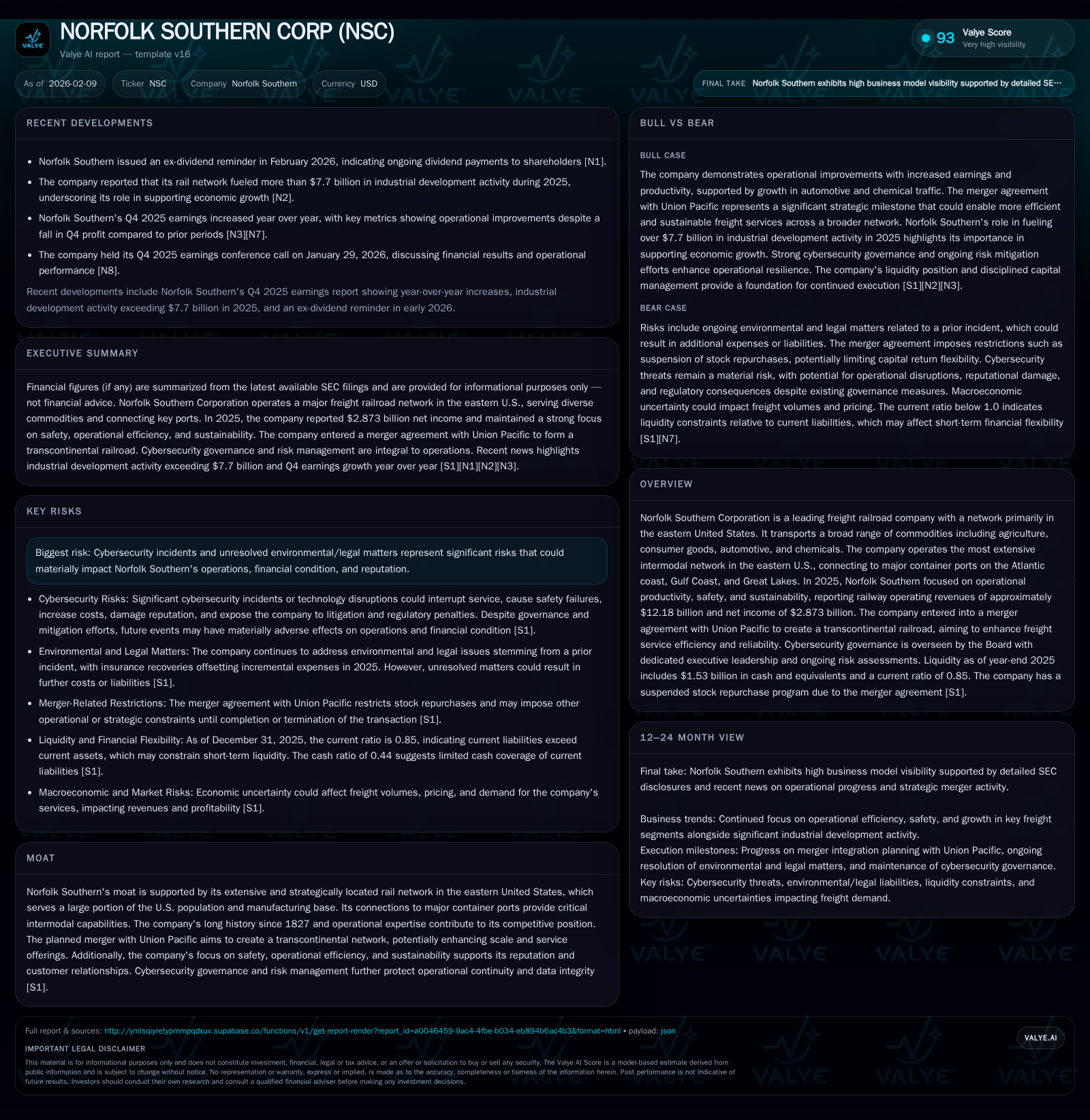
Norfolk Southern Corporation stands as a cornerstone of freight rail in the eastern United States, uniquely positioned through its extensive network and intermodal connections to key ports. In 2025, it reported solid revenues and net income that exceeded some expectations despite mounting cost pressures. The company’s ambitious merger attempt with Union Pacific, aimed at constructing a transcontinental rail system, faced regulatory roadblocks that cloud near-term growth prospects. Operational excellence grounded in safety, sustainability, and efficiency underpins Norfolk Southern’s moat, though significant risks persist around cybersecurity threats and environmental liabilities. This analysis underscores Norfolk Southern’s critical role in freight transportation and regional economic development amid a complex industry landscape in early 2026.
Norfolk Southern’s Rail Empire: Strategic Footprint and Franchise Strength
Established in 1827 and operating primarily across the eastern United States, Norfolk Southern commands one of the most comprehensive freight rail networks focused on an area that contains a large portion of the country’s population and manufacturing base [S1]. This geographical expanse is not merely extensive but finely interwoven into the fabric of critical industrial corridors stretching from the Midwest to the Atlantic coast.
Its network's breadth enables access to major container ports on the Atlantic Coast, Gulf Coast, and Great Lakes – crucial gateways for importing and exporting goods. This intermodal connectivity enhances its value proposition by integrating rail services seamlessly with maritime logistics chains after decades of infrastructural investment [S1]. The breadth and depth of this system serve as a formidable barrier to new entrants attempting to replicate such scale or geographic reach.
Beyond physical infrastructure, Norfolk Southern has built long-standing customer relationships rooted in reliable service offerings across broad commodity classes: agriculture, consumer goods, automotive components, chemicals, among others. These diversified revenue streams are anchored by its franchise rights within dense economic regions that rely heavily on efficient freight transportation.
This strategic positioning imbues Norfolk Southern with a defensible moat fostered by high switching costs for shippers dependent on its network’s coverage combined with economies of scale that competitors find challenging to match.
2025 Performance Snapshot: Earnings Surprises Amid Growing Pressures
The financial performance in 2025 highlights a nuanced narrative. Despite some outlets reporting a decline in Q4 profits or caution over cost headwinds [N13], Norfolk Southern beat earnings estimates for the quarter according to multiple reports [N1][N4]. The company delivered around $12.18 billion in railway operating revenues for the year with a net income tallying $2.873 billion — reflecting resilience amid intensifying operational pressures [F1].
Revenue strength was supported by sustained demand across key commodity sectors and improved pricing strategies. Nevertheless, rising input costs—fuel expenses, maintenance outlays—and wage inflation pressured margin sustainability. The precise mix of these elements was addressed during earnings calls where management acknowledged cost challenges but emphasized ongoing productivity efforts aimed at mitigating their impact without compromising service quality [N3][N5].
Importantly, such results underscore Norfolk Southern's capability to adapt flexibly amid inflationary environments while balancing capital allocation toward growth-supportive projects.
Merging Roads Ahead: The High-Stakes Union Pacific Deal and Regulatory Roadblocks
A pivotal strategic initiative for Norfolk Southern has been its announced merger agreement with Union Pacific Corporation intending to forge a transcontinental railroad network spanning coast-to-coast traffic flows [S1]. This combination promised synergies from scale economies, broader service portfolios for customers requiring seamless long-haul solutions between the eastern seaboard and western markets.
However, the transaction encountered vigorous opposition from regulatory bodies culminating in the Surface Transportation Board rejecting the merger application citing anti-competitive concerns that could jeopardize market balance [N10]. The ruling underscored apprehensions about reduced competition leading to potential service degradation or pricing power abuses.
Industry rivals such as Canadian National welcomed this decision given their own competitive postures along certain corridors contested by NSC-UNP aims [N10]. This regulatory setback necessitates reassessment within Norfolk Southern regarding organic growth avenues versus pursuing other forms of alliances or incremental route partnerships.
While not derailing ambitions entirely, this outcome reveals the complexity shale within U.S. antitrust frameworks affecting major transportation infrastructure deals – an ever-present signal that scaling entrenched networks is often met with stringent scrutiny.
Safety, Sustainability, and Operational Efficiency: Cornerstones of Competitive Moat
Norfolk Southern views safety not just as compliance but foundational asset protection essential to sustaining operational continuity. Their safety records incorporate rigorous protocols designed to minimize accidents or derailments thus safeguarding employee welfare alongside ecosystem integrity [S1].
Concurrently sustainable practices have gained emphasis aligned with broader societal shifts toward decarbonization within transportation sectors. Initiatives encompass fuel efficiency enhancements through locomotive upgrades alongside investments targeting emissions reduction.
Efficiency improvements focus squarely on optimizing crew utilization patterns, yard operations automation, and precision scheduling technologies meant to enhance throughput while controlling costs – all contributing tangibly toward maintaining customer satisfaction levels even under incremental volume pressures or supply chain disruptions.
These pillars intertwine with corporate reputation formation further strengthening stakeholder confidence rendering it more challenging for competitors lacking similar rigor to penetrate NSC’s client base effectively.
Navigating the Cyber Frontier: Board-Driven Governance Against Escalating Threats
Cybersecurity emerges explicitly as an acute vulnerability with realistic consequences extending beyond digital realms into physical operations disruption – an area where rogue actors potentially induce safety incidents or result in severe service interruptions [S1].
The governance framework at Norfolk Southern places cybersecurity risk oversight directly within Board jurisdiction receiving regular reports from seasoned Chief Information Defense Officer (CIDO) and Chief Information Security Officer (CISO). These professionals carry backgrounds interfacing with federal agencies formulating critical infrastructure protections ensuring alignment with best practice standards.
Embedded within organizational routines is continuous auditing combined with tabletop exercises simulating breach scenarios empowering rapid incident response readiness.
Regular employee training campaigns educate personnel across phishing prevention techniques through data handling protocols complementing technology defenses thereby constructing layered safeguards across vectors of attack typical within transportation sectors today.
Such multifaceted structures reflect growing awareness that cyber resilience forms an indispensable dimension towards sustaining railroad reliability critical to interstate commerce flows.
Financial Health at a Glance: Liquidity Constraints and Balance Sheet Dynamics
On paper corporate liquidity presents headwinds; end-of-2025 disclosures cite current assets approximating $3.2 billion offset by current liabilities around $3.8 billion translating into a current ratio close to 0.85 – indicative of short-term funding tightness requiring vigilant working capital management [F1].
Cash reserves near $1.53 billion provide partial buffer but operational cash flow generation remains essential alongside disciplined capital expenditure prioritization particularly when facing emerging needs for technology upgrades or infrastructure refreshment commitments within an aging rail system framework.
Leverage levels though stable demand attention as debt maturities approach in coming years especially if external financing conditions become less favorable amid macroeconomic volatility or possible disruptions tied to legal/environmental contingencies mentioned below.
Capital deployment strategies need balance between supporting maintenance capex ensuring track availability versus pursuing growth initiatives if merger pathways remain closed due to regulator constraints.
Risk Landscape: Environmental Liabilities, Cybersecurity, and Legal Headwinds
Material risks layer onto core operations from unresolved environmental remediation obligations stemming from legacy contamination coupled with emerging stricter regulatory enforcement trajectories [S1]. Such liabilities carry potential for unexpected cost surges or reputational damage particularly when litigations arise invoking punitive damages or increased monitoring requirements.
Cyber incidents underline non-trivial exposure levels; prior outages already evidenced impacts on service delivery underscoring importance of rapid root cause analyses combined with preventive investments necessary going forward [S1].
Legal headwinds also reside within labor relations domains or contractual disputes which if escalated might deter workforce stability or customer confidence undermining operational steadiness vital for retention in competitive markets.
Management transparency about these vulnerabilities signals prudent governance yet demonstrates embedded uncertainties shaping near-term risk profiles requiring consistent mitigation focus.
Industrial Development Catalyst: Norfolk Southern’s Influence on Regional Growth
Beyond freight hauling specifics lies Norfolk Southern’s growing footprint as an enabler of substantial industrial expansion across served regions. In 2025 alone rail-served property developments fueled activity valued above $7.7 billion attributable partially to site designations such as Alabama Platinum REDI certification highlighting quality infrastructure conducive for business attraction efforts [N12][N14].
These strategic partnerships between public economic entities leveraging NSC access translate into job creation multipliers reinforcing regional ecosystems bolstering demand elasticity for rail-based transport over time.
This broader economic role underscores how Norfolk Southern transcends pure logistics functions embedding itself deeply within community growth narratives – amplifying its mandate beyond shareholder returns alone towards inclusive infrastructural stewardship responsibilities.
Looking Forward: Strategic Imperatives in a Shifting Railroad Landscape
Faced with regulatory setbacks curtailing merger ambitions, Norfolk Southern must recalibrate focusing on organic growth drivers manifested through incremental service innovations combining digital tools optimizing shipment tracking alongside customer engagement platforms enhancing supply chain visibility [valye_report_excerpt][N7].
Operational resiliency gains prominence sensitive not only to physical asset robustness but also intangible cyber defense mechanisms continually tested against increasingly sophisticated adversaries threatening core business continuity.[S1] Capital investment cadence will require both prudence amid liquidity constraints yet decisiveness ensuring network modernization sustaining competitive relevancy amidst evolving modal choices including trucking advancements challenging rail freight share.[F1]
Competitive dynamics dictated by peer carriers pursuing alternative alliances meanwhile place premium on NSC differentiating through customer intimacy combined with efficiency gains potentially reclaiming lost ground over longer haul corridors missed due to merger denial.[N10]
Ultimately perseverance balanced by innovation anchored on core competencies—safety excellence, sustainability fidelity—and meticulous risk stewardship positions Norfolk Southern uniquely poised albeit cautiously navigating junctions ahead within U.S. freight railroad territory converging legacy strengths with future imperatives.
This analysis synthesizes publicly available company data alongside recognized industry context valid as of early 2026 without forecasting nor providing specific investment opinions. Readers should interpret findings mindful of evolving market conditions possibly influencing future developments materially.
Disclaimer: This is research-only, informational analysis and not investment advice. It may include AI-generated interpretation and general industry context. Always verify important details using primary sources.

Comments