
Nuvera Communications Targets Growth with Accelerated FTTH Expansion and Strategic Subsidy Management
Nuvera's Q1 2026 update highlights ongoing fiber expansion fueled by steady federal subsidies amidst competitive and capital challenges.
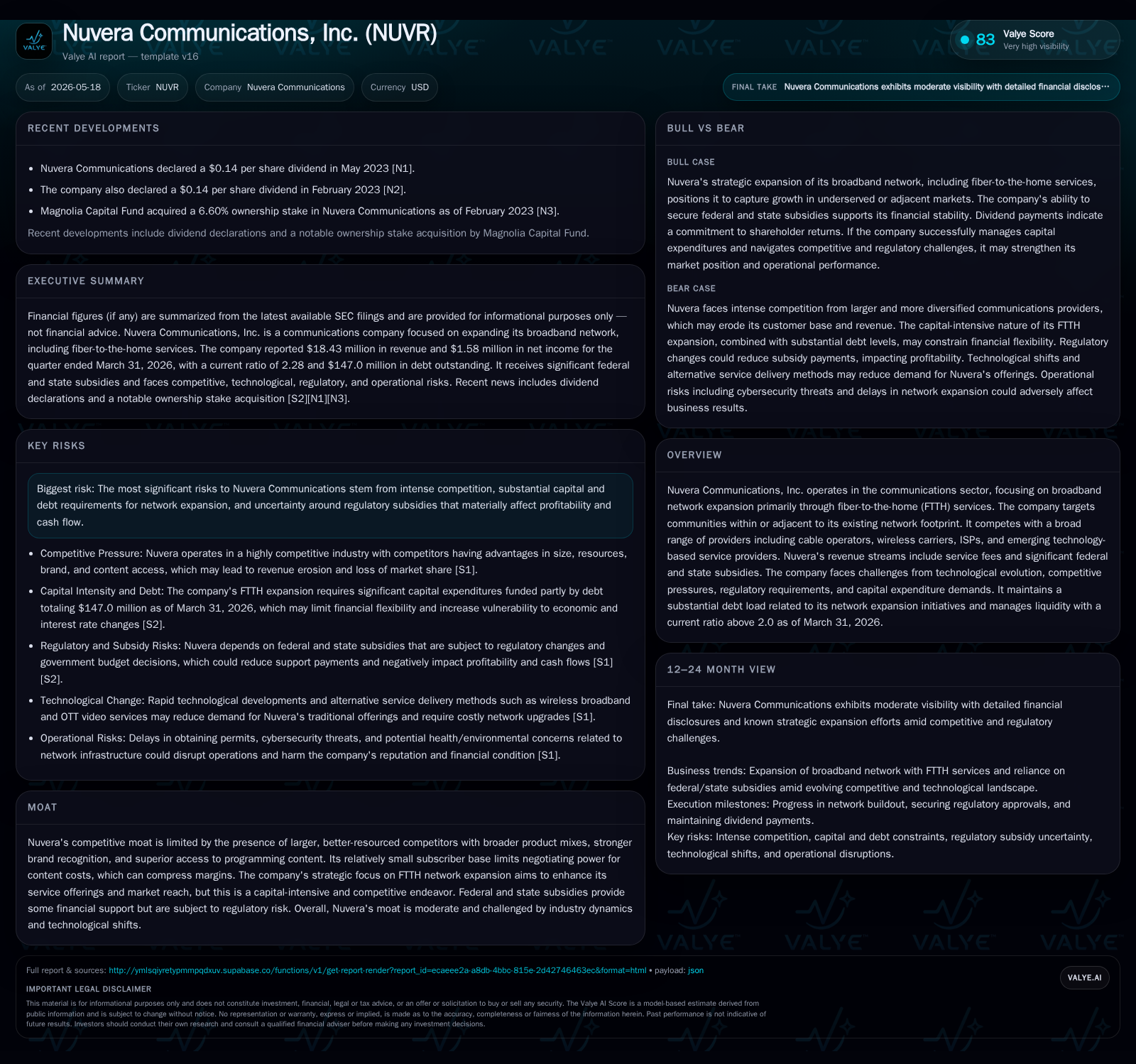
In its latest quarterly filing dated May 15, 2026, Nuvera Communications reaffirmed its strategic commitment to expanding its fiber-to-the-home broadband network in communities within and adjacent to its existing footprint. The company continues to receive significant federal subsidies, crucial to supporting margins, with $4.27 million of A-CAM/FUSF payments in Q1 2026. However, Nuvera faces challenges including capital intensity from network buildouts, substantial debt obligations approximating $147 million, competition from larger incumbents with broader offerings, and regulatory uncertainties impacting subsidy stability. Growth depends heavily on securing construction permits, successful customer acquisition in new markets, and maintaining subsidy flows.
Key Developments in Latest Quarter: FTTH Expansion and Subsidy Flows
Nuvera Communications' most recent quarterly filing (10-Q) dated May 15, 2026, provides a focused update on the company's fiber-to-the-home (FTTH) network rollout [S2]. Management reaffirms firm progress extending broadband service into communities within or adjacent to its existing footprint. Despite the capital-intensive nature of this expansion strategy, Nuvera maintained steady receipt of critical federal subsidies under the A-CAM and FUSF programs totaling approximately $4.27 million for Q1 2026—consistent with prior periods
However, the company notes persistent operational constraints related to securing franchises and construction permits required for network deployment. Delays or challenges in entering these regulatory agreements remain key risks to the timing and cost-effectiveness of the FTTH buildout [S2]. Additionally, supply chain complexities affecting contractors and material availability also influence execution timelines.
These factors collectively shape a near-term operating environment characterized by calibrated growth expectations balanced against notable execution risks.
Nuvera’s Business Model: Service Offerings, Revenue Streams, and Product Quality
Nuvera's revenue largely derives from broadband service fees paid by residential customers subscribing to its FTTH offerings complemented by pronounced support from federal and state universal service funds [S1][S2]. The firm strategically focuses on expanding fiber deployments deepening penetration where legacy infrastructure permits incremental coverage expansion without incurring prohibitive greenfield costs.
The company’s FTTH products deliver high-speed internet access primarily targeting underserved or lightly penetrated semi-rural communities. Pricing mechanisms rely on monthly subscription fees often benchmarked against incumbent cable or DSL-based providers but generally influenced by regulated subsidy inflows that help sustain attractive pricing tiers [F1]
Product quality is positioned around superior bandwidth potential via all-fiber routes relative to legacy copper or hybrid infrastructure operated by competitors. However, Nuvera lacks the broad product bundles (TV content packages plus mobile services) commonly offered by larger cable operators—with less negotiating power over programming costs due to smaller subscriber counts—that compresses potential margin upside [S1]. Thus, the business model is highly dependent on successful customer acquisition within new FTTH footprints aided substantially by ongoing subsidy receipts.
Sector Dynamics and Competitive Positioning Within Broadband Services
Nuvera faces an intensely competitive landscape comprising established cable operators with extensive economies of scale, wireless carriers increasingly substituting traditional wired services, emerging independent ISPs utilizing niche technologies, and over-the-top (OTT) video platforms saturating consumer entertainment options [S1][S2].
Large cable incumbents enjoy distinct advantages including diversified product portfolios that bundle high-speed data with proprietary content—providing both higher average revenue per user (ARPU) potential and robust customer retention levers through exclusive programming access. These providers also have stronger credit profiles enabling lower-cost capital investments for network upgrades.
By contrast, Nuvera operates with a moderate moat constrained by brand recognition limitations outside core geographic zones coupled with smaller scale inhibiting bargaining power to reduce content acquisition expenses or secure more favorable equipment pricing [F1][S1]. Competition further intensifies with growing wireless LTE/5G uptake eroding fixed-line telephony subscribers—a segment where Nuvera historically maintains residual market share—and evolving consumer preference shifts toward flexible OTT streaming services reducing conventional video package traction.
Growth Drivers: Network Footprint Expansion, Customer Acquisition, and Subsidy Stability
The cornerstone of Nuvera’s growth thesis resides in expanding its FTTH network into contiguous or adjacent communities currently underserved or reliant on inferior connectivity alternatives [S2][S1]. This strategy leverages existing operational capabilities while aiming for incremental subscriber additions benefiting from rising broadband demand trends driven by remote work proliferation and increased digital content consumption.
Successful execution hinges on obtaining requisite municipal franchises and construction permits enabling timely deployment schedules. Positive momentum in these administrative processes directly correlates with new service launches and subsequent customer acquisition velocity.
Critically underpinning margins in these initiatives are continued federal subsidy inflows from programs such as A-CAM (Alternative Connect America Model) and the Federal Universal Service Fund (FUSF), which provide compensation for high-cost rural deployments that would otherwise lack commercial viability [S2]. The reported steady subsidy payments of $4.27 million in Q1 2026 reflect program stability that supports pricing strategy elasticity.
Nonetheless, given the historical FCC reforms beginning with the 2011 Order that redirected universal funding emphasis toward broadband rather than legacy voice services, future subsidy availability remains contingent upon political and regulatory dynamics—a source of inherent uncertainty detailed in risk disclosures [S11]
Risks and Constraints: Capital Intensity, Competitive Pressures, and Regulatory Uncertainties
A paramount constraint confronting Nuvera is the substantial capital outlay associated with aggressive FTTH rollouts designed to capture new subscriber bases.
Regulatory risks center on the durability of federal subsidy programs underpinning the economics of rural broadband buildouts. Any reduction or reallocation of Universal Service Fund budgets would materially impair profitability forecasts given the thin margin profile absent these payments [S11][S2]
Forward-Looking Indicators: Construction Permits, Customer Penetration, and Subsidy Policy Updates
Stakeholders should closely track several measurable leading indicators that signal execution progress at Nuvera:
- The pace at which new franchises and construction permits are secured governs rollout cadence directly impacting subscriber onboarding timing,
- Quarterly net customer additions reflecting market acceptance and marketing effectiveness within recently served regions,
- Any formal regulatory updates regarding the scope or funding levels of universal service programs including A-CAM reforms signaling underlying subsidy stability or contraction risk,
- Refinancing activities or amendments related to credit facilities that might affect liquidity buffers amid capital expenditure cycles.
Observation of these metrics will clarify the viability of Nuvera’s growth pathway amidst evolving external influences [S2][S11].
Financial Position Overview: Liquidity, Debt Profile, and Cash Flow Implications
While detailed financial statements remain proprietary beyond SEC filings reviewed here, publicly available balance sheet snapshots as of March 31, 2026 suggest a reasonably healthy liquidity cushion evidenced by a current ratio approximating 2.28—calculated using current assets near $24.13 million against liabilities around $10.6 million—providing working capital adequacy for near-term obligations [F1]
Operating cash flows must therefore balance sustaining ongoing network capex demands while meeting obligatory debt principal and interest payments constraining discretionary investment capacity necessary for faster market expansion [F1]
This financial profile underscores management’s dual imperative: prudently align capital allocation strategies while aggressively pursuing incremental subscriber growth supported by stable government grants to optimize long-term value creation.
This analysis synthesizes information drawn exclusively from public filing disclosures provided through SEC references ([S1], [S2], etc.) and companyfacts ([F1]) current as of mid-2026. It aims to offer an informed perspective without prescriptive investment direction consistent with Valye News editorial standards.
Disclaimer: This is research-only, informational analysis and not investment advice. It may include AI-generated interpretation and general industry context. Always verify important details using primary sources.

Comments