
NVE Corporation Advances Spintronics Leadership with Robust Quarterly Results and Strategic Dividend Policy
NVE’s Q4 FY2026 results underscore operational resilience driven by proprietary spintronic technology and controlled wafer fabrication amid sector challenges.
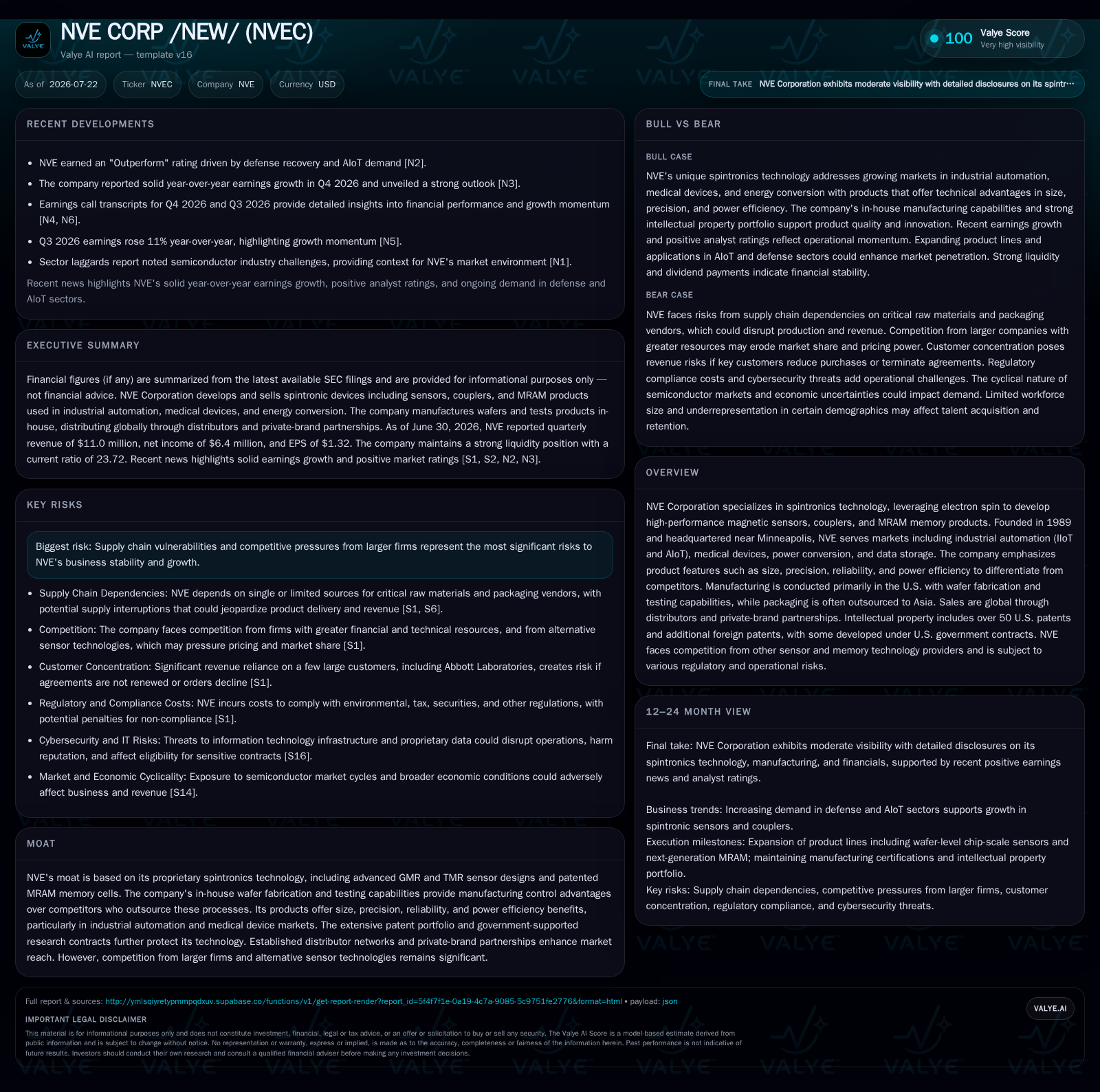
In its latest quarterly report ending June 30, 2026, NVE Corporation demonstrated strong operating income margins and reaffirmed its commitment to shareholder returns through a $1.00 per share quarterly dividend [S2][S3]. The company’s competitive moat rests on its unique spintronics IP portfolio exceeding 50 patents and in-house wafer fabrication capabilities — factors that support product differentiation in industrial automation, medical devices, and data storage markets [S1]. NVE faces significant supply chain risks due to dependence on single-source wafers and critical chemical suppliers, alongside competitive pricing pressures from larger semiconductor firms [S18]. However, growth catalysts remain robust, anchored by expanding demand for IIoT sensors, MRAM applications, and government-supported R&D. Monitoring capacity utilization trends, R&D intensity, and customer adoption rates will be key for assessing near-term execution momentum [S2][S3].
Q4 FY2026 Results Reinforce Operational Resilience and Shareholder Returns
NVE Corporation reported solid financial and operational results for the quarter ended June 30, 2026, demonstrating resilience amid ongoing semiconductor sector volatility. The company sustained robust operating income margins, reflecting disciplined cost management and operational leverage despite broader industry cyclicality [S2]. Concurrently, NVE’s Board of Directors declared a quarterly cash dividend of $1.00 per share payable August 31, 2026, signaling confidence in stable free cash flow generation and reinforcing its shareholder return strategy [S3].
This performance is notable given the capital-intensive nature of spintronic device manufacturing and the competitive pressures from larger semiconductor firms. NVE’s ability to maintain profitability while continuing to invest in research and development underscores its operational discipline and strategic focus.
Proprietary Spintronics Technology and Manufacturing Control as Core Differentiators
NVE’s competitive moat centers on its proprietary spintronics technology portfolio, which exploits giant magnetoresistance (GMR) and tunneling magnetoresistance (TMR) effects to produce high-performance magnetic sensors, couplers, and magnetoresistive random-access memory (MRAM) products [S1]. The company’s magnetic tunnel junctions (MTJs) incorporate ultra-thin conductor layers down to approximately two nanometers, enabling sensors that combine miniaturization with high sensitivity and low power consumption.
These devices serve critical roles in industrial automation, medical instrumentation, and data storage markets, where precision, reliability, and power efficiency are paramount. For example, NVE’s sensors are used in implantable medical devices requiring stringent certification standards and in factory automation robotics demanding high-speed, noise-immune data acquisition [S1].
A key operational advantage is NVE’s in-house wafer fabrication capability at its Minnesota facility, which contrasts with many spintronics peers who outsource wafer production to foundries [S16]. This vertical integration allows tighter control over wafer yield rates, process consistency, and quality metrics such as device failure rates—factors that directly impact product reliability and customer satisfaction in demanding end markets.
Competitive Positioning and Industry Dynamics
Operating primarily at the intersection of design and manufacturing within the semiconductor value chain, NVE differentiates itself from larger diversified semiconductor companies that often outsource fabrication or focus on broader memory or sensor platforms without spintronic specialization [S16].
However, this manufacturing control comes with supply chain concentration risks. NVE depends heavily on single-source suppliers for raw silicon and semiconductor foundry wafers, many of which are foreign-based and subject to geopolitical risks, tariffs, and trade restrictions [S18][S21]. Additionally, critical chemical inputs—such as specialized photoresists, polymers, and metals—are sourced from limited suppliers, and packaging is outsourced primarily to Asian vendors, exposing the company to potential supply interruptions and cost volatility.
Competitive pressures are intensifying as larger semiconductor firms with greater scale and marketing resources enter magnetic sensor and MRAM markets. These competitors can leverage volume-driven pricing advantages, potentially eroding NVE’s average selling prices (ASPs) and market share if NVE’s performance differentials narrow. Maintaining technological leadership through continuous innovation and patent protection is therefore critical to sustaining pricing power and customer loyalty.
Growth Drivers: Industrial Automation, AIoT Sensor Demand, and MRAM Applications
NVE’s growth prospects are anchored in secular trends driving demand for advanced spintronic devices. The expansion of industrial automation and smart manufacturing fuels the need for precise, low-power magnetic sensors embedded in Industrial Internet of Things (IIoT) and Artificial Intelligence of Things (AIoT) applications [N2][S1].
Medical device miniaturization trends increase demand for high-sensitivity magnetic switch points, achievable through advanced MTJ sensor designs developed in NVE’s long-term R&D programs initiated in fiscal 2026. These include ultrahigh-low power TMR variants targeting implantable devices such as hearing aids, where power efficiency and reliability are critical.
On the memory front, while MRAM remains a nascent commodity market compared to DRAM and flash, niche applications such as military-grade antitampering and industrial secure storage offer early-stage revenue opportunities [S1]. These segments benefit from NVE’s government-supported R&D contracts exceeding $50 million, which have helped build an extensive intellectual property portfolio of over 50 U.S. patents
Continuous patent filings and accelerated product development cycles reflect NVE’s focus on reducing time-to-market for next-generation ultrahigh-sensitivity TMR sensors and advanced MRAM cells tailored for security applications.
Risk Factors: Supply Chain Dependencies and Competitive Pressures
NVE’s operational risks are primarily linked to its supply chain dependencies. The company’s reliance on single-source wafer suppliers without qualified alternates poses a significant risk of production disruption if supply is interrupted, despite some inventory buffers [S18]. Similarly, shortages or discontinuations of critical chemicals and materials could delay manufacturing and increase costs.
Packaging vendor dependence, while mitigated by multiple potential suppliers, remains a vulnerability given the complexity of NVE’s products and stringent magnetic and electrical isolation requirements [S18]. Geopolitical tensions, trade tariffs, and natural disasters further exacerbate these supply chain risks.
Pricing pressures from larger semiconductor competitors with economies of scale threaten to compress gross margins if NVE cannot maintain its technological advantages. Additionally, patent infringement litigation risks could impose legal costs or licensing obligations, impacting profitability.
Customer concentration is notable but partially offset by a diversified global distributor network spanning over 75 countries and private-label partnerships, which provide resilience compared to direct sales models with fewer end customers [S1]
Key Performance Indicators and What to Monitor
Several operational KPIs are critical to assessing NVE’s near-term execution and growth trajectory. Fabrication capacity utilization rates serve as a proxy for demand scaling and operational efficiency, with higher utilization indicating improved absorption of fixed costs and margin expansion [S2]
R&D expenditure as a percentage of sales (R&D intensity) is a vital metric reflecting the company’s commitment to sustaining technological leadership amid rapid innovation cycles [S2]. Elevated R&D spend supports continuous product pipeline renewal, including ultrahigh-sensitivity TMR sensors and next-generation MRAM devices
Product unit shipments and average selling prices provide insight into market acceptance and pricing power, particularly in AIoT sensor categories where adoption rates are key. Monitoring distributor contract renewals and shifts in customer technology preferences will also indicate competitive positioning.
Supply chain lead times and inventory levels should be closely watched for signs of disruption or bottlenecks, especially given the single-source wafer and chemical supplier dependencies. Any material changes in these variables could impact delivery schedules and revenue recognition.
Upcoming product launches, particularly in ultrahigh-sensitivity TMR sensors and secure MRAM applications, represent important catalysts that may drive incremental revenue growth and reinforce NVE’s market differentiation [S3]
Financial Position and Liquidity
As of June 30, 2026, NVE held $2.9 million in cash and equivalents, with current assets totaling approximately $35.7 million against current liabilities of $1.5 million, resulting in a strong current ratio of 23.72x [F1]. This liquidity position supports ongoing capital-intensive wafer fabrication investments and sustained R&D funding while enabling stable dividend payouts.
The company’s financial stability, combined with operational discipline, positions it to navigate the capital demands of spintronic device manufacturing and the competitive landscape effectively.
Disclaimer: This analysis is for informational purposes only and does not constitute investment advice. All data and claims are sourced from NVE Corporation’s SEC filings and publicly available documents as cited.
Disclaimer: This is research-only, informational analysis and not investment advice. It may include AI-generated interpretation and general industry context. Always verify important details using primary sources.

Comments