
Biofrontera's Q1 2026 Update Highlights Liquidity Constraints and Patent Defense Challenges
The latest quarterly results reveal steady sales of Ameluz alongside ongoing patent litigation and moderate liquidity, shaping Biofrontera's growth outlook.
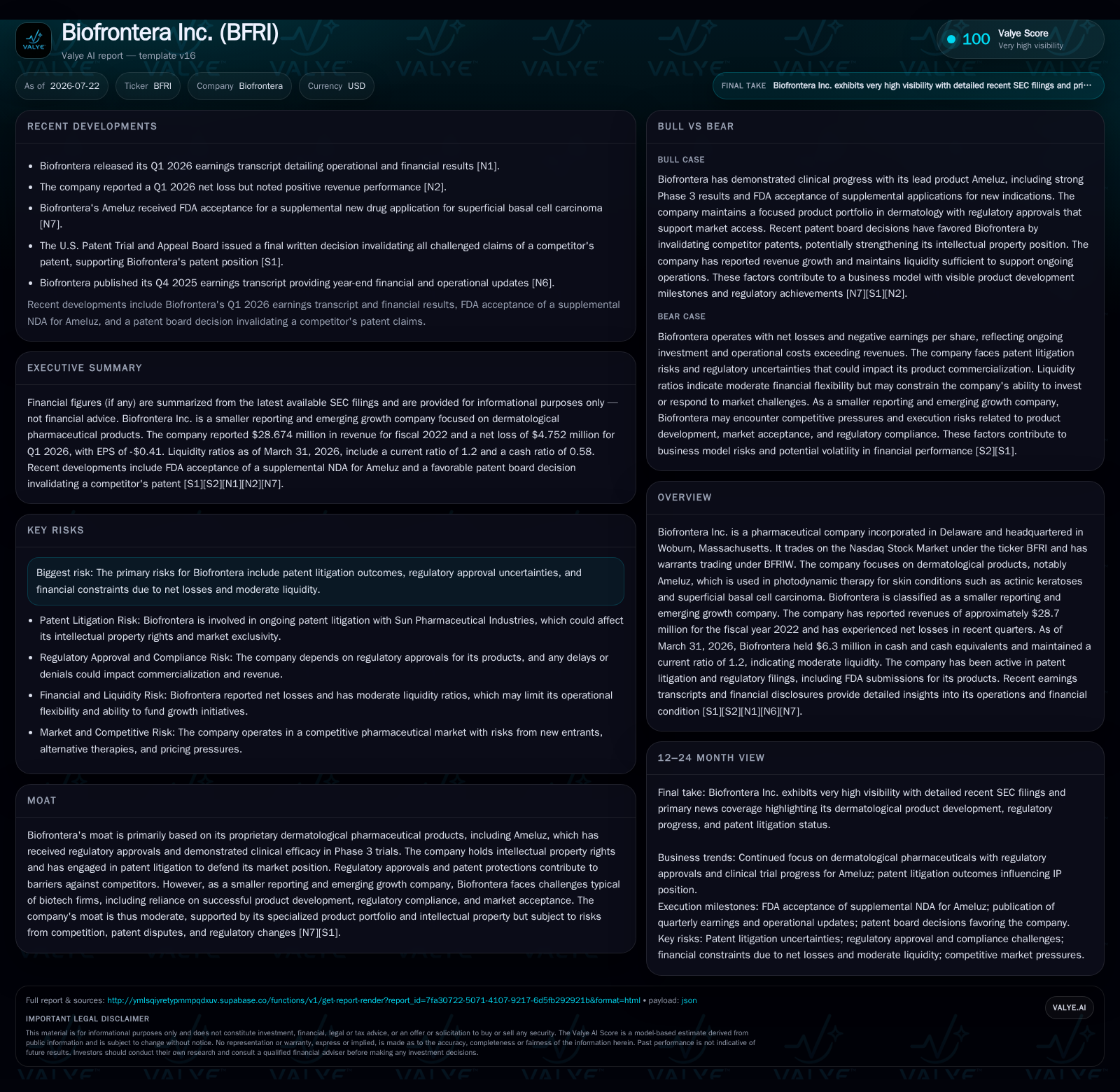
Biofrontera Inc.'s Q1 2026 filing indicates revenue stability anchored by its core dermatological product Ameluz, used in photodynamic therapy for actinic keratoses and basal cell carcinoma. The company continues to operate at a net loss with constrained cash reserves totaling $6.3 million as of March 31, 2026, reflecting moderate liquidity (current ratio ~1.2). Meanwhile, ongoing patent litigation creates persistent risk but also underscores the value of Biofrontera’s intellectual property moat. Comparisons with peer emerging growth dermatology biotech firms emphasize the balance between defending proprietary assets, managing limited financial runway, and pursuing regulatory approvals to support market penetration.
Q1 2026 Operational Snapshot: Revenue Stability Amid Legal and Liquidity Challenges
Biofrontera Inc. reported steady operational performance in the first quarter of 2026, anchored by its flagship dermatological pharmaceutical, Ameluz®. As of March 31, 2026, the company held $6.3 million in cash and cash equivalents against current liabilities of $10.9 million, resulting in a current ratio of approximately 1.2, indicating a constrained liquidity buffer that may limit operational flexibility without additional financing or improved cash flow generation [F1],[S2]. This liquidity profile is typical for emerging growth companies in the dermatology biotech sector, which often balance ongoing research and development (R&D) investments with commercialization efforts while defending proprietary assets.
Ameluz®: Core Revenue Driver with Market-Specific Dynamics
Ameluz® remains Biofrontera’s primary revenue source, generating approximately $28.7 million in revenue in 2022 through sales focused on photodynamic therapy (PDT) for actinic keratoses and superficial basal cell carcinoma [F1],[S1]. The drug’s mechanism involves topical application of a photosensitizer followed by controlled light activation to selectively target and destroy precancerous and cancerous skin cells. This targeted approach differentiates Ameluz® within the dermatological pharmaceuticals market, where clinical efficacy and safety profiles are critical for market acceptance.
Revenue generation depends on successful commercialization via direct sales channels and partnerships targeting dermatologists and oncology specialists. Adoption rates are influenced by clinical trial outcomes, regulatory approvals, and reimbursement coverage by healthcare payers. The company’s pricing power is supported by the specialized nature of PDT and limited availability of equivalent alternative therapies offering comparable efficacy and convenience [S1]. Regulatory filings and approvals remain essential to maintain and expand Ameluz®’s market indications and geographic reach.
Intellectual Property and Patent Litigation: Navigating Competitive Barriers
Biofrontera operates in a competitive environment where intellectual property protection is vital to safeguarding market exclusivity and recouping R&D investments. The company is actively engaged in patent litigation defending Ameluz®’s composition and method patents against challengers, including Sun Pharmaceutical Industries [S22].
In early 2026, the U.S. Patent Trial and Appeal Board invalidated certain claims held by Sun, representing a partial victory for Biofrontera; however, other patent challenges remain unresolved with potential appeals pending [S22]. The outcome of these disputes will materially affect Biofrontera’s competitive positioning by either reinforcing barriers to generic entry or exposing the company to increased competition. Maintaining a robust patent portfolio is therefore a key operating variable influencing pricing power and market share sustainability.
Industry and Peer Context: Regulatory Dependencies and Commercialization Challenges
Within the dermatological biotech sector, companies such as Dermira and Galderma illustrate the balance between heavy R&D expenditure and commercialization under stringent regulatory oversight. Like these peers, Biofrontera faces extended clinical development cycles, where clinical trial success rates and FDA approval milestones are pivotal to unlocking new indications and expanding market penetration.
The pathway from regulatory approval to broad market adoption involves additional complexities, including payer reimbursement negotiations and physician education to drive prescribing behavior. These factors collectively influence market acceptance and revenue growth potential.
Growth Drivers: Pipeline Expansion, Partnerships, and Market Reach
Biofrontera’s growth prospects depend on diversifying beyond Ameluz®’s current indications. The company has initiated clinical development targeting moderate-to-severe acne vulgaris using Ameluz® PDT, signaling potential pipeline expansion into a larger patient population [S7],[S15]. Successful trial outcomes and subsequent regulatory approvals could significantly enhance long-term revenue streams.
Strategic partnerships, such as the December 2025 supply agreement with Midas Pharma GmbH, aim to bolster manufacturing capacity and distribution capabilities, facilitating geographic expansion and operational scalability [S1]. Additionally, securing broader reimbursement coverage from healthcare payers remains critical to improving physician adoption and patient access.
Risks and Operational Constraints
Biofrontera’s concentrated product portfolio, heavily reliant on Ameluz®, exposes the company to risks related to regulatory setbacks, patent litigation outcomes, and competitive pressures from generics or alternative therapies [F1],[S2],[S3]. The company’s net losses exceeding $10 million annually reflect ongoing investments in R&D and commercialization, common among emerging growth dermatology biotech firms.
Liquidity constraints, evidenced by a modest cash reserve of $6.3 million and a current ratio near 1.2, underscore the need for prudent capital management. Without additional financing or improved operational cash flow, sustaining commercialization and R&D activities may be challenging over the medium term.
Regulatory uncertainties, including potential delays or failures in expanding Ameluz®’s approved indications, could stall growth momentum. Similarly, adverse patent litigation outcomes could erode exclusivity, intensifying pricing pressures and market share erosion.
Forward-Looking Indicators: Monitoring Catalysts and Market Signals
Upcoming developments to watch include the resolution of ongoing patent disputes, which will clarify Biofrontera’s intellectual property defensibility and competitive moat [S22]. Favorable rulings would reinforce barriers to generic competition, while unfavorable outcomes could accelerate market entry of alternatives.
Regulatory filings and clinical trial results related to acne vulgaris indications will provide critical validation of the company’s pipeline diversification strategy [S7],[S15]. Post-approval sales volume trends will offer insights into market penetration and adoption dynamics.
Additionally, changes in payer reimbursement policies or pricing environments should be monitored closely, as these factors directly impact gross margin sustainability and revenue growth.
Financial Overview: Liquidity and Capital Structure
At the end of Q1 2026, Biofrontera reported cash and cash equivalents of $6.3 million, current assets of $13.2 million, and current liabilities of $10.9 million, yielding a current ratio of approximately 1.2 [F1],[S2]. This liquidity position provides a limited runway, necessitating careful management of operating expenses and capital allocation.
Total debt remains minimal, with approximately $296,000 recorded as of mid-2024, indicating low leverage and limited refinancing risk [F1]. However, the company’s net losses of around $10.5 million annually highlight ongoing cash burn typical of emerging growth companies investing ahead of profitability [F1].
Balancing R&D expenditure with commercialization investments, alongside potential equity raises or strategic partnerships, will be essential to sustaining operations and supporting growth initiatives.
Disclaimer: This report is for informational purposes only and does not constitute investment advice or research views. All facts presented are based upon publicly available SEC filings as referenced; no speculative forecasts are made beyond supported evidence.
Disclaimer: This is research-only, informational analysis and not investment advice. It may include AI-generated interpretation and general industry context. Always verify important details using primary sources.

Comments