
United Rentals Advances Profitability Through Fleet Optimization and Technology Integration
United Rentals’ latest quarter highlights focused growth in rental revenues and operational efficiency within a capital-intensive, cyclical equipment rental sector.
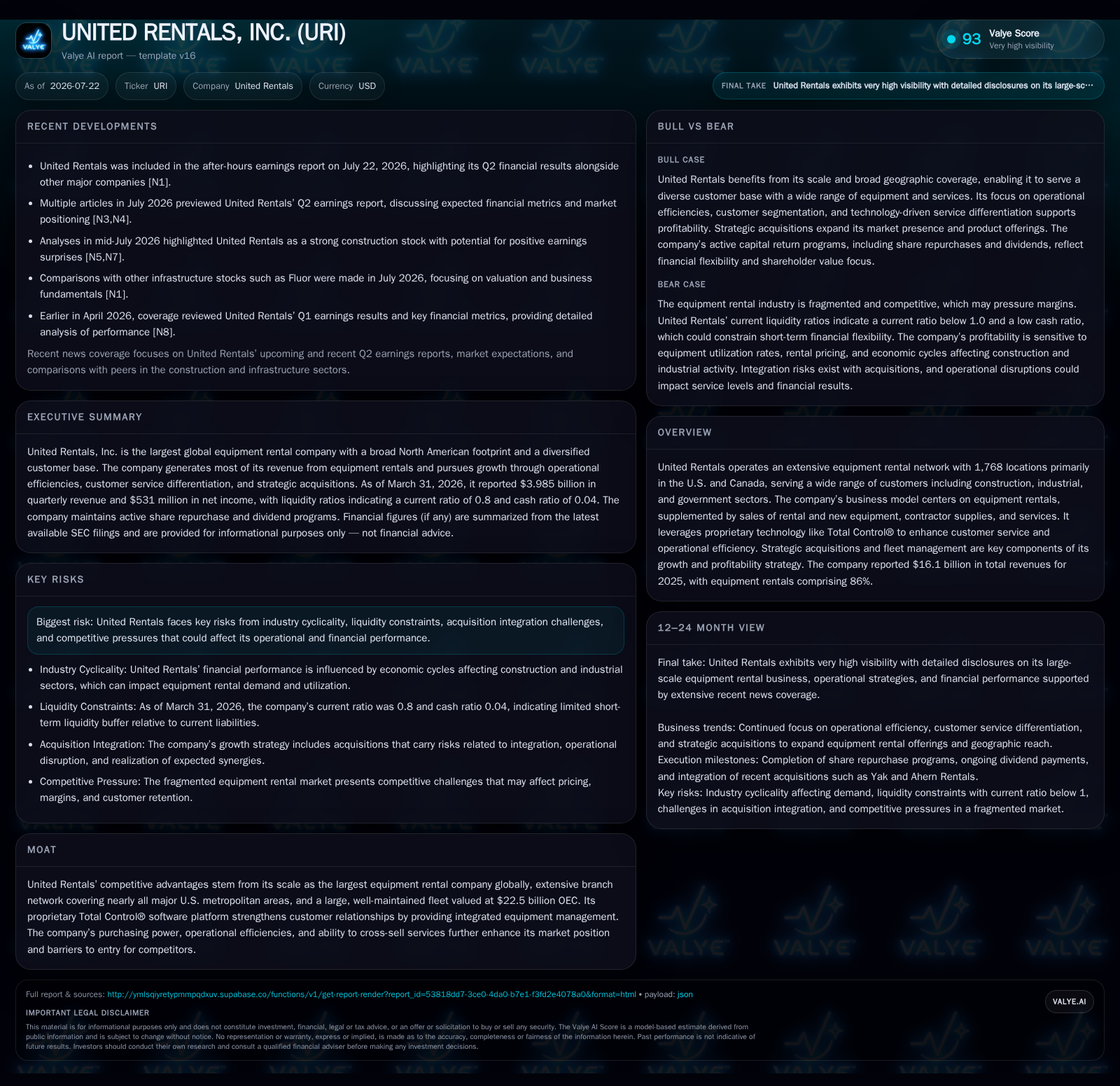
In the Q2 2026 update, United Rentals reinforced its position as the largest equipment rental provider in North America by maintaining strong rental revenue dominance and leveraging proprietary technology to deepen customer service differentiation. Its business model is anchored on a vast, well-maintained fleet supplemented by specialty services and contractor supplies, with profitable growth targeted through fleet optimization, rate management, and ongoing acquisitions. Despite macroeconomic cyclicality and high leverage inherent to the industry, the company’s extensive geographic reach and integrated software tools give it competitive advantages over fragmented regional providers. Key risks include demand volatility linked to construction activity and the need to manage substantial capital expenditures alongside debt maturities. Monitoring fleet utilization, rental rates, margin trends, and acquisition integration will be critical to assessing ongoing execution.
Recent Operating Update
United Rentals reported Q2 2026 results that reinforced its focus on profitable growth driven by rental revenue expansion and operational efficiencies [S2], [S3]. The company emphasized continued execution of customer segmentation strategies targeting large construction and industrial clients, leveraging its broad equipment portfolio and proprietary Total Control® fleet management software to deepen service differentiation. Management highlighted disciplined rental rate management amid a variable demand environment, reflecting sensitivity to macroeconomic cycles impacting construction activity.
The Total Control® platform remains a key competitive asset, offering customers centralized visibility and control over equipment usage, which facilitates optimized procurement, scheduling, and logistics coordination. This digital integration supports improved fleet utilization and asset turnover by reducing equipment downtime through streamlined delivery, pickup, and maintenance scheduling.
Business Model Analysis
The company’s revenue model centers on short- to medium-term equipment rentals to a diverse customer base including construction firms, industrial companies, municipalities, and government entities. Supplemental revenue streams include sales of used rental equipment, new equipment sales sourced from manufacturers, contractor supplies (tools, safety gear), and ancillary onsite services. These complementary offerings help diversify revenue but remain secondary to rental operations.
Growth in rental revenue is driven by several levers: expanding branch network coverage, optimizing fleet mix toward higher-demand and specialty equipment categories, increasing average rental rates through pricing discipline and product mix shifts, and lengthening average rental durations during stable market conditions. Cross-selling contractor supplies and specialty rentals enhances revenue per customer and supports margin improvement.
Operational efficiency is critical in this capital-intensive sector. Maintenance and repair costs per unit directly impact margins, as does depreciation relative to capital expenditure (CapEx) investment in fleet renewal and expansion [S1]. United Rentals employs lean management principles, including kaizen continuous improvement processes, to reduce equipment preparation cycle times, optimize logistics for delivery and pickup, and improve maintenance throughput—key drivers of asset turnover and fleet utilization
A distinctive operational advantage is United Rentals’ ability to transfer equipment across its extensive branch network, enabling higher fleet utilization rates and reducing idle assets compared to smaller, fragmented regional competitors lacking such scale and integrated logistics capabilities.
Industry Structure & Competitive Position
The North American equipment rental market is fragmented, with numerous local and regional providers alongside large national players such as United Rentals, Herc Rentals, and Ashtead Group’s Sunbelt Rentals division. United Rentals’ scale leadership, with coverage in 49 U.S. states and every Canadian province, supports superior purchasing power and fleet management capabilities [S1].
This scale facilitates deployment of proprietary technology like Total Control®, which enhances customer retention by reducing total cost of ownership (TCO) through data-driven equipment management. The platform’s integration supports contactless end-to-end service, a differentiator in customer experience.
Expansion into specialty rental services through acquisitions such as Yak Access broadens United Rentals’ product suite beyond traditional earthmoving and lifting equipment to include environmental containment and access solutions. These specialty segments often command higher margins and benefit from regulatory-driven demand growth.
Financial leverage is elevated industry-wide due to the capital-intensive nature of fleet ownership. Companies must balance ongoing multi-billion-dollar CapEx programs for fleet renewal and expansion with depreciation schedules and technological obsolescence risks. United Rentals’ financial structure reflects this dynamic, necessitating vigilant liquidity and refinancing management.
Growth Drivers
Several structural trends underpin United Rentals’ growth prospects:
- Infrastructure Spending: Increased public and private infrastructure projects drive demand for heavy equipment rentals, as customers prefer flexible rental arrangements over ownership amid uncertain project timelines.
- Shift from Ownership to Rental: Customers increasingly favor renting to reduce upfront capital expenditures and transfer maintenance responsibilities to vendors.
- Technology-Enabled Fleet Management: Platforms like Total Control® improve utilization forecasting and operational efficiency, enhancing returns on invested capital.
- Specialty Services Expansion: Growth in environmental and access solutions through acquisitions supports higher-margin cross-selling opportunities.
- Geographic Network Expansion: Incremental branch openings in underserved markets capture new customers and improve service responsiveness.
These drivers translate into key operating KPIs including fleet utilization rate (percentage of rentable days rented), average rental rate per day, maintenance cost per unit, customer retention rates, and equipment turnover velocity. Monitoring these metrics provides insight into the company’s ability to sustain profitable growth amid industry cyclicality.
Risks & Growth Constraints
United Rentals faces several risks inherent to the equipment rental industry:
What to Watch Next
Key indicators to monitor following the Q2 2026 update include:
- Trends in fleet utilization rates, signaling demand strength relative to supply capacity.
- Movement in average rental rates, reflecting pricing power and mix shifts.
- Maintenance and repair costs per unit, indicating operational efficiency.
- Progress on integrating specialty acquisitions and cross-selling synergies.
- Capital expenditure levels relative to used equipment sales, demonstrating fleet renewal discipline.
- Customer retention rates, particularly among large accounts using Total Control®.
- Adjusted EBITDA margin trends, reflecting scale benefits and cost management effectiveness.
Financial Profile Discussion
Capital expenditures net of used equipment disposals exceeded $2.7 billion in 2025, reflecting ongoing investment in fleet expansion and replacement to maintain competitive positioning [S13]. This level of CapEx must be balanced with free cash flow generation, which can be pressured by cyclical demand fluctuations.
United Rentals’ liquidity is supported by asset-based lending facilities and accounts receivable securitization programs, with compliance to covenants maintained as of the latest filings. However, refinancing risk remains a key consideration given the magnitude of outstanding debt and the cyclical nature of the business.
Disclosure: This analysis synthesizes publicly available regulatory filings without endorsing any investment decision regarding United Rentals stock.
Disclaimer: This is research-only, informational analysis and not investment advice. It may include AI-generated interpretation and general industry context. Always verify important details using primary sources.

Comments