
NETSTREIT Corp. Expands Defensive Retail Portfolio with Stable Long-Term Leases
The 2026 second quarter update highlights NETSTREIT’s continued acquisition-driven growth focused on single-tenant retail properties with high credit quality and strong e-commerce resistance.
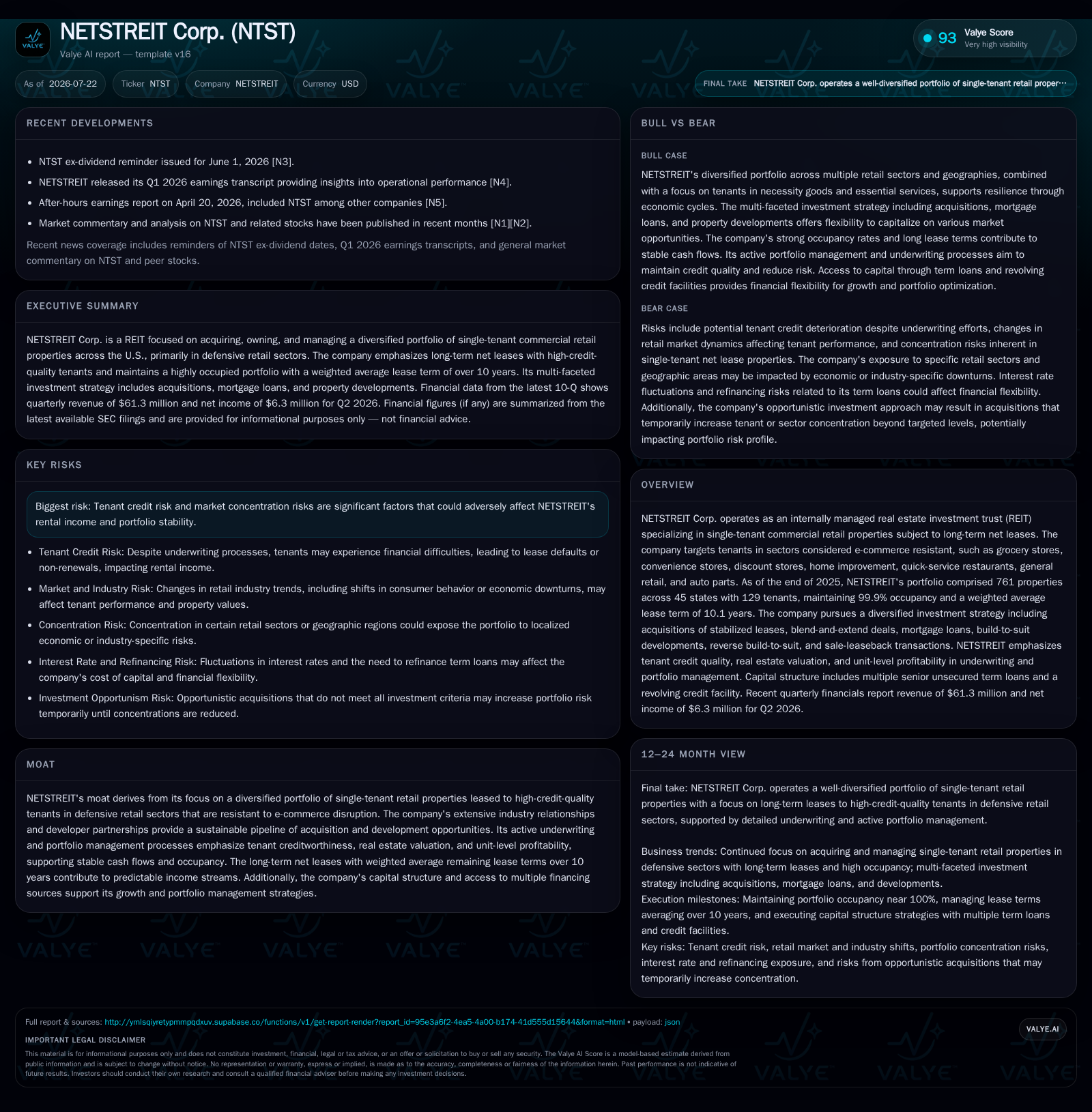
NETSTREIT Corp., an internally managed REIT specializing in single-tenant net-leased retail properties, reported no material changes to risk factors in its latest Q2 2026 filing. The company’s portfolio stood at 761 properties across 45 states with exceptional occupancy and a weighted average lease term of over 10 years, emphasizing defensive retail sectors such as grocery and convenience stores. Its recent financing activities and follow-on equity offerings underpin growth initiatives including acquisitions and build-to-suit developments. Tenant credit quality remains a core focus, balancing acquisition activity with prudent underwriting to mitigate risks from tenant defaults or market concentration.
Recent Operating Update
NETSTREIT Corp.'s Q2 2026 filing confirmed operational stability with no material changes to risk factors since the 2025 annual report, reinforcing the resilience of its portfolio amid ongoing macroeconomic uncertainties [S2], [S20]. The company’s July 2026 press release and supplemental disclosures highlight steady rental income generation from its diversified portfolio of single-tenant net-leased retail properties [S3], [S11]. While detailed quarterly operating metrics were limited in the filings, balance sheet data reflects consistent leverage management aligned with prior periods [F1].
The portfolio's strong performance is underpinned by disciplined tenant credit underwriting focused on defensive retail sectors such as grocery stores, convenience stores, quick-service restaurants, discount stores, and home improvement centers—categories known for their resistance to e-commerce disruption [S1]. Key operating metrics include an exceptionally high occupancy rate of 99.9% and a weighted average lease term (WALT) of approximately 10.1 years, excluding mortgage loans, which are critical indicators of lease stability and cash flow predictability in the net-leased REIT sector [S1].
Business Model Insights
NETSTREIT operates as an internally managed REIT specializing in single-tenant retail properties leased under long-term net leases where tenants assume nearly all property operating expenses, including taxes, insurance, and maintenance [S1]. This structure minimizes landlord operational responsibilities and stabilizes net operating income (NOI), primarily generated through contractual annualized base rent (ABR).
Revenue is derived from fixed or inflation-linked rents under leases averaging over a decade, providing cash flow visibility that supports dividend distributions consistent with REIT income requirements. The company’s portfolio diversification across necessity-based retail sectors mitigates concentration risk and enhances resilience against structural retail shifts such as e-commerce growth.
Monetization strategies include property acquisitions funded through a combination of equity raises and debt facilities, alongside strategic dispositions aimed at portfolio optimization [S1]. In 2025, NETSTREIT acquired 140 properties across 31 states for $603 million, with an average WALT near 13.9 years, while disposing of 78 non-core or lower-yield assets for $169 million in net proceeds, reflecting active capital recycling to enhance portfolio quality and returns [S1].
Additional revenue streams arise from mortgage loans secured by real estate and build-to-suit developments or sale-leaseback transactions, which expand exposure while maintaining stringent tenant credit standards.
Industry Structure and Competitive Position
Within the single-tenant net-leased retail REIT sector—where peers include Realty Income Corporation (O), National Retail Properties (NNN), and STORE Capital (STOR)—NETSTREIT’s portfolio of approximately 761 properties, long WALT exceeding 10 years, and near-full occupancy position it competitively among mid-scale operators focused on defensive retail niches. Its internal management model reduces fee-related overhead compared to externally managed peers, enhancing capital deployment efficiency and operational control.
Geographically, NETSTREIT spans 45 states with diversification across roughly 28 retail sectors, reducing vulnerability to localized economic downturns or sector-specific disruptions common in mall-centric or department-store-heavy portfolios [S1]. The emphasis on tenants providing essential goods and services aligns with consumer demand trends favoring convenience, grocery access, home improvement, and quick-service dining—sectors less exposed to permanent store closures or aggressive rent renegotiations.
The company’s access to capital markets through forward sale agreements and at-the-market (ATM) equity programs at prices reflective of portfolio stability supports its growth and acquisition strategies [S21].
Growth Drivers
NETSTREIT’s growth is driven by several interrelated factors:
- Property Acquisitions: The company targets stabilized retail assets with long-term net leases, focusing on defensive sectors to sustain annualized base rent near $198 million as of end-2025 [S1].
- Build-to-Suit Developments: These projects allow customization of properties for creditworthy tenants, securing attractive capitalization rates and lease terms.
- Mortgage Loans: Select lending secured by real estate complements direct ownership, enhancing yield.
- Sale-Leaseback Transactions: These facilitate capital recycling from existing asset holders while locking in long-term leases at favorable spreads.
- Capital Markets Access: Forward share sales and ATM programs provide financial flexibility to fund acquisitions and development pipelines efficiently.
Maintaining high tenant credit quality through rigorous underwriting remains central to portfolio durability. Key performance indicators to monitor include lease renewal rates, same-property net operating income growth, and acquisition versus disposition volumes, which collectively influence cash flow stability and growth potential.
Risks and Watchpoints
Primary risks include tenant credit risk, where defaults by larger tenants could materially impact rental income, and market concentration risk if geographic or sector exposures become stressed simultaneously. Although the defensive retail focus mitigates risks from e-commerce disruption, macroeconomic downturns affecting consumer spending could impair tenant sales and rent payments.
Interest rate volatility poses refinancing risks, particularly for variable-rate debt portions. While significant hedging covers major term loans through maturity dates beyond five years, unhedged debt segments may expose the company to rising financing costs if interest rates increase further [S1]. Development execution risk exists but is limited given the small scale of properties under development without commenced rent.
Other watchpoints include lease renewal outcomes post-WALT expiry, which affect occupancy and cash flow continuity, and potential regulatory or tax changes impacting REIT operations.
What to Watch Next
Upcoming indicators for assessing NETSTREIT’s operational execution and financial health include:
- Acquisition and disposition volumes reflecting portfolio optimization and growth momentum.
- Occupancy rates sustaining near-peak levels as a sign of leasing demand strength.
- Lease renewal activity signaling tenant retention and lease term extensions.
- Same-property net operating income trends indicating effective inflation pass-through and operational performance.
- Interest expense patterns aligned with hedging strategies confirming cost control amid changing market rates.
- Capital raising activity through ATM and forward sale programs demonstrating liquidity and funding capacity.
Financial Profile Discussion
As of June 30, 2026, NETSTREIT reported total debt of approximately $1.41 billion, supporting its acquisition and development activities [F1]. The company’s capital structure benefits from recent debt refinancings that reduced borrowing costs tied to its investment grade credit rating, enhancing capital efficiency [S1]. Equity capital is raised through forward sale agreements and ATM programs, which provide flexible, accretive funding sources for growth initiatives [S21].
Dividend distributions align with REIT payout requirements, supported by stable cash flows from long-term leases and high occupancy. The internal management structure reduces overhead compared to externally managed peers, contributing to predictable free cash flow generation critical for sustaining shareholder returns.
This analysis is based exclusively on SEC filings through July 22, 2026, combined with sector-specific knowledge relevant to single-tenant net-leased retail REITs. It refrains from speculative commentary or investment research views.
Financial Position Summary
As of June 30, 2026, NETSTREIT’s total and net debt stood at approximately $1.41 billion [F1]. This leverage level supports ongoing portfolio expansion while maintaining financial flexibility.
Disclaimer: This is informational research content and not investment advice. Verification from primary sources is recommended.

Comments