
Travel & Leisure Co. Shares Insights on Q2 Earnings, Capital Management and Market Sensitivity
Q2 2026 reveals nuanced operational dynamics for Travel & Leisure Co., highlighting discretionary demand sensitivity and disciplined capital allocation through share repurchases.
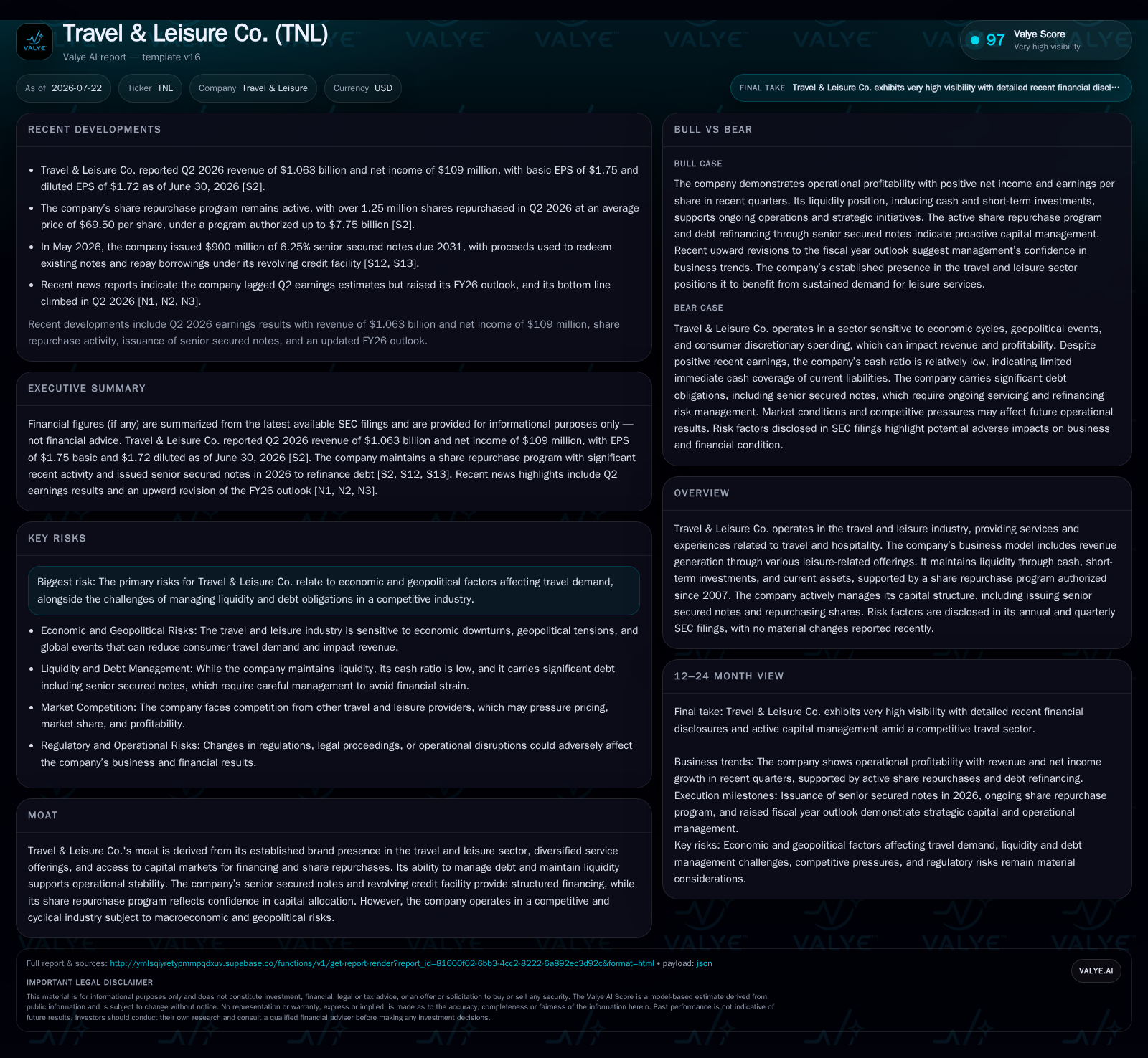
In its latest quarter ended June 30, 2026, Travel & Leisure Co. demonstrated revenue resilience amid persistent seasonality and macroeconomic headwinds common in discretionary travel sectors. The company’s expansion of its share repurchase program by $750 million to a total authorization of $7.75 billion underscores confidence in cash flow stability and capital structure management. While competitive pressures from timeshare peers and digital travel platforms persist, diversified revenue streams including vacation ownership sales and loyalty-driven hospitality services provide structural support. Monitoring customer retention rates and occupancy trends remain key as the firm navigates economic cycles and geopolitical uncertainty.
Q2 Operating Overview: Assessing Revenue Growth Amid Seasonality and Macroeconomic Sensitivity
Travel & Leisure Co.'s Q2 2026 results reflect the quintessential seasonality embedded in its vacation ownership and timeshare business model alongside discernible effects from broader macroeconomic factors influencing discretionary leisure spending. While the company exhibited revenue growth aligned with expectations for a mature player in the travel sector, the cadence of sales activity remains notably seasonal—typical of vacation ownership cycles where contract closings and occupancy fluctuate by quarter [S2]. This aligns with historical industry behavior where consumer decisions about discretionary travel purchases often cluster around timing factors such as holiday planning windows and economic confidence swings.
Management's commentary confirms that customer retention rates have stayed robust, supporting steadier recurring revenue streams even as new sales are impacted by tightening consumer budgets or cautious travel sentiment amidst geopolitical uncertainties [S2][N1]. Thus, underlying customer loyalty—a critical KPI for Travel & Leisure Co.—continues to act as a cushion against demand volatility, maintaining a baseline of occupied inventory and repeat business
Capital Allocation Highlight: Expansion of Share Repurchase Program Reflects Confidence
One of the standout developments in recent quarters is the company's decisive move to bolster its share repurchase program by an additional $750 million in early 2026, lifting total repurchase capacity to $7.75 billion [S4][S8]. This increment marks an eleventh increase since inception in 2007, signaling sustained confidence in free cash flow generation amid a capital-intensive operating context.
Share repurchases in this mature segment serve multiple strategic purposes: besides returning excess capital to shareholders, they optimize the capital structure by potentially reducing share count while managing equity dilution from employee compensation plans. This mirrors practices among peers such as Marriott Vacations Worldwide, which similarly use buybacks to reinforce shareholder returns while balancing debt leverage.
The execution pace in Q2 alone included repurchasing over 1.25 million shares at an average price near $69.50, underscoring active market engagement within permitted regulatory frameworks [S8]. This volume reflects both operational cash flow robustness and willingness to deploy liquidity efficiently despite ongoing debt obligations.
Core Business Model Resilience via Diversified Travel Product Mix and Customer Loyalty Dynamics
Travel & Leisure Co.'s diversified product suite spans vacation ownership contracts (timeshares), traditional hospitality services, and curated travel packages—each contributing distinct revenue streams but collectively leveraging shared customer bases through loyalty programs [S1]. This model hedges against overreliance on any single channel or geography while enabling recurring revenue through membership renewals and ancillary service upsells.
Customer retention remains pivotal; high renewal rates support stable occupancy levels across managed properties even when new contract sales face headwinds. Through sustained investments in consumer experience enhancements via technology upgrades and brand promotions, the company seeks to foster stickiness within its membership base—an approach shown effective in competitor comparisons with Hilton Worldwide’s loyalty strategy albeit in different hospitality segments.
Operational KPIs like occupancy rates and average daily rates (ADR) are more muted by seasonality but benefit over time from cross-selling bundled offerings combining accommodations with experiential travel components. This multidimensional product architecture helps diversify unit economics beyond pure timeshare sales volatility [S1][F1]
Competitive Environment Reflecting Fragmented Hospitality and Timeshare Markets' Pressures
Operating within a sector characterized by fragmented competitors ranging from branded vacation ownership firms like Marriott Vacations Worldwide to expansive hospitality operators (e.g., Hilton Worldwide) and large online travel agencies such as Expedia Group introduces complex pricing pressures. Travel & Leisure Co. contends with evolving consumer routes to purchase—shifting increasingly through online aggregators—which may constrain legacy channels’ pricing power.
Capacity constraints inherent to fixed inventory models (like timeshare units) further complicate growth pacing given physical limits on expansion without significant capital outlays. Concurrently, digital platforms intensify competition on convenience and pricing transparency, demanding ongoing innovation alongside customer engagement investments.
This competitive landscape implies margin pressure potential unless offset by operational efficiencies or monetization enhancements within loyalty platforms or higher-margin ancillary services.
Emerging Growth Opportunities in Membership Expansion and Experiential Travel Trends
Industry-wide growth drivers include rising middle-class disposable incomes globally fueling appetite for experiential travel—trends that align well with Travel & Leisure Co.’s movement toward expanding membership-oriented products alongside traditional timeshare contracts [S1]. Membership or subscription-based offerings present double-digit recurring revenue growth opportunities that augment stability beyond cyclical booking spikes.
Technological enhancements targeting enhanced personalization, seamless booking experiences, and loyalty rewards can serve as future margin catalysts by increasing engagement frequency while reducing distribution friction—aligning with observed shifts among peers deploying AI-driven customer interaction platforms.
Strategic partnerships or targeted acquisitions might further deepen experiential offerings or broaden geographic reach; however, no specific pipeline disclosures have been made yet.
Risks to Monitor: Economic Cycles, Geopolitical Uncertainty, And Debt Servicing Challenges
As disclosed repeatedly [S1][S2], Travel & Leisure Co. faces inherent risks tied to macroeconomic downturns that dampen discretionary travel spending—a sector known for cyclicality accentuated during economic contractions. Geopolitical tensions affecting international traveler flows add unpredictability to bookings patterns especially across overseas properties.
Financially, while liquidity metrics appear adequate with a current ratio close to 1.19 supported by roughly $282 million in cash reserves as of mid-2026, net debt remains substantial near $5 billion based on last available figures (minus cash), amplifying leverage risk amid rising interest environments or slower cash conversion cycles common in capital-intensive hospitality operations [F1]
Debt servicing capability will remain under scrutiny given the senior secured notes outstanding; any erosion of operating margins or cash flow generation linked to slower demand recoveries could pressure this balance.
What Investors Should Watch: Key Milestones Including Quarterly Guidance Revisions And Demand Indicators
Market participants should monitor upcoming quarterly earnings releases for signals across bookings momentum, occupancy rates stability, ADR trends, and membership growth statistics—all pivotal indicators reflecting both immediate consumer behavior shifts and medium-term structural progress on diversification strategies [S3][N8]
Additionally, updates on share repurchase execution rates relative to authorization can provide insight into management’s confidence level regarding future cash flow robustness amid industry cyclicality.
Macroeconomic developments impacting discretionary spending patterns or unexpected geopolitical events remain wildcard factors warranting attentive tracking alongside potential regulatory changes affecting operational jurisdictions.
Financial Profile Discussion: Liquidity Metrics, Debt Positioning And Cash Flow Support
From a financial perspective as of June 30, 2026, Travel & Leisure Co.'s liquidity position demonstrates modest cushion with cash plus equivalents reported at approximately $282 million complemented by current assets totaling multiple billions though partially offset by current liabilities yielding a current ratio around 1.19—a moderate short-term buffer consistent with capital-intensive service sectors [F1]
Notably though, gross debt levels stand elevated near $5.24 billion (albeit last confirmed end-2018), implying sustained dependence on operating cash flows for leverage maintenance and interest obligations servicing [F1]. The absence of more recent explicit debt figures limits precision but underscores leverage as an ongoing watchpoint.
Overall financial health supports continued capital deployment flexibility including share buybacks but requires attentive monitoring given cyclical demand sensitivities intrinsic to discretionary travel services.
This analysis relies exclusively on publicly available SEC filings dated through July 22, 2026 ([S1]-[S8]), official company press releases (), and validated financial data ([F1]). It does not constitute investment advice but aims to provide domain-informed insight into Travel & Leisure Co.’s evolving operating landscape within the context of industry dynamics.
Disclaimer: This is research-only, informational analysis and not investment advice. It may include AI-generated interpretation and general industry context. Always verify important details using primary sources.

Comments