
PulteGroup’s Second Quarter Reveals Margin Pressures and Strategic Inventory Management
Q2 2026 results show PulteGroup navigating demand softness with inventory adjustments, pricing levers, and financial discipline amid persistent housing affordability challenges.
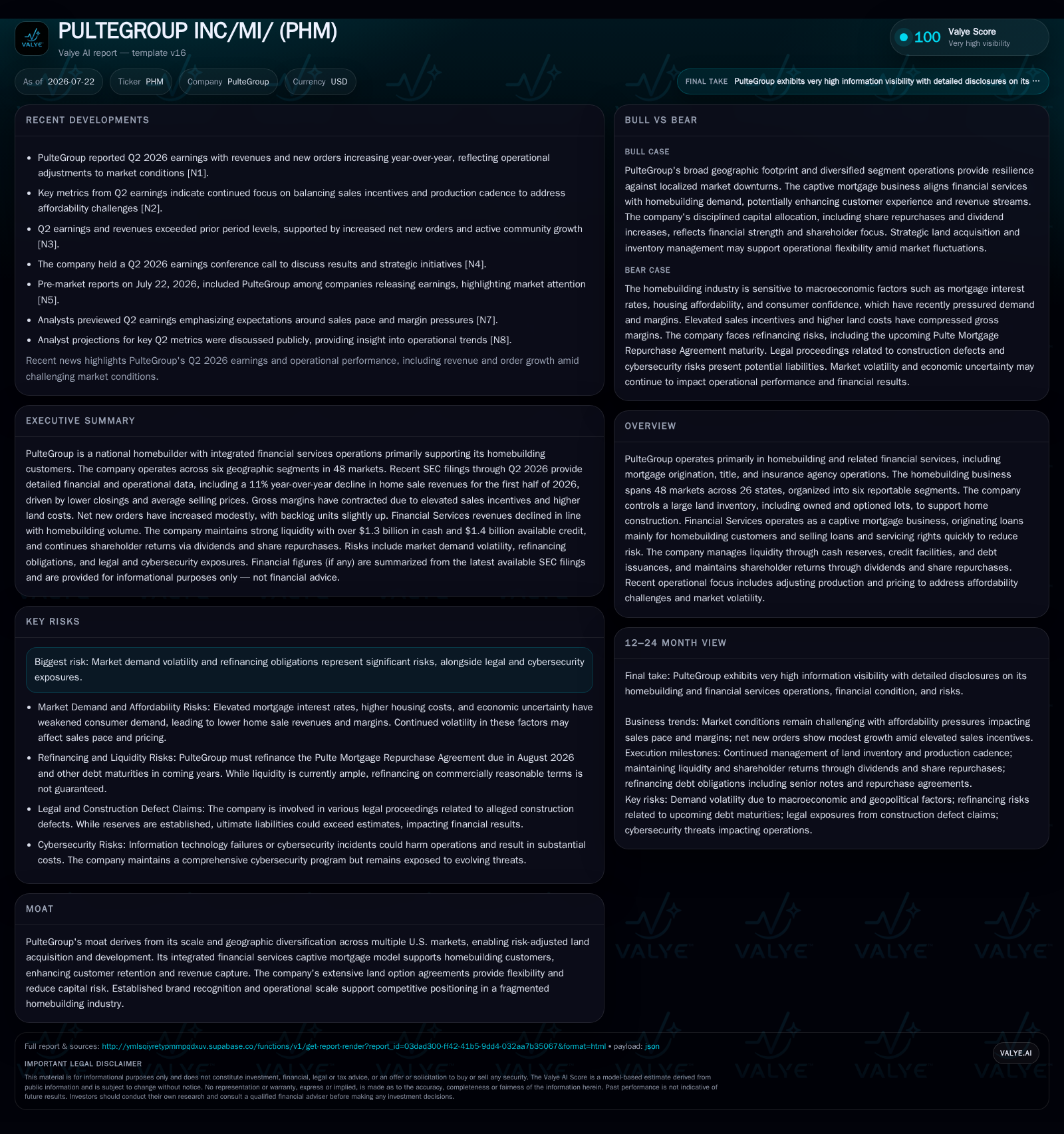
In Q2 2026, PulteGroup faced an 8% decline in home closings and a 3% drop in average selling price, driving an 11% reduction in home sale revenues year-over-year. Elevated mortgage rates and geopolitical volatility have pressured demand and gross margins, prompting the company to recalibrate production cadence, emphasize sales incentives on spec homes, and selectively manage its large land pipeline via owned and optioned lots. The captive Financial Services segment mitigated earnings volatility despite lower volumes. Liquidity remains ample with $1.3 billion cash on hand and a recently expanded revolving credit facility supporting share repurchases and dividends. Key watchpoints include backlog trends, net new orders growth, and successful refinancing of mortgage repurchase agreements.
PulteGroup’s Q2 2026 Results Reflect Margin Pressure Amid Strategic Inventory and Capital Management
PulteGroup’s second-quarter 2026 financial and operating results illustrate the challenges facing the homebuilding sector amid persistent housing affordability headwinds and macroeconomic volatility. The company reported an 8% year-over-year decline in home closings and a 3% decrease in average selling price, culminating in an 11% reduction in home sale revenues compared to Q2 2025 [S2]. These dynamics reflect the broader industry environment where elevated mortgage rates and geopolitical uncertainties have dampened demand and pressured gross margins.
Navigating Demand and Pricing: Sales Volume Decline Offset by Net New Orders Growth
The contraction in home closings primarily stems from a lower backlog entering 2026 and ongoing affordability constraints impacting buyer capacity [S2]. Despite this, PulteGroup achieved a 6% increase in net new orders year-over-year, driven by targeted pricing incentives including discounts on spec homes, closing cost assistance, and mortgage interest rate buydowns designed to mitigate financing burdens for buyers [S2][N1]. This divergence between declining closings and rising orders suggests that demand remains responsive to tactical pricing, although the durability of this trend depends heavily on mortgage rate trajectories and broader economic stability.
Inventory and Production Strategy: Reducing Spec Homes, Growing Build-to-Order Backlog
In response to market volatility, PulteGroup strategically adjusted its production cadence and inventory mix. The company successfully reduced spec home inventory—completed homes without committed buyers—to limit capital tied up in unsold properties that carry elevated market risk [S2]. Concurrently, the backlog shifted toward build-to-order homes, which typically require longer lead times but align more closely with buyer customization preferences and reduce inventory carrying costs.
Sales incentives have been concentrated on spec homes to accelerate turnover, contributing to margin compression. Gross margin on home sales declined to 25.0% in Q2 2026 from 27.0% in Q2 2025, reflecting higher land acquisition costs, elevated sales incentives, and pricing adjustments aimed at maintaining sales volume amid affordability challenges [S2]. Notably, gross margin improved sequentially from 24.4% in Q1 2026, indicating early signs of stabilization despite ongoing cost pressures. The company continues to collaborate with trade partners to update material and labor costs, aligning overhead expenses with current demand conditions [S2].
Captive Financial Services: Managing Mortgage Origination and Refinancing Risks
PulteGroup’s integrated Financial Services segment, which includes mortgage origination and related activities, plays a critical role in dampening earnings volatility. At quarter-end, Pulte Mortgage had approximately $478 million outstanding under its master Repurchase Agreement, a financing mechanism allowing rapid sale of originated loans, with an additional $147 million of available capacity [S12][S16]. The agreement matures in August 2026 and requires refinancing or renewal, which remains uncertain but is a key liquidity watchpoint.
Maintaining compliance with covenants under the Repurchase Agreement and managing loan sales efficiently are essential to mitigating short-term liquidity risks within this segment. The captive mortgage origination capability also supports home sales by providing buyers with financing options, enhancing customer retention and cross-selling synergies common among integrated homebuilders.
Land Acquisition Optionality: Capital Discipline Amid Rising Costs and Demand Uncertainty
A significant strategic lever for PulteGroup is its sizeable land inventory, which includes both owned lots and optioned lots that provide flexibility in capital deployment [S15]. As of June 30, 2026, the company held approximately $9.7 billion in remaining purchase price commitments under land option contracts, with deposits of about $717 million, mostly non-refundable but only partially so, allowing selective conversion to ownership based on market conditions [S2][S15].
In Q2, management updated underwriting standards for land acquisitions, reflecting increased selectivity amid rising land development costs and uncertain demand. The company prudently walked away from several land option contracts to preserve capital flexibility and avoid overexposure [S2]. This approach aligns with industry best practices where disciplined land acquisition mitigates risk from fluctuating demand and construction cost inflation.
Risk Factors: Construction Costs, Legal Exposure, and Cybersecurity Oversight
PulteGroup continues to face upward pressure on construction input costs, driven by labor shortages and inflation in materials prices, which weigh on profitability despite ongoing supplier negotiations [S1][S2]. Legal proceedings related to alleged construction defects represent contingent liabilities; while current reserves are deemed adequate, adverse outcomes beyond insured limits remain a potential risk [S1].
Cybersecurity governance is a material focus given the company’s increasing digital reliance across Homebuilding and Financial Services operations. Centralized oversight by experienced CIO and CISO executives, with regular board-level risk reviews, supports a comprehensive cybersecurity program. No material incidents have occurred recently, but evolving cyber threats require sustained vigilance [S1].
Forward-Looking Indicators: Backlog, Orders, and Mortgage Rate Sensitivity
Key operating metrics such as backlog—the dollar value of homes contracted but not yet closed—and net new orders provide forward-looking insight into demand sustainability [S2][N1]. The build-to-order backlog growth helps smooth production cadence and reduces inventory risk, while the 6% increase in net new orders reflects effective incentive strategies partially offsetting affordability headwinds.
However, the durability of demand remains sensitive to mortgage interest rate fluctuations, which directly impact monthly payment affordability and buyer purchasing power. Continued monitoring of these variables alongside cancellation rates and geographic demand shifts will be critical to assessing recovery trajectories.
Financial Position: Strong Liquidity Supports Operational Flexibility and Shareholder Returns
At June 30, 2026, PulteGroup held approximately $1.34 billion in unrestricted cash and equivalents, complemented by $1.4 billion available under an amended revolving credit facility extended through February 2031 [F1][S2][S4]. The company’s debt-to-total capitalization ratio, excluding Financial Services debt, stood at 12.3%, reflecting a conservative leverage profile supportive of financial flexibility [S4].
In February 2026, PulteGroup issued $800 million in unsecured senior notes at lower interest rates, replacing $589.1 million of maturing notes and reducing interest expense while deferring refinancing needs until 2031 or later [S7]. Other notes payable, primarily secured by land positions, totaled $37.4 million with maturities up to four years and interest rates up to 9% [S2].
Competitive and Industry Context
PulteGroup operates in a competitive landscape alongside national and regional homebuilders that also integrate financial services to enhance margins and customer retention. The company’s emphasis on land acquisition optionality, inventory mix management, and captive mortgage origination aligns with sector best practices observed among peers such as D.R. Horton and Lennar Corporation, which similarly balance production cadence and financial services integration amid affordability challenges.
Summary
PulteGroup’s Q2 2026 results underscore the persistent challenges in the homebuilding sector driven by elevated mortgage rates, affordability constraints, and cost inflation. The company’s strategic responses—adjusting production cadence, rebalancing inventory toward build-to-order homes, managing land acquisition optionality, and leveraging captive financial services—reflect a measured approach to navigating demand volatility while preserving capital flexibility. Key variables to monitor include backlog progression, net new order trends, mortgage rate movements, and refinancing outcomes for mortgage repurchase agreements. Liquidity remains ample, supporting operational needs and shareholder returns amid an uncertain macroeconomic backdrop.
This analysis is based exclusively on the company’s latest filings and recognized industry frameworks and does not constitute investment advice.
Disclaimer: This is research-only, informational analysis and not investment advice. It may include AI-generated interpretation and general industry context. Always verify important details using primary sources.

Comments