
Weatherford International Strengthens Well Completions Amid Cyclical Oilfield Services Challenges
Weatherford's latest quarterly report highlights operational resilience anchored in its drilling and production segments, while addressing customer concentration and cyclical market risks.
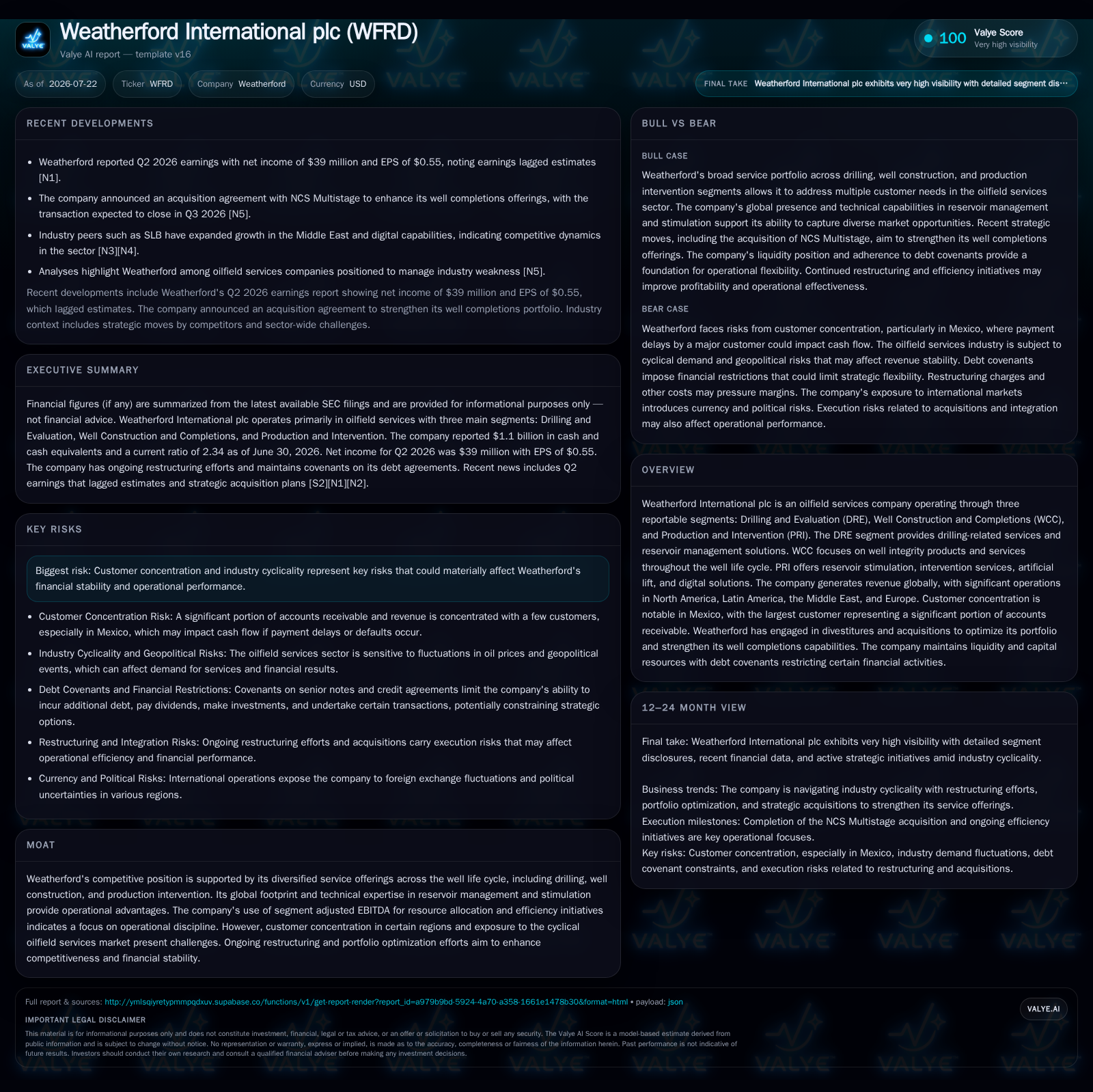
In its second quarter ended June 30, 2026, Weatherford International plc reaffirmed its diversified service portfolio across drilling, well construction, and production intervention, underpinning segment adjusted EBITDA growth despite ongoing macroeconomic pressures. The company navigates industry cyclicality and regional customer concentration, particularly in Mexico, while pursuing portfolio optimization through acquisitions and divestitures. Its liquidity position remains solid with a current ratio above two, supporting operational flexibility amid evolving upstream spending patterns.
Recent Operating Update
Weatherford International plc's second-quarter 2026 results, filed on July 22, 2026, demonstrate continued operational resilience across its core segments: Drilling and Evaluation (DRE), Well Construction and Completions (WCC), and Production and Intervention (PRI) [S2]. The company reported steady segment adjusted EBITDA growth driven by improved rig utilization rates, enhanced cost efficiencies, and disciplined operational execution. These gains reflect Weatherford’s focus on optimizing service contract delivery and equipment fleet availability, which are key performance indicators in the oilfield services sector.
In a contemporaneous event filing dated July 21, 2026, management reaffirmed strategic priorities emphasizing portfolio optimization through targeted acquisitions aimed at strengthening well completions capabilities within the WCC segment [S3]. This strategic shift aligns with industry trends where operators increasingly seek integrated service providers capable of delivering full lifecycle well integrity solutions, from drilling through production optimization.
Business Model Analysis
Weatherford operates as a diversified upstream oilfield services provider, generating revenue primarily through service contracts, equipment rentals, project-based fees, and digital oilfield solution subscriptions to upstream oil and gas operators worldwide [S1]. The company’s business model monetizes technical expertise and equipment deployment across the well lifecycle stages, with each segment addressing distinct customer needs:
- Drilling and Evaluation (DRE): Provides drilling services, reservoir evaluation, and contract drilling support, with revenue linked to rig utilization rates and service contract backlog.
- Well Construction and Completions (WCC): Focuses on well completions products and services that ensure well integrity during construction, including stimulation and cementing services.
- Production and Intervention (PRI): Delivers stimulation services, artificial lift installations, well intervention operations, and software-driven production optimization tools.
Geographically, Weatherford’s revenue streams are diversified across North America, Latin America—particularly Mexico—and the Middle East. However, customer concentration risk is significant, with a major Mexican client representing a substantial portion of accounts receivable balances, impacting days sales outstanding (DSO) and credit exposure [S1]. This concentration necessitates vigilant credit risk management and diversification efforts.
Operational KPIs such as rig utilization rates in DRE, contract backlog and average contract duration in WCC, equipment fleet size and availability in PRI, and segment adjusted EBITDA margins are critical metrics guiding Weatherford’s financial and operational performance. The company’s ability to retain customers hinges on technological innovation, especially in digital oilfield solutions, and consistent service quality amid competitive pressures.
Industry Structure and Competitive Position
The oilfield services industry is characterized by high cyclicality, with upstream operator capital expenditure (CAPEX) budgets closely tied to volatile oil and gas commodity prices. Weatherford competes with integrated oilfield services giants like Halliburton and Schlumberger, which have substantial technological R&D capabilities, as well as specialized firms such as TechnipFMC, focusing on subsea and well construction services, and National Oilwell Varco, a leading equipment supplier.
Weatherford’s competitive advantage lies in its balanced service portfolio spanning drilling evaluation to production interventions, complemented by reservoir management expertise. This integrated approach differentiates it from pure-play drilling contractors or standalone stimulation service providers. Nonetheless, the company faces operational risks from customer concentration and geopolitical uncertainties, particularly in Latin America and the Middle East, which can disrupt contract flows and increase regulatory compliance costs.
Digital transformation is an emerging battleground, with Weatherford investing in AI-enabled predictive maintenance and digital oilfield platforms to enhance operational efficiency and client value. The pace of innovation and successful commercialization of these technologies will be pivotal in maintaining competitive positioning against peers rapidly scaling software-driven service models.
Growth Drivers
Weatherford’s growth prospects are closely linked to upstream capital expenditure cycles. As commodity prices recover, exploration and drilling activities typically increase, driving higher rig utilization rates and demand for DRE services [S3]. Expansion into emerging basins in Africa and Asia-Pacific offers additional market opportunities, supported by the company’s strategic acquisitions aimed at enhancing WCC capabilities
Technological advancements that improve drilling efficiency and reservoir stimulation effectiveness directly contribute to customer cost savings, strengthening Weatherford’s pricing power. The company’s digital oilfield solutions facilitate production optimization, enabling operators to boost output without proportionate CAPEX increases.
Moreover, infrastructure development in mature markets and rising demand for enhanced oil recovery techniques fuel the need for advanced well intervention technologies embedded within PRI offerings. These factors collectively support Weatherford’s medium-term revenue growth and margin expansion potential.
Risks and Watchpoints
Customer concentration remains a significant risk, with reliance on a major Mexican client heightening credit exposure and potential cash flow volatility if spending patterns change [S1]. Geographic concentration also exposes Weatherford to political and regulatory risks that may necessitate operational adjustments.
The sector’s inherent cyclicality, driven by crude price fluctuations, continues to pressure contract renewals and pricing across all segments [S19]. Supply chain disruptions could delay equipment availability, increasing project costs during demand surges.
Currency volatility in global operations may compress margins if cost structures and revenue streams are mismatched. Additionally, technological obsolescence risk persists if Weatherford lags peers in adopting AI and digital innovations, potentially impacting client retention and margin profiles.
The company’s proposed redomestication from Ireland to Texas involves execution risks, including potential delays in shareholder approval and unforeseen tax or regulatory consequences [S14][S15]. Monitoring developments in this corporate restructuring will be important for assessing governance and strategic implications.
What To Watch Next
Key near-term catalysts include the anticipated closing of the NCS Multistage Holdings acquisition in Q3 2026, which is expected to enhance Weatherford’s well completions expertise and expand its service offerings [S21]. Integration progress and synergies realization will be critical to watch.
Operational metrics such as rig utilization rates in Latin America and the Middle East, segment adjusted EBITDA margin trends, and backlog growth in WCC projects will provide insights into demand sustainability and pricing power.
Changes in payment patterns or credit terms from the largest customer warrant close attention due to potential impacts on cash flow and working capital. Progress in deploying digital oilfield solutions and AI-enabled platforms will signal competitive positioning shifts over the medium term.
Approval status of the redomestication plan will offer clarity on corporate structure evolution and potential impacts on shareholder value [S17]. Finally, global oil price trends remain a fundamental driver of upstream CAPEX and, consequently, Weatherford’s service demand.
Financial Profile Discussion
As of June 30, 2026, Weatherford held approximately $1.1 billion in cash and cash equivalents against current liabilities of $1.41 billion, resulting in a robust current ratio of 2.34, which supports operational flexibility amid the sector’s working capital volatility [F1]
Total debt stood near $1.506 billion at year-end 2025, with net debt—total debt less cash—around $406 million, indicating moderate leverage relative to the company’s asset base and earnings capacity [F1]. Weatherford remains compliant with financial covenants under its credit agreements, reflecting manageable interest coverage and debt servicing obligations [S8][S16].
Capital allocation prioritizes strategic acquisitions and disciplined cost management to enhance free cash flow conversion. The company’s emphasis on segment adjusted EBITDA margin improvement underscores operational rigor aimed at sustaining profitability despite cyclical headwinds.
Overall, Weatherford’s financial position provides resilience through industry downturns while enabling selective investments critical for maintaining medium-term competitiveness.
Disclaimer: This is research-only, informational analysis and not investment advice. It may include AI-generated interpretation and general industry context. Always verify important details using primary sources.

Comments