
Newton Golf Pushes Product Innovation Amid Scaling Challenges
Newton Golf’s latest quarter reveals early traction for its technology-driven shafts even as liquidity constraints temper near-term scalability.
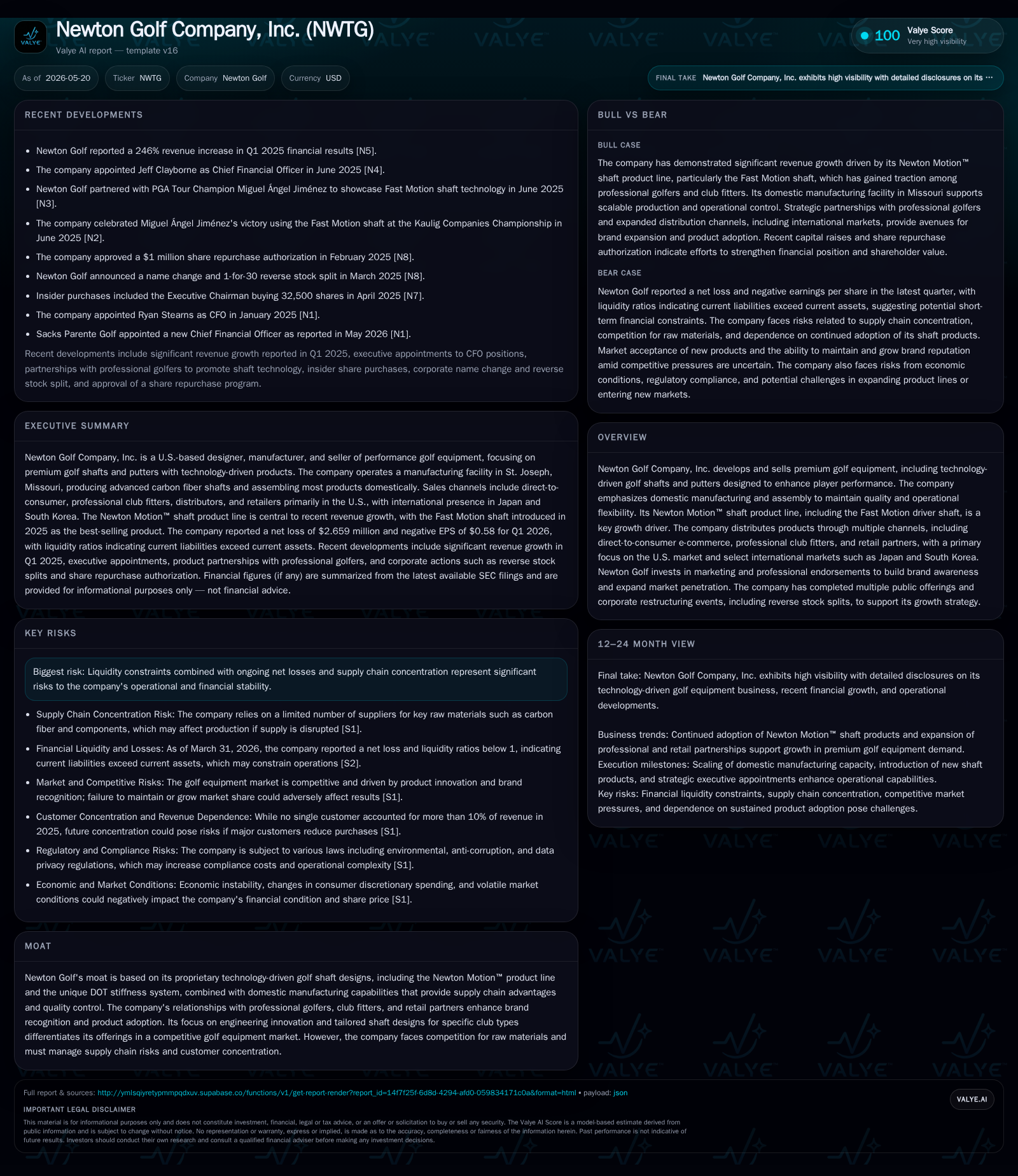
Newton Golf Company, Inc. reported modest operational progress in Q1 2026 centered on growing adoption of its proprietary Newton Motion™ golf shaft platform. The company leverages domestic manufacturing and differentiated engineering to compete in a highly fragmented golf equipment market. However, persistent liquidity pressures combined with competitive and supply chain risks pose challenges to sustained scaling. Growth will hinge on successful expansion into professional fitter channels, e-commerce penetration, and international markets while managing costs effectively.
Q1 2026 Operating Update: Evidence of Early Growth Momentum
The operating environment remains challenging, with no material changes in risk factors reported versus the prior annual filing [S2]. However, the operational focus is clearly on expanding manufacturing throughput — notably leveraging the St. Joseph, Missouri carbon fiber facility opened in 2022 — to meet rising demand without sacrificing quality control [S1]. The latest event filings confirm renewed emphasis on marketing spend toward digital channels and professional endorsements designed to cement Newton as a technology leader among performance golf shafts [S3].
Business Model and Product Strengths: Technology-Driven Performance Golf Shafts
Newton Golf primarily generates revenue through sales of premium golf shafts, putters, grips, and related gear [S1]. The centerpiece is the Newton Motion™ shaft product family featuring patented DOT stiffness system technology designed to optimize torque-flex profiles for varying swing types and clubs. This engineering innovation positions Newton shafts as performance enhancers targeting discerning players who seek measurable improvements in distance and accuracy.
Revenue mechanics revolve around consumer payments routed via multiple sales channels: direct-to-consumer websites that provide higher margins but require upfront marketing investment; relationships with club fitting specialists such as Club Champion who integrate Newton shafts into custom club builds; and retail partnerships encompassing pro shops and specialty golf stores [S1][S27]. Typically, volume growth depends on increased shaft adoption by fitting centers driving unit sales velocity while price stability stems from proprietary features limiting commoditization.
The company’s strategic choice to manufacture predominantly in the U.S., particularly at its St. Joseph plant opened in April 2022 for advanced carbon fiber shaft production, is a double-edged sword [S1]. While this supports tighter quality assurance and faster iteration cycles compared to offshore competitors heavily reliant on Asia-based production, it elevates fixed costs and exposes Newton to supplier concentration risks due to a limited domestic materials vendor pool [S11]. Nonetheless, management believes this arrangement enhances supply chain resilience and branding cachet among premium buyers.
Industry Dynamics and Competitive Positioning in Golf Equipment
The global golf equipment sector is characterized by intense competition from a mix of well-capitalized incumbents such as Callaway, TaylorMade, Ping, alongside innovative niche players [S1][S7]. Market entry barriers include rigorous compliance with golfing regulatory bodies (Rules of Golf), high R&D expense mandates for continuous product innovation, established brand loyalties among consumers, and distribution network entrenchment.
Newton occupies a small fraction of the overall market but seeks differentiation through its technology-focused shaft offerings targeting a performance-conscious segment [S1]. The competitive landscape pressures limit rapid market share gains given entrenched distributor relationships held by incumbents. Moreover, media exposure via televised tournaments affects brand visibility; thus endorsements from pros using Newton equipment represent a vital promotional lever [S1][S27]. Retail consolidation trends raise potential credit risk exposure but also could streamline partnership opportunities.
Technology Edge and Manufacturing Strategy as Key Economic Moats
Newton’s moat arguably hinges on its proprietary shaft design technology coupled with U.S.-based manufacturing capability [S1]. The DOT stiffness system enables unique torque profiles engineered specifically for different clubs (driver vs irons), providing customized flight paths sought by advanced amateurs and professionals. This technical sophistication creates switching costs relative to generic or mass-produced shafts.
Domestic manufacturing at the St. Joseph facility provides operational flexibility not typical among Asian contract manufacturers deeply integrated into global supply chains prone to disruption [S1][S11]. Proximity shortens lead times enabling iterative R&D cycles aligned with seasonal product launch windows fundamental to golf equipment success. However, supplier concentration—particularly for specialty carbon fiber composites—remains a watchpoint threatening continuity if alternatives are not identified expediently.
Growth Drivers: Market Penetration, Channel Expansion, and Product Adoption
Key catalysts include ramped engagement with professional club fitters whose endorsement directly influences golfer purchase decisions. Programs with Club Champion and others expand product trials converting into repeat sales [S27]. Enhanced digital marketing campaigns targeting performance golfers boost direct-to-consumer channel contribution where margins are higher though customer acquisition cost pressure exists.
Internationally, focus markets of Japan and South Korea reflect strong golfing cultures aligned with high-tech equipment appreciation fostering incremental revenue streams beyond primary U.S. base [S11]. The company signals intent for possible product portfolio extension via internal development or strategic acquisitions that complement core shaft technologies or introduce new categories for cross-selling opportunities [S1][S14].
Overall growth remains strongly correlated with improving brand awareness metrics measured via social media engagement rates, fitter network penetration statistics, and online order volumes—all noted as key KPIs under management’s control framework [S3].
Risks and Constraints: Liquidity, Industry Cyclicality, and Supply Chain Exposure
Newton Golf faces significant headwinds from persistent liquidity challenges highlighted by a cash balance of $593K against current liabilities exceeding $3.69 million as of March 31, 2026 resulting in a constrained current ratio around 0.42 [F1][S2]. This capital tightness restricts operating flexibility during scale-up efforts requiring expanded marketing spend and staffing increases.
The company continues to operate at an operating loss exceeding $7.5 million last fiscal year underscoring ongoing funding needs until positive operating cash flow can be achieved [F1]. Although total debt is moderate ($404K last reported mid-2023), reliance on equity raises dilution concerns while debt financing may carry restrictive covenants unfavorable during early growth phases [F1][S17].
On the industry front, cyclical participation levels impact demand volatility given golf’s discretionary nature sensitive to macroeconomic shifts or demographic trends signaling reduced younger generation engagement [S1][S7]. Supply chain concentration risks arise from limited U.S.-based raw material suppliers impacting cost control and inventory availability status quo [S11]. Regulatory compliance cost increases related to conflict minerals disclosures add marginal operational burden although currently non-material.
Forward Look: Key Milestones and Indicators to Monitor
Investors should track quarterly revenue trajectories linked explicitly to Newton Motion shaft unit sales growth as a proxy for market traction acceleration [S3]. Breakthroughs in channel expansion particularly club fitter count increases or meaningful international sales pickup will serve as leading indicators validating strategic execution.
Capacity utilization trends at the St. Joseph plant will reveal efficiency gains pivotal for margin improvement alongside operating expense leverage potential. Marketing ROI measured by customer acquisition cost trends relative to lifetime value can signal sustainable scaling viability.
Potential announcements around new product introductions or strategic partnerships could broaden addressable markets further aiding diversification beyond core shafts enhancing resilience. Return-to-compliance efforts regarding Nasdaq listing minimums also remain essential near-term corporate governance milestones worth watching given equity liquidity implications [S19][S28]
Brief Financial Overview: Liquidity Pressures Amid Scaling Investments
As of March 31, 2026, Newton Golf holds approximately $593K in cash equivalents juxtaposed with $3.69 million current liabilities yielding a strained liquidity position reflected by a current ratio near 0.42 [F1], below typical healthy benchmarks above 1.0.
Operating losses remain substantial with an operating deficit of roughly $7.5 million noted at fiscal year-end December 31, 2025 [F1], signaling negative cash flow persisting through early 2026 months per management disclosures [S2][S3]. Total reported debt stands moderate at about $404K last recorded mid-2023 without recent indications of material increment [F1]. These figures collectively highlight ongoing reliance on external financing resources amidst investment-heavy scaling initiatives focused on capacity buildout and marketing ramp-up.
Disclaimer: This analysis is based solely on publicly available information from SEC filings and news sources as of May 20, 2026. It does not constitute investment advice or research views. Readers should perform their own due diligence before making any investment decisions.
Disclaimer: This is research-only, informational analysis and not investment advice. It may include AI-generated interpretation and general industry context. Always verify important details using primary sources.

Comments