
NextCure’s Clinical ADC Pipeline Advances Amid Persistent Financial Challenges
NextCure pushes forward with antibody-drug conjugate candidates SIM0505 and LNCB74 while navigating ongoing operating losses and capital constraints.
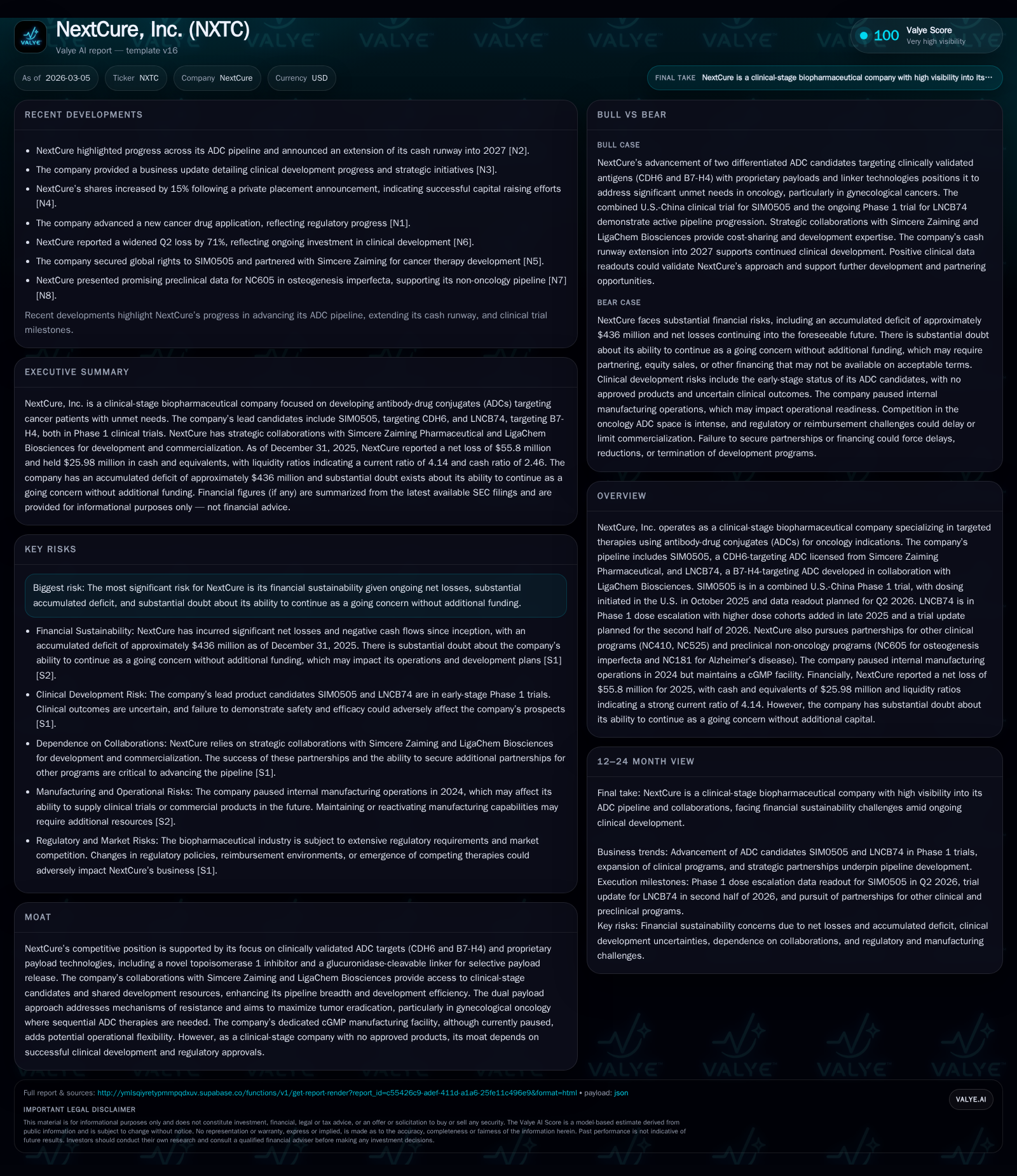
NextCure, Inc., a clinical-stage biopharmaceutical company focused on antibody-drug conjugates (ADCs) for oncology, is advancing Phase 1 trials for its lead candidates SIM0505 and LNCB74 with expected data readouts in 2026. The company reported consistent net losses around $56 million annually and an accumulated deficit exceeding $436 million as of FY2025, reflecting continued investment in R&D without commercial revenues. Cash and equivalents stood at approximately $26 million at year-end 2025, supporting operational runway into 2027 through cost controls and financing efforts. Strategic collaborations with Simcere Zaiming Pharmaceutical and LigaChem Biosciences broaden NextCure's pipeline while internal manufacturing was paused to conserve capital. Significant risks include ongoing intellectual property litigation involving senior management and regulatory compliance complexities that could impact commercialization timelines and funding access.
Historical Financial Overview
NextCure has operated as a clinical-stage biopharmaceutical company focused on developing targeted oncology therapies primarily through antibody-drug conjugates (ADCs). The company has experienced consistent operating losses due to significant investments in research, clinical development, and infrastructure without generating product revenues.
From fiscal year (FY) 2022 through FY2025, NextCure's operating income improved slightly from -$75.9 million to -$57.6 million, representing a year-over-year improvement of approximately 3.6% as of FY2025 [F1]. Net income remained relatively stable near -$56 million annually during this period, culminating in an accumulated deficit of approximately $436 million by the end of FY2025 [F1; S1].
Operating cash flows worsened by over 21% year-over-year to nearly -$49.6 million in FY2025 despite flat capital expenditures around $474,000, reflecting deliberate capex restraint consistent with the pause of internal manufacturing operations since 2024 [F1; S1]. The company's liquidity remains strong in the short term with a current ratio above 4.1x at December 31, 2025, though returns on equity are negative at approximately -160%, typical for pre-commercial biotech enterprises reliant on external funding [F1].
Historical performance (annual)
| FY | Net ($mm) | CFO ($mm) | OpInc ($mm) | Capex ($mm) | Net YoY |
|---|---|---|---|---|---|
| 2025 | -56 | -50 | -58 | 0 | -0.3% |
| 2024 | -56 | -41 | -60 | 0 | +11.3% |
| 2023 | -63 | -53 | -68 | 1 | +16.1% |
| 2022 | -75 | -54 | -76 | 2 |
Source: SEC companyfacts cache [F1].
Capital returns and efficiency (annual)
| FY | FCF ($mm) | ROE% |
|---|---|---|
| 2025 | -50 | -159.8 |
| 2024 | -41 | -85.0 |
| 2023 | -54 | -54.8 |
| 2022 | -56 | -44.6 |
Source: SEC companyfacts cache [F1].
Table: NextCure Historical Financial Performance Summary (FY2022-FY2025) [F1]
Clinical Pipeline Progress
NextCure's pipeline centers on ADCs designed to selectively target tumor antigens while minimizing systemic toxicity.
SIM0505: This lead candidate targets cadherin-6 (CDH6), using a proprietary topoisomerase I inhibitor payload licensed from Simcere Zaiming Pharmaceutical. Preclinical models have demonstrated robust antitumor activity with favorable safety profiles. Phase 1 dose escalation studies are ongoing both in China and the United States following FDA IND transfer approval to NextCure in mid-2025. The first patient was dosed in October 2025 with interim Phase 1 data expected in Q2 of 2026 [S1; N1; N3].
LNCB74: Targeting the immune checkpoint protein B7-H4 prevalent across multiple solid tumors including breast and gynecological cancers. This candidate is advancing through dose escalation phases supported by collaboration with LigaChem Biosciences. Preclinical data indicate promising efficacy and safety profiles. Trial updates are anticipated during the second half of 2026 [S1; N3].
These programs exemplify NextCure’s focus on leveraging biological pathways and tumor microenvironment interactions to develop next-generation ADC therapies.
Strategic Collaborations and Manufacturing Approach
NextCure holds an exclusive worldwide license for SIM0505 from Simcere Zaiming excluding Greater China markets (China mainland plus Hong Kong, Macau, Taiwan). This geographic segmentation allows specialized regional development strategies [S1].
Collaboration with LigaChem Biosciences enhances resource sharing for LNCB74's development including research capabilities and manufacturing technologies [N3].
The company paused internal current Good Manufacturing Practice (cGMP) manufacturing operations starting in 2024 as a cost-containment measure while maintaining facility readiness for potential future scale-up if clinical progress warrants [F1; S1]. This shift reduces fixed costs but introduces reliance on external contract manufacturers.
Upcoming Milestones and Regulatory Developments
Key near-term catalysts include:
- Interim Phase 1 dose escalation results for SIM0505 expected Q2 2026.
- Dose escalation updates for LNCB74 anticipated H2 2026.
- Progress related to new cancer drug applications indicating ongoing regulatory interactions aiming toward accelerated approvals or expanded clinical programs [N2; N3].
These milestones will be critical in validating NextCure’s clinical hypotheses and influencing future financing or partnership opportunities.
Financial Position and Capital Allocation
As of December 31, 2025, NextCure held approximately $26 million in cash and equivalents against current liabilities just over $10 million resulting in a strong current ratio of about 4.14x supporting short-term liquidity needs [F1]. However, negative free cash flow approximated $50 million in FY2025 due to persistent operating cash outflows exceeding minimal capital expenditures (~$474K), underscoring ongoing funding requirements typical for clinical-stage biopharma companies [F1].
Management acknowledges substantial doubt regarding the company's ability to continue as a going concern without securing additional capital through equity raises or partnerships within the near term [S2]. Cost reduction initiatives and selective collaborations partially mitigate funding pressures but do not obviate the need for significant new financing to sustain operations beyond current projections.
Risks: Litigation and Regulatory Environment
NextCure faces material risks including ongoing intellectual property litigation implicating its CEO as co-defendant related to alleged misappropriation claims predating company formation which could result in financial liabilities or loss of proprietary rights impacting R&D continuity [S4; S5].
Regulatory challenges encompass strict FDA controls on promotional activities before product approval limiting market education efforts during critical commercial preparation phases [S6; S10], alongside compliance demands under healthcare fraud and abuse regulations that may increase operational complexity and costs during late-stage development and commercialization planning .
Patent enforcement uncertainties domestically and internationally add further risk around exclusivity protections essential for future competitive positioning and revenue generation [S19]. Additionally, evolving healthcare policies affecting reimbursement rates could impact long-term commercial viability.
Conclusion: Monitoring Key Developments Beyond 2026
Investors should closely observe:
- The quality and implications of SIM0505 Phase 1 interim data expected mid-2026.
- Safety and efficacy signals emerging from LNCB74 dose escalation cohorts later in the year.
- Progression of regulatory filings including any feedback impacting study designs or approval timelines.
- Balance sheet evolution reflecting capital raises under potentially challenging market conditions.
- Outcomes of intellectual property litigation affecting corporate governance stability.
Overall financial sustainability depends heavily on successful clinical validation events triggering subsequent funding rounds while managing legal exposures and regulatory compliance demands.
This analysis is based exclusively on publicly available information including SEC filings ([S1],[S2],[S3]) and company news releases ([N1],[N2],[N3]) as well as validated financial data ([F1]) current through March 5th, 2026.
Disclaimer: This is research-only, informational analysis and not investment advice. It may include AI-generated interpretation and general industry context. Always verify important details using primary sources.

Comments