
Nexentis Technologies: Strategic Diversification Meets Capital Constraints in Energy Storage and Biotech
Nexentis Technologies Inc. is pursuing an ambitious dual-pronged strategy—expanding European battery energy storage assets while acquiring a cancer therapeutics platform—underpinned by recent net income and reported liquidity position, but shadowed by ongoing operating losses, a going-concern warning, and the need for fresh capital to sustain and scale its vision.
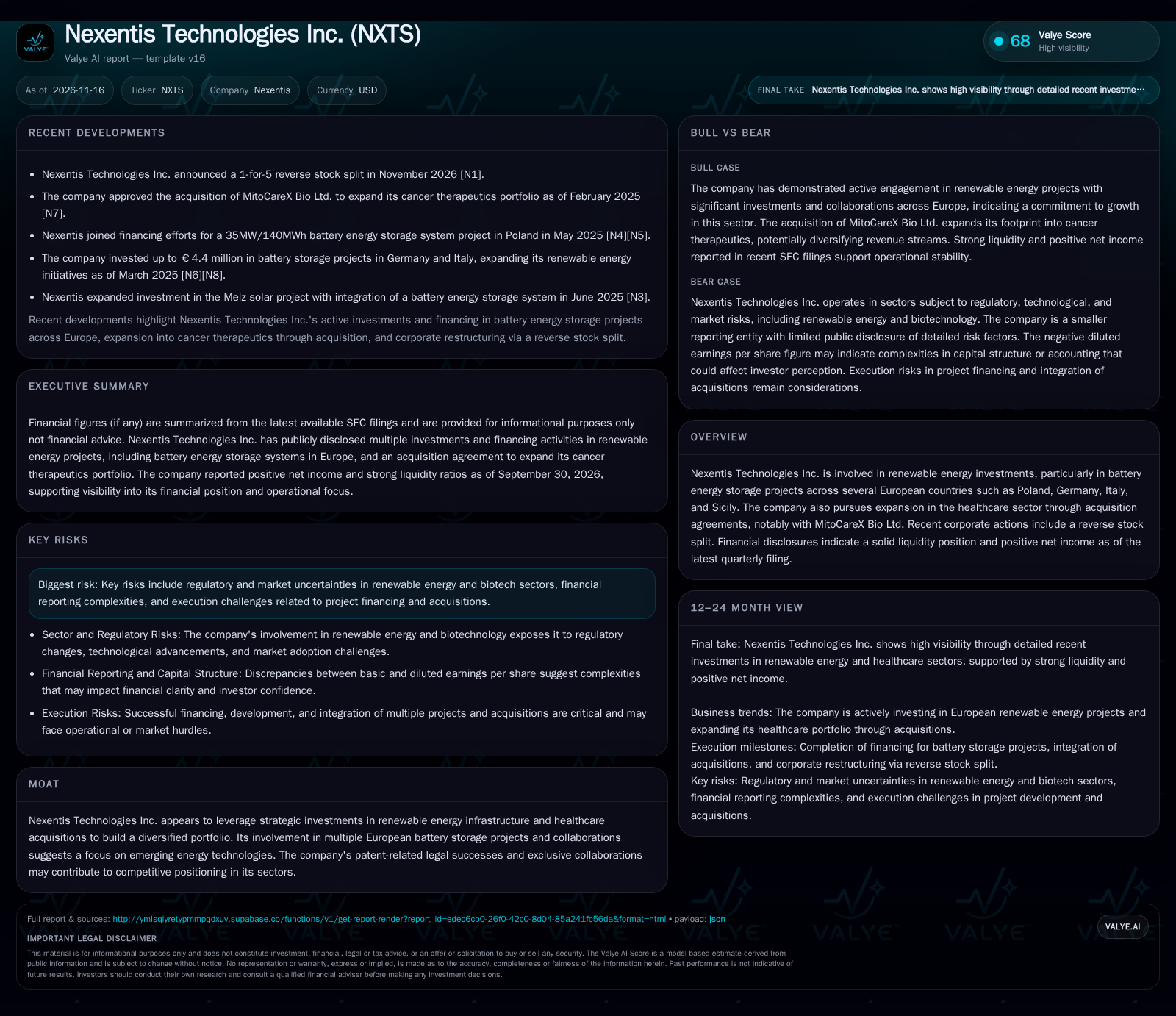
Nexentis Technologies reports positive net income and reported liquidity position, but faces substantial doubt about its ability to continue as a going concern due to persistent operating losses, heavy investment outflows, and reliance on external financing. Its expansion into European battery storage and biotech via the MitoCareX acquisition diversifies potential revenue streams, but execution risk and capital needs are high.
Nexentis Technologies Inc. is at a strategic crossroads, aggressively investing in European battery energy storage projects and expanding into cancer therapeutics through the acquisition of MitoCareX Bio Ltd. Nexentis’ ability to raise new funds and successfully execute on both fronts—energy and biotech—will determine whether its diversification delivers lasting value or exposes it to heightened risk.
Recent Moves: Expansion, Acquisition, and a Stark Liquidity Warning
Nexentis Technologies has recently invested up to €4.4 million in battery energy storage projects across Germany and Italy, and has signed exclusive collaborations for renewables in Albania, signaling an assertive expansion in the European energy storage market. Concurrently, the company has entered an agreement to acquire MitoCareX Bio Ltd., a move that extends its reach into the cancer therapeutics sector and introduces new R&D and commercialization challenges. Financially, Nexentis reported net income of $5.029 million and a current ratio of 3.9 as of September 30, 2026, with cash and equivalents of $2.837 million. However, the company’s own filings underscore a critical vulnerability: management has raised substantial doubt about its ability to continue as a going concern due to ongoing operating losses, a $51.3 million accumulated deficit, and the expectation that existing capital resources will not suffice for the next twelve months. This tension between recent financial visibility and looming capital scarcity is now central to the Nexentis investment thesis [S1].
How Nexentis’ Portfolio Strategy Could Generate Value—And Where It Burns Cash
Nexentis’ business model hinges on two high-potential, capital-intensive sectors: battery energy storage and biotechnology. In energy storage, value creation depends on the company’s ability to finance, develop, and operate grid-scale battery assets—likely monetized through a mix of capacity payments, grid services, and potentially energy trading, contingent on market structure and regulatory frameworks in each geography. Upfront capital expenditures are high, with project payback and returns sensitive to utilization rates, regulatory incentives, and power market volatility. Successful project execution could unlock operating leverage as fixed costs are spread over larger asset bases, but underperformance or delays can quickly erode margins.
The MitoCareX Bio acquisition adds a biotech growth vector, with prospective value driven by successful R&D, regulatory approvals, and eventual commercialization of cancer therapeutics. However, this segment is typically cash-consuming for years before any revenue materializes, and carries high scientific and regulatory risk. The company’s recent negative operating cash flow ($3.186 million used in nine months) illustrates the cash burn required to support both R&D and early-stage infrastructure buildout, a dynamic that will likely persist or intensify absent major revenue breakthroughs or asset monetizations [S1].
Given the company’s stated need for additional capital, future dilution or debt may be necessary, with potential impacts on existing shareholder value. If capital markets are inaccessible or terms unfavorable, Nexentis may be forced to scale back projects or delay R&D, materially altering its economics.
Navigating Crowded Fields: Energy Storage and Oncology Drug Development
In the European battery energy storage market, Nexentis faces entrenched competition from global energy majors, renewable project developers, and infrastructure funds, all vying for attractive grid service contracts and regulatory incentives. Scale, access to low-cost capital, and local market expertise are critical differentiators. Exclusive collaborations in Albania and investments in Germany and Italy could provide early-mover advantages, but the durability of these positions will hinge on execution, regulatory support, and the ability to secure grid access and long-term contracts.
The cancer therapeutics segment via MitoCareX Bio is even more competitive. Success here depends on differentiated science, intellectual property protection, and the ability to navigate lengthy clinical and regulatory pathways. Larger pharmaceutical incumbents, well-funded biotech peers, and academic spinouts all compete for breakthroughs and partnership opportunities. Nexentis’ diversification could reduce portfolio risk, but also exposes it to the pitfalls of spreading limited capital and managerial bandwidth across two highly demanding sectors.
Unlocking Value: If Capital Flows and Execution Align
The positive scenario for Nexentis is predicated on its ability to secure sufficient capital to fully fund its portfolio of battery storage projects and the integration and development of MitoCareX Bio’s pipeline. If the company successfully completes project financings, secures long-term grid contracts in Europe, and achieves key R&D milestones in oncology, it could establish recurring cash flows from energy assets while capturing upside from biotech value inflection points (e.g., successful clinical trials or licensing deals).
Evidence that would confirm this trajectory includes announcements of completed project financings, regulatory approvals or offtake agreements for energy assets, and positive clinical or partnership updates from MitoCareX. Accelerating revenue, reduced operating cash burn, and sustained positive net income would further validate the case for operating leverage and value creation. Falsification would come from a failure to close necessary financings, material project delays, clinical trial setbacks, or continued heavy cash burn without corresponding funding inflows.
Balancing Ambition with Scarcity: The Most Likely Outcome
The most plausible path for Nexentis is a period of constrained progress, marked by incremental advances in energy storage deployment and early-stage biotech development, but paced by the availability and cost of external capital. The company may secure some project-level or corporate financing, but likely at terms that reflect its risk profile and going-concern status—implying shareholder dilution or restrictive covenants. Energy projects could gradually come online, generating modest revenues, while the biotech portfolio progresses through preclinical or early clinical stages, consuming cash.
Operational milestones may be met, but at a slower or smaller scale than originally envisioned. Financially, the company may oscillate between periods of positive and negative net income as project timing and investment cycles play out. Confirmation of this scenario would be visible in mixed quarterly results: some new financings, modest revenue growth, continued but declining cash burn, and interim R&D or project updates. Falsification would hinge on either a decisive capital raise enabling rapid expansion (tilting toward the upside) or acute capital scarcity forcing asset sales or retrenchment (tilting toward the downside).
When Capital Runs Out: Dilution, Delay, or Forced Retrenchment
The adverse scenario materializes if Nexentis is unsuccessful in raising additional capital on acceptable terms, leading to a forced reduction in project scope, delayed or cancelled development milestones, and potential asset sales or wind-downs. With management explicitly warning of insufficient capital for the next twelve months and persistent operating losses, the risk of near-term dilution or creditor intervention is acute. In the biotech segment, inability to fund clinical development could stall or abandon promising programs, eroding any strategic value from the MitoCareX acquisition.
Confirmation of this scenario would include failure to announce new financings, project delays or cancellations, layoffs, or disclosures of asset sales or strategic alternatives. A sharp increase in shareholder dilution or the emergence of going-concern qualifiers in future filings would further reinforce the downside thesis.
Testing the Nexentis Thesis: Funding, Execution, and Portfolio Progress
Announcements or SEC filings disclosing new project or corporate financings, including amount, terms, and dilution impact.
Updates on the operational status or commercial arrangements for European battery storage projects—such as grid connections, regulatory approvals, or revenue-generating contracts.
Progress reports or clinical data releases from the MitoCareX Bio oncology pipeline, if disclosed.
Quarterly trends in operating cash flow and net income, especially evidence of narrowing cash burn or sustainable profitability.
Changes in management commentary or auditor language regarding going-concern status in future filings.
Any strategic reviews, asset sales, or partnership announcements that could signal changes in business model or capital allocation priorities.
Market or regulatory developments in key European energy markets (e.g., subsidy changes, grid access policies) that could alter project economics.
Disclaimer: This is research-only, informational analysis and not investment advice. It may include AI-generated interpretation and general industry context. Always verify important details using primary sources.

Comments