
NEXTNRG’s Liquidity Crunch: Can Integrated Energy Solutions Outrun the Clock?
NEXTNRG, INC. faces urgent capital needs and a going-concern warning, even as it pursues growth through healthcare microgrids and mobile fuel delivery. The company’s future hinges on securing financing and executing a pivot to higher-value smart energy infrastructure in a market fraught with competition, regulatory flux, and operational hazards.
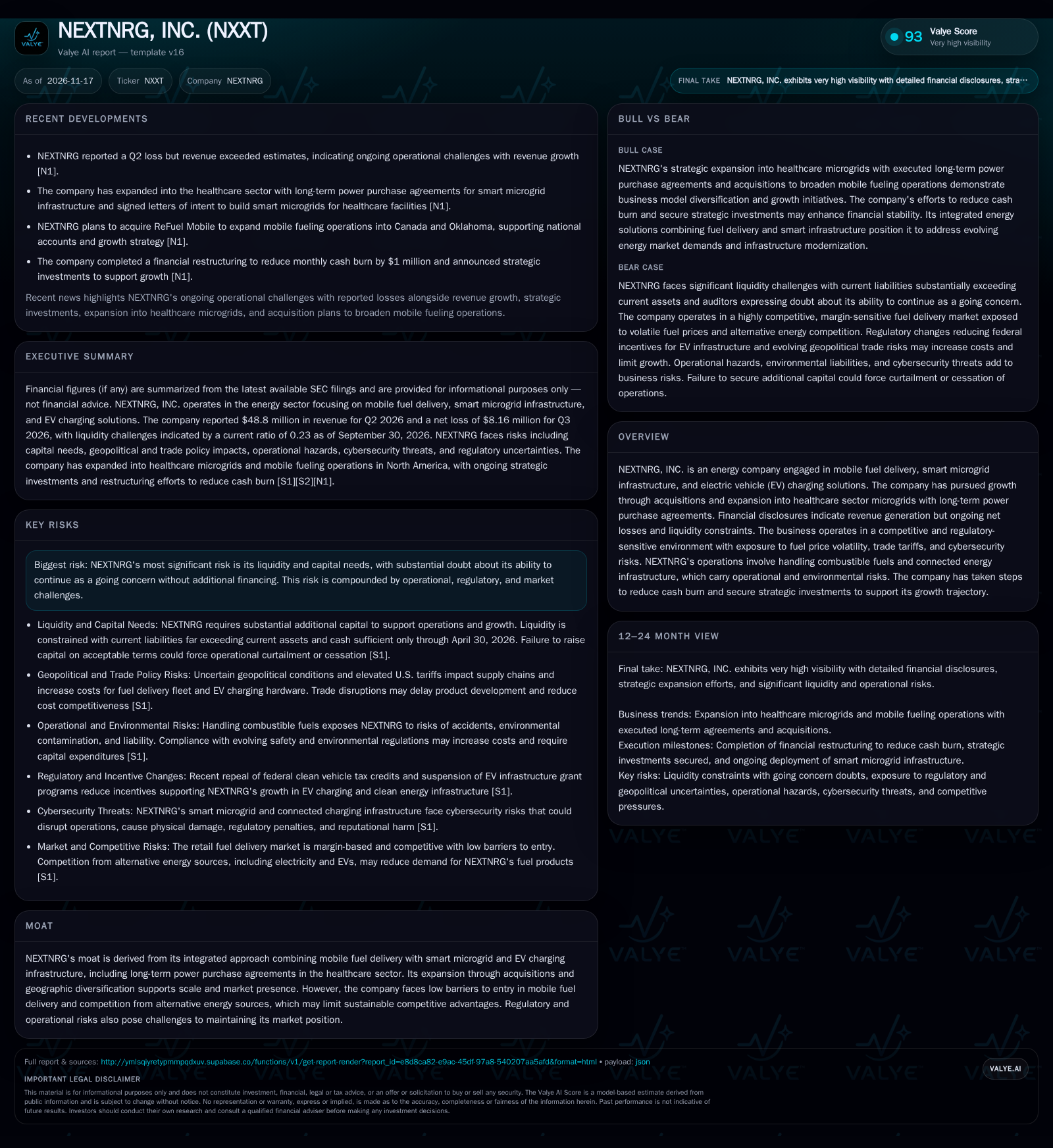
NEXTNRG, INC. reported $48.8M in quarterly revenue but remains deeply unprofitable with a net loss of $8.16M and a current ratio of just 0.23 as of September 30, 2026. Auditors have flagged substantial doubt about its ability to continue as a going concern without new capital. The company’s expansion into healthcare microgrids and smart EV charging could diversify revenue, but execution risk is high given the need for urgent financing and exposure to fuel price volatility, competitive pressures, and regulatory uncertainty [S1] [S2].
NEXTNRG, INC. sits at a strategic crossroads. With current liabilities dwarfing current assets, auditors have cast doubt on its survival past April 2026 unless fresh capital is secured. This tension between ambition and solvency defines NEXTNRG’s near-term outlook: can the company bridge its capital gap fast enough to realize the promise of integrated, smart energy solutions in a highly competitive and rapidly changing sector?
Liquidity Crisis and Strategic Expansion: NEXTNRG’s Present Reality
NEXTNRG, INC. reported $48.8 million in revenue for the quarter ended June 30, 2026, but remains unprofitable, posting a net loss of $8.16 million for the quarter ended September 30, 2026. [S2] Auditors have included an explanatory paragraph in recent filings, flagging substantial doubt about NEXTNRG’s ability to continue as a going concern unless it raises additional capital. Management has disclosed that existing liquidity is expected to last only through April 2026 [S1]. These facts underscore the urgency of NEXTNRG’s capital needs and cast a shadow over its ongoing expansion into healthcare microgrids and mobile fuel delivery operations.
How NEXTNRG’s Revenue Model Interacts with Capital Constraints
NEXTNRG’s business model spans three main segments: mobile fuel delivery, smart microgrid infrastructure, and EV charging solutions. Mobile fuel delivery is typically a volume-driven, low-margin business, highly sensitive to fluctuations in wholesale fuel prices and operational costs. The economics hinge on route density, fuel procurement terms, and the ability to pass through volatile input prices to customers—a challenge in competitive, commoditized markets.
The push into smart microgrids and EV charging aims to capture higher-margin, recurring revenue streams, especially through long-term power purchase agreements (PPAs) with institutional clients such as healthcare facilities. These agreements could provide predictable cash flows and help smooth the volatility inherent in fuel delivery. However, such infrastructure projects are capital-intensive, requiring upfront investment in hardware, permitting, and integration, which strains liquidity further in the near term.
NEXTNRG’s ability to realize operating leverage depends on scaling its smart infrastructure base while managing the fixed cost burden of its fleet and technology operations. Without external financing, NEXTNRG’s business model may remain trapped in a cycle of unprofitability and underinvestment [S1] [S2].
Competitive Dynamics: Low Barriers, Rising Alternatives, and Regulatory Flux
NEXTNRG faces a challenging competitive landscape. The mobile fuel delivery segment is characterized by low barriers to entry and intense price competition, with numerous regional and national players vying for market share. Margins are thin, and differentiation is often limited to service reliability and geographic coverage.
The company’s move toward integrated microgrid and EV charging solutions brings it into competition with specialized energy infrastructure firms, utility-backed platform providers, and technology-driven entrants focused on electrification. These competitors may benefit from stronger balance sheets, established customer relationships, and access to lower-cost capital.
Substitution risks are acute: as fleet electrification accelerates and distributed energy solutions gain traction, traditional fuel delivery faces secular decline. Regulatory changes—such as the recent repeal of federal clean vehicle tax credits and grant suspensions—can alter the competitive balance almost overnight, impacting both demand and the cost structure for NEXTNRG’s offerings [S1].
Additionally, NEXTNRG’s reliance on a limited number of fuel suppliers increases supply chain risk, while operational hazards and cybersecurity vulnerabilities could erode customer trust and brand equity if not proactively managed.
What Could Unlock Value: Secured Financing, Execution on Microgrids, and Regulatory Tailwinds
A favorable outcome for NEXTNRG hinges on three interlocking developments. Second, successful execution on healthcare microgrid deployments and associated long-term PPAs could establish a stable, recurring revenue base, reducing exposure to fuel price swings and providing a platform for further smart infrastructure expansion.
If macro conditions stabilize and federal/state incentives for EV charging and distributed energy are reinstated or expanded, NEXTNRG could benefit from improved project economics and customer demand. A meaningful reduction in cash burn, visible project milestones (such as new microgrid go-lives or major customer signings), and evidence of improved gross margins on smart infrastructure projects would help confirm this upside scenario.
Falsification would occur if funding efforts fail, project deployments stall, or regulatory support continues to erode—leaving NEXTNRG unable to shift its revenue mix or escape the drag of unprofitable fuel delivery.
Survival Versus Growth: The Most Likely Short-Term Trajectory
The most plausible near-term outcome is a period of financial triage. NEXTNRG will likely prioritize cash preservation—slowing expansion, deferring capital expenditures, and focusing on core customers—while seeking emergency financing to avoid insolvency. Revenue may remain flat or decline modestly as competitive and regulatory pressures persist, and the company’s cost structure remains elevated due to its mixed business model.
Operational progress on microgrid projects may be incremental, with timelines stretched by financing and permitting constraints. The mobile fuel delivery business could continue to generate cash but with limited margin improvement, leaving NEXTNRG dependent on external capital to fund its infrastructure ambitions.
Confirmation of this scenario would include bridge financings, asset sales, or restructuring activity, as well as continued auditor going-concern language. Falsification would occur if NEXTNRG rapidly closes a substantial funding round and demonstrates clear operational momentum in higher-margin segments.
Liquidity Exhaustion and Forced Retrenchment: How NEXTNRG Could Unwind
If NEXTNRG is unable to secure additional capital by April 2026, the company faces a high likelihood of operational curtailment or even bankruptcy proceedings. Acute liquidity stress could force management to halt expansion, lay off staff, and sell off assets at distressed valuations. Core operations, especially those with ongoing environmental or regulatory liabilities, could be wound down in a disorderly fashion.
In this scenario, customer and supplier relationships would likely deteriorate, further constraining cash flow and eroding any remaining strategic value. Regulatory setbacks, such as additional cuts to clean energy incentives or new compliance costs, could accelerate the decline. Confirmation would come in the form of missed payroll, default notices, or formal restructuring filings.
Milestones That Will Define NEXTNRG’s Pivot from Distress to Viability
Announcement of a completed financing round, strategic investment, or other capital-raising event sufficient to address the company’s April 2026 liquidity deadline.
Execution and public disclosure of new or expanded long-term power purchase agreements in the healthcare or institutional sector.
Evidence of significant progress or completion of smart microgrid infrastructure projects, including go-live dates and initial revenue recognition.
Gross margin trends in both the legacy mobile fuel delivery segment and new infrastructure deployments—improvement would signal operating leverage.
Any further auditor commentary or SEC filing language regarding going-concern status, especially if it shifts to a more positive or neutral tone.
Updates on regulatory policy, including the reinstatement or expansion of federal/state incentives for EV charging or distributed energy infrastructure.
Disclosure of cybersecurity incidents, environmental liabilities, or supply chain disruptions, as these could materially impact reputation and cash flow.
A useful metric would be customer concentration and churn rates in both mobile fueling and microgrid segments, if disclosed.
Disclaimer: This is research-only, informational analysis and not investment advice. It may include AI-generated interpretation and general industry context. Always verify important details using primary sources.

Comments