
Oxley Bridge Acquisition Reveals Early Path Toward Business Combination with New Quarterly Update
The May 2026 quarterly filing confirms Oxley Bridge Acquisition Ltd’s solid liquidity and ongoing target search ahead of its mid-2027 combination deadline.
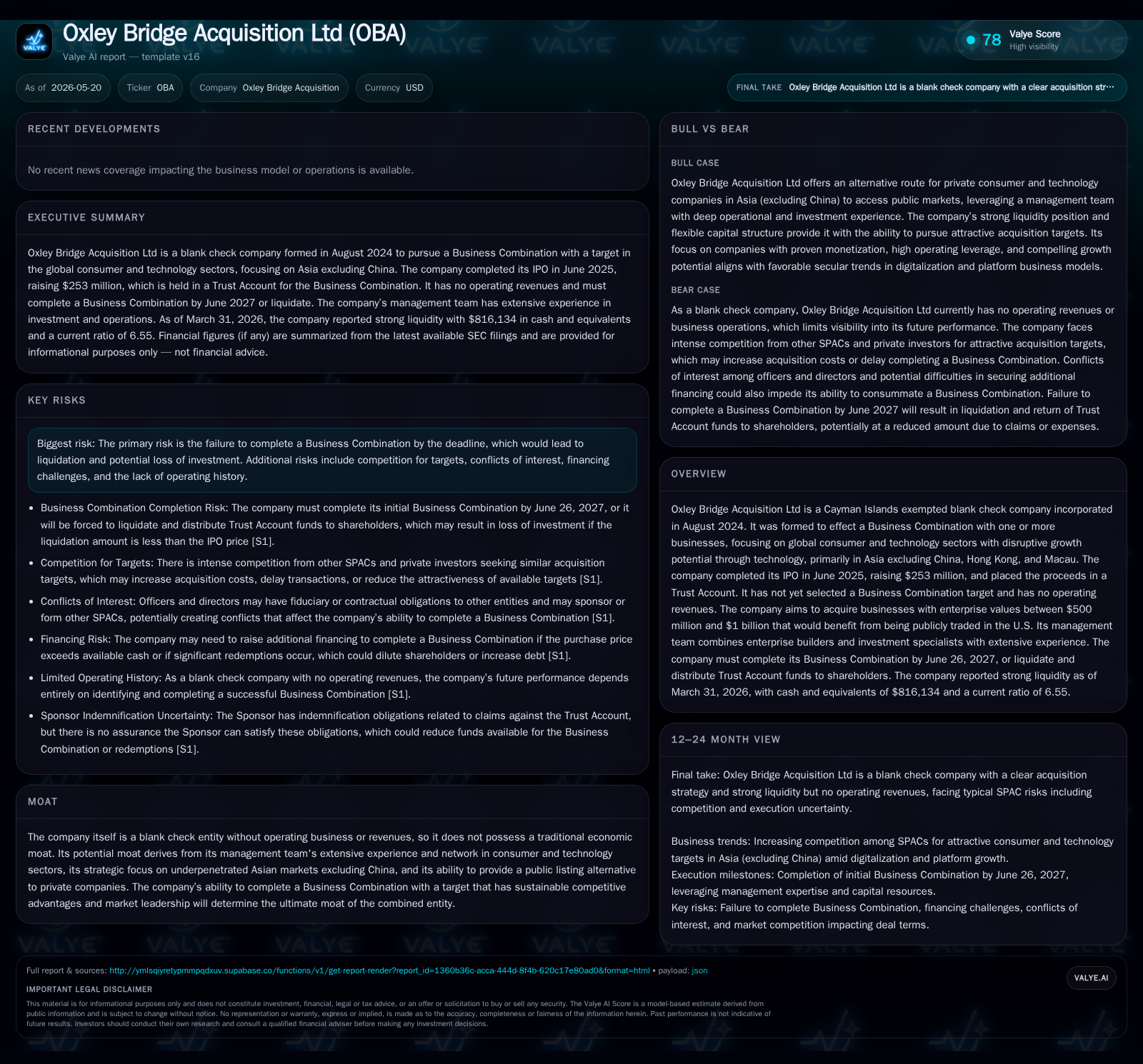
Oxley Bridge Acquisition Ltd (OBA) remains a blank check entity focused on identifying a market-ready consumer or technology company outside China for a business combination. Its May 2026 quarter filing reveals no operational revenues but a robust cash position with a current ratio above 6, underscoring strong liquidity for deal execution. The company targets mid-sized firms valued between $500 million and $1 billion operating in underpenetrated Asian markets excluding China, leveraging a management team experienced in public/private markets. Competitive pressures and timing risk persist as critical constraints before the June 2027 business combination deadline.
Latest Quarterly Filing and Operational Status
Oxley Bridge Acquisition Ltd’s latest Form 10-Q filed May 19, 2026 ([S2]) maintains its status as a non-operating blank check company. No business combination target has been announced or selected yet, nor has the company generated any operating revenue. The filing confirms the company's financial position remains secure with cash held in a Trust Account earmarked exclusively for its inaugural business combination. With a current ratio of approximately 6.55 at March 31, 2026 ([F1]), Oxley Bridge exhibits ample liquidity against minimal current liabilities, indicating solid readiness to pursue transaction opportunities within its timeframe. This stability is critical given the fixed business combination deadline of June 26, 2027.
Blank Check Model and Capital Structure
Incorporated as a Cayman Islands exempted company in August 2024 ([S1]), Oxley Bridge is structured as a Special Purpose Acquisition Company (SPAC). It raised $253 million net proceeds through an IPO completed in June 2025 ([S1]), placing these funds along with $6.4 million from private placement warrants into a U.S.-based trust account held by Continental Stock Transfer & Trust Company ([S27]). Each unit sold consisted of one Class A ordinary share plus one-half of one redeemable warrant exercisable at $11.50 per share, establishing potential future dilution from warrant exercises. The Sponsor holds Founder shares and private placement warrants that may dilute public shareholders upon exercise or conversion although this dynamic is standard across SPACs.
The governance framework vests final authority over the initial Business Combination with the Sponsor and management team who combine enterprise building acumen with seasoned investment backgrounds ([S24]). This enables them to provide deal optionality through equity or cash consideration, balancing target preferences for liquidity events, capital for expansion, or deleveraging balance sheets.
Target Market Focus and Business Model Criteria
Oxley Bridge directs its search toward global consumer and technology businesses leveraging innovative technologies primarily serving Asian markets outside mainland China, Hong Kong, and Macau ([S9], [S1]). The strategy excludes China due to regulatory complexities and competitive saturation.
The management team seeks targets sized between roughly $500 million to $1 billion enterprise value possessing compelling unit economics characterized by scalable operations, substantial recurring revenue components, and attractive customer lifetime values relative to acquisition costs ([S17]). These criteria aim to identify businesses with clear paths to profitability supported by operational leverage.
The target companies should be "public market ready," encompassing mature governance structures and proven management teams capable of navigating U.S. regulatory compliance post-merger ([S17]). By providing an alternative route to public listing beyond traditional IPOs—typically fraught with higher costs and longer timelines—the SPAC model underpins Oxley Bridge’s thesis of delivering value through strategic partnerships in less penetrated ecosystems ([S18]).
Competitive and Industry Context for SPACs in Consumer-Tech Asia Ex-China
The broader industry environment presents challenges centered on intense competition among SPACs, private equity firms, strategic buyers, and traditional IPO routes competing for quality consumer-tech companies exhibiting high growth potential outside China ([S17], [S20]).
Oxley Bridge faces rivalry not only from other blank check firms but also from operating companies seeking strategic acquisitions in these sectors. Moreover, only businesses able to prepare audited financial statements compliant with SEC proxy rules within required timelines qualify as feasible targets—limiting the addressable universe somewhat ([S10]).
The emphasis on Asia ex-China reflects both untapped economic opportunity driven by digitization trends and relatively lighter regulatory burdens compared to mainland China. However, navigating cross-border considerations such as tax implications under Cayman Islands incorporation status adds complexity ([S25]).
Key Growth Drivers for Successful Business Combination Execution
Primary growth enablers revolve around fast identification of an appropriately sized, financially mature target that aligns with the SPAC’s thematic focus ([S5]). Management’s extensive network across venture capital, private equity, and public markets is expected to yield a strong pipeline of vetted opportunities demonstrating sustainable competitive advantages.
Strategic flexibility in deal structuring—employing combinations of cash from trust accounts plus equity or debt securities tailored to seller preferences—increases transaction viability ([S4]). Post-combination support leveraging operational expertise aims at accelerating scale through enhanced capital access, acquisitions, geographic expansion, or product innovation ([S24]).
These drivers collectively improve prospects of assembling a public entity that can capitalize on digitization trends fueling demand for uniquely positioned consumer and technology offerings within large underpenetrated markets outside China ([S24]).
Risks and Constraints Unique to OBA's Strategy and Timeline
The most salient risk remains failure to consummate a suitable business combination by the statutory June 26, 2027 deadline necessitating liquidation of the SPAC trust account at near-IPO price levels—a scenario implying material losses due to foregone upside participation ([S2], [S1]).
Competition among numerous SPAC sponsors targeting similar sectors inflates price expectations at deal tables while scarcity of truly "public market ready" companies adds sourcing pressure ([S17]). Potential dilution effects stemming from sponsor warrants or future fundraising rounds could impact investor returns if additional capital is needed beyond the trust account balance ([S28], [S4]). Lack of operating history requires investor patience as value realization hinges entirely on successful acquisition execution.
Cross-border regulatory nuances intrinsic to Cayman Islands exempted entities combined with varying accounting standards among potential targets could introduce transaction timelines' uncertainties or compliance costs factoring into deal feasibility ([S10], [S25]).
Milestones and Future Event Watchpoints
Critical forthcoming developments include official announcements identifying prospective business combination targets followed by SEC filings such as proxy statements detailing transaction terms intended for shareholder approval processes ([S1], [S5]). The availability of audited financial statements conforming to U.S. GAAP or IFRS will be pivotal in advancing merger timelines alongside any proposed financing arrangements necessary if transaction sizing exceeds trust account balances or shareholder redemptions occur.
Tracking progress toward securing shareholder votes prior to the mid-2027 deadline will be essential markers signaling execution momentum alongside monitoring any amendments extending business combination windows.
Concise Financial Position and Liquidity Summary
At fiscal quarter end March 31, 2026, Oxley Bridge reported cash and equivalents approximating $816 million alongside total current assets near $962 thousand versus minimal current liabilities around $147 thousand yielding a current ratio exceeding 6.5—a robust liquidity profile commensurate with funding first-time acquisitions without immediate operational expenses impacting capital availability ([F1]). This cash pool is sourced primarily from the IPO proceeds held securely in trustee accounts pending investment deployment.
Operating expenses remain nominal consistent with blank check status; no revenues have been realized as anticipated before consummation of an initial business combination. Net income figures reflect non-operational gains rather than core earnings attributable solely to structuring activities ([F1]). This financial posture supports adequate runway duration conducive to disciplined deal sourcing within defined regulatory time constraints.
This analysis is based entirely on publicly available SEC filings up to May 19, 2026. It does not constitute investment advice but aims to provide informed insights into Oxley Bridge Acquisition Ltd’s strategic direction and operational context ahead of its planned initial business combination.
Disclaimer: This is research-only, informational analysis and not investment advice. It may include AI-generated interpretation and general industry context. Always verify important details using primary sources.

Comments