
Our Bond, Inc. Drives Growth Ambitions Amid Heightened Data and Security Demands
The company’s latest quarter reflects operational scaling within an integrated personal security platform under ongoing regulatory and profitability pressures.
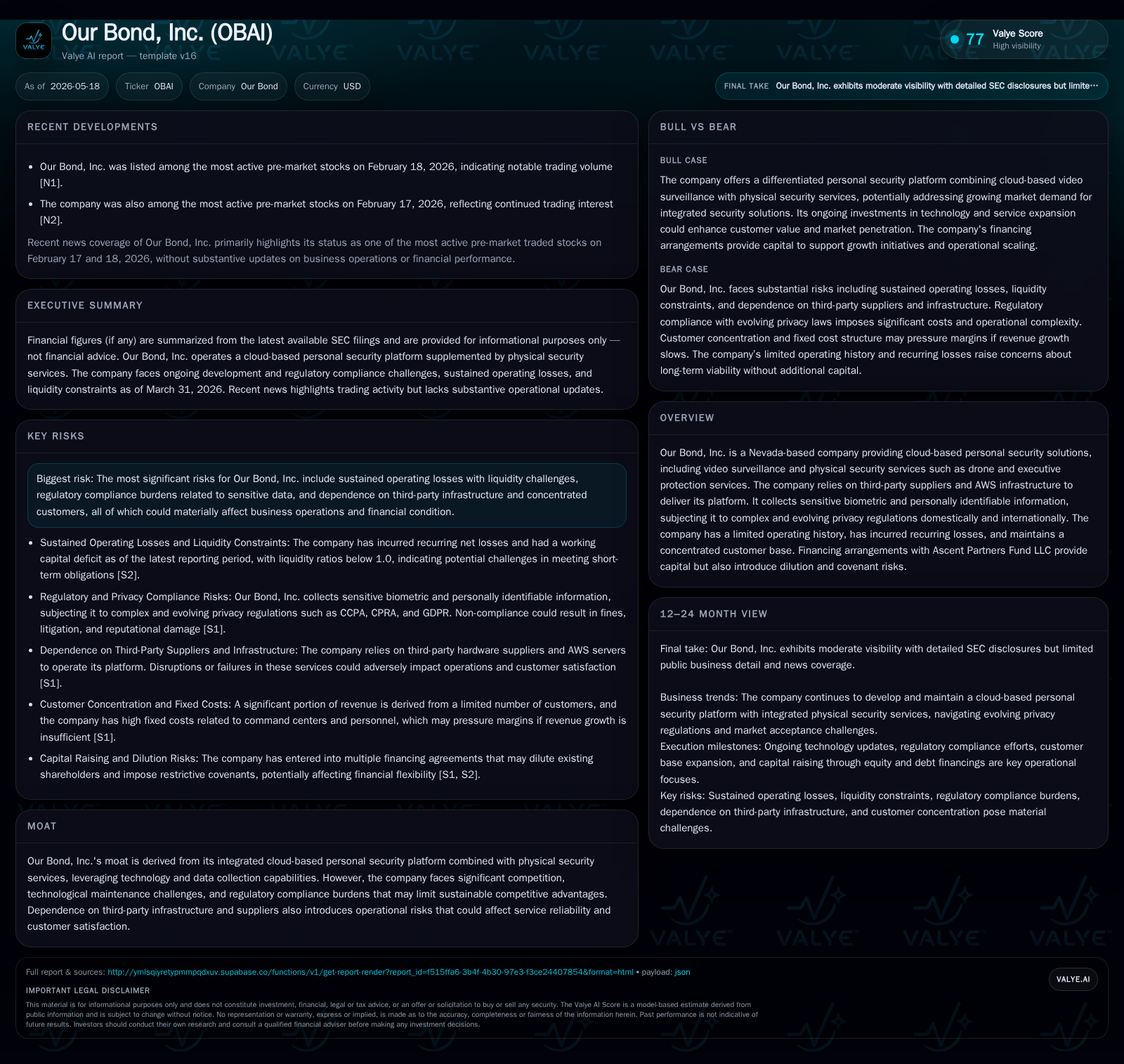
Our Bond, Inc. reported no material changes in risk factors in its Q1 2026 filing but continues to face significant operating losses and working capital challenges. The company’s business model combines a cloud-based personal security platform with physical security services, relying heavily on third-party infrastructure and a concentrated customer base. Regulatory compliance related to biometric data privacy and the costs of maintaining ecosystem compatibility remain central operational demands. While management is investing in expanding command centers and engineering capacity to support growth, fixed costs ahead of revenue ramp present execution risks. Near-term liquidity constraints and potential dilution from additional financing rounds are notable risk factors to monitor.
Latest Quarterly Update Sets the Stage: What Changed in Q1 2026
Our Bond’s Q1 2026 10-Q filing reaffirmed the company’s continuing financial challenges highlighted by sustained operating losses and liquidity constraints with no material changes to previously disclosed risk factors [S2][S13]. The filing underscored a business environment marked by significant fixed cost commitments as the company advances its strategy to scale its integrated personal security platform. Notably, the CEO made an investor-focused media appearance on May 14, 2026 via the “Big Biz Show,” signaling heightened executive emphasis on market visibility amidst ongoing capital market engagement [S3][S17]. While no updated guidance was provided, these events frame near-term expectations: managing fixed expenses during the revenue ramp remains critical.
Business Model Breakdown: Integrated Cloud Security and Physical Services
Our Bond operates an integrated service platform combining cloud-based personal security solutions—primarily video surveillance enabled by biometric technologies—with physical security services such as drone surveillance and executive protection agents deployed onsite [S1]. The revenue model primarily derives from subscription fees for platform access plus contracted fees for physical service engagements. Customers pay for ongoing access to real-time monitoring services supported by backend cloud infrastructure predominantly hosted on Amazon Web Services (AWS). This dependence on AWS alongside multiple third-party suppliers shapes both performance capabilities and operational risk factors.
Fixed costs are substantial due to investments in engineering teams responsible for software maintenance across multiple ecosystems (iOS, Android) alongside command center staffing for physical service delivery.
Technology Platform & Data Privacy: Core Strengths Meet Regulatory Complexities
The company's core technical strength lies in its combined digital-physical approach to personal security leveraging biometric data capture. However, this advantage introduces high operating complexity driven by continuous R&D requirements. The environment mandates frequent platform updates aligning with evolving mobile OS releases (Apple's iOS; Google's Android), cloud infrastructure maintenance (AWS dependency), and compliance mandates covering biometric personally identifiable information (PII) management—a domain tightly regulated under global frameworks such as the European Union's GDPR [S1].
Biometric PII storage and transmission demands robust cybersecurity measures due to exposure to breach risks that could damage reputation and incur liabilities. Our Bond must invest heavily in multidisciplinary engineering disciplines not only for feature development but also for system integrity assurance. These regulatory demands create substantial capital expenditures that are inherently speculative but unavoidable expenses required to keep offerings competitive.
Competitive Environment: Pressure Points from Peers and Infrastructure Dependencies
Our Bond’s market position reflects a challenging interplay between innovative integration capabilities and structural vulnerabilities. The personal security industry encompasses numerous competitors addressing segments of cloud-based monitoring or physical security services separately; Our Bond attempts differentiation through unified offerings. However, this integration also increases operational complexity.
Moreover, dependence on AWS exposes the company to single-vendor risk influencing cost structures and service stability. Maintaining technical compatibility across multiple technology ecosystems necessitates steady investment in experienced engineers—an expense generally higher than pure software or hardware standalone competitors face [S1]. The company's ability to develop sustainable pricing power is mitigated by its relatively concentrated customer base and competitive offerings from larger incumbents or specialized providers. This dynamic weakens any durable moat despite the company's data collection advantages.
Growth Catalysts: Customer Base Expansion and Technology Scaling
Key growth drivers center on broadening the current customer base while scaling service delivery infrastructure such as command centers staffed by trained personnel matched with expanded engineering capacity supporting software evolution [S6]
This strategic play involves up-front fixed costs increasing short-term operating losses but potentially generating economies of scale if market adoption accelerates as planned. Expansion efforts may be measured through booking pipelines or client contract wins in upcoming quarters—metrics not explicitly disclosed but critical indicators to watch.
A successful transition from development-stage operations toward broader commercialization hinges on striking this balance effectively while navigating cost absorption cycles inherent in technology-and-service hybrid models.
Risks to Watch: Losses, Customer Concentration, Regulatory Compliance
Liquidity remains strained with a current ratio below 0.6 at March 31, 2026 ($5.8M current assets vs $10.25M current liabilities) indicating short-term funding pressure absent additional capital inflows [F1]. Operating losses exceeding $10 million annually reflect an entrenched cash-burn profile with uncertain timeline toward profitability [F1][S6].
Customer concentration among two main buyers poses demand risk that could force pricing concessions or reduced purchase volumes if those relationships deteriorate unexpectedly [S4]. Compliance with evolving privacy legislation concerning biometric information imposes ongoing legal and operational risks particularly given potential gaps by third-party vendor controls that could expose the firm despite internal safeguards [S21].
What Investors Should Monitor Next: Milestones and Execution Risks
Upcoming milestones include Q2 2026 operational metrics revealing whether commanded client traction materializes against escalated fixed costs from prior capacity build-out efforts. CEO Doron Kempel's recent media appearance indicates elevated efforts at investor communication which may presage incremental disclosure around client acquisition progress or product upgrades enhancing appeal [S3][S17]. Careful attention should be paid to any updates regarding regulatory developments affecting biometric data usage or announcements concerning infrastructure scaling such as new command centers or expanded engineering headcount.
Execution risks mainly derive from managing costs during scaling phases without corresponding revenue acceleration—failure here would exacerbate liquidity strain compelling more dilutive financing potentially detrimental to shareholder value.
Financial Context: Liquidity, Debt Profile, and Profitability Snapshot
As of March 31, 2026, Our Bond held approximately $3.76 million in cash against total debt nearing $7.44 million yielding net debt around $3.68 million; current liabilities notably surpass current assets leading to a sub-1.0 current ratio (~0.57), underscoring near-term liquidity concerns [F1]. The company sustained net losses just over $10 million in fiscal year ending December 31, 2025 reflecting ongoing investments into operational capacity without yet reaching profitability thresholds [F1][S6].
Financial position in context
As of 2026-03-31, companyfacts shows $3.76 million in cash and equivalents and $7.44 million of total debt with net debt of roughly $3.68 million, keeping balance-sheet context relevant but secondary to the operating story [F1]. Current assets of $5.8 million and current liabilities of $10.25 million imply a current ratio near 0.57x for 2026-03-31 [F1].
This analysis is based solely on publicly available SEC filings through May 18, 2026 and Valye News proprietary sector expertise without offering investment advice or opinion on securities transactions.
Disclaimer: This is research-only, informational analysis and not investment advice. It may include AI-generated interpretation and general industry context. Always verify important details using primary sources.

Comments