
Orion S.A.’s 2025 Earnings Slide Reflects Shifts in Carbon Black Markets and Cost Pressures
A nuanced look at how market dynamics and cost factors have led to profit contraction despite modest volume growth in 2025.
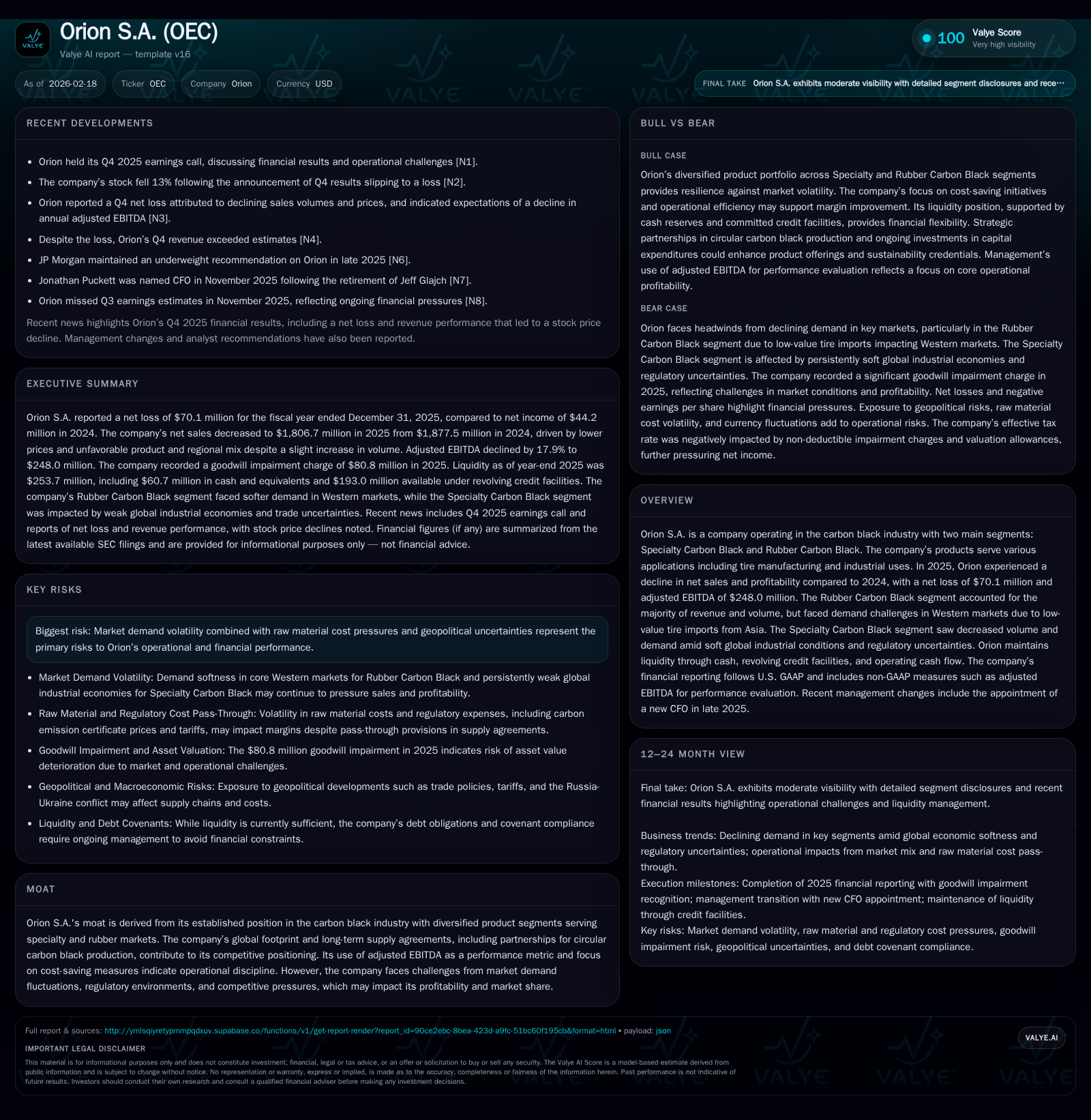
Orion S.A. reported a challenging 2025 marked by marginally higher shipment volumes yet sharply declining profitability. Volume in the Rubber Carbon Black segment grew by 1.5%, offsetting Specialty declines, but net sales fell 3.8%, pressured by lower oil-linked pricing and unfavorable mix effects. An $80.8 million goodwill impairment, driven by competitive Asian tire imports and regulatory uncertainties, compounded margin pressures, resulting in a net loss of $70.1 million despite improved operating cash flow. Liquidity remains stable with ample revolving credit facility capacity, though free cash flow was negative due to elevated capex investments. Future recovery depends on pricing adaptations, trade flow shifts, and innovation in circular carbon black production.
Evolution of Orion’s Sales and Segment Dynamics Through 2025
Historical performance (annual)
| FY | Net ($mm) | CFO ($mm) | OpInc ($mm) | Net YoY |
|---|---|---|---|---|
| 2025 | -70 | 216 | 28 | -258.6% |
| 2024 | 44 | 125 | 103 | -57.3% |
| 2023 | 104 | 346 | 205 | -2.5% |
| 2022 | 106 | 81 | 197 |
Note: Omitted columns lack sufficient annual XBRL coverage in the provided tags (need ≥2 annual points): Rev, Capex, FCF. Source: SEC companyfacts cache [F1].
Capital returns and efficiency (annual)
| FY | Div ($mm) | Buybacks ($mm) | ROE% |
|---|---|---|---|
| 2025 | 5 | 25 | -18.2 |
| 2024 | 5 | 27 | 9.3 |
| 2023 | 5 | 66 | 21.6 |
| 2022 | 5 | 4 | 23.1 |
Source: SEC companyfacts cache [F1].
Orion S.A.’s shipments increased slightly by 1.5% to approximately 948.6 thousand metric tons in 2025 compared to the prior year [F1][S1]. This volume increase was primarily driven by the Rubber Carbon Black segment, partially offset by decreases in the Specialty Carbon Black segment amid muted global industrial demand [S1][N3]. Despite volume gains, net sales declined by 3.8%, falling from $1,877.5 million in 2024 to $1,806.7 million in 2025 [F1][S1]. The decline was mainly due to the pass-through effect of lower oil prices—a key raw material—as well as an unfavorable product and regional mix weighted toward lower-margin products and weaker markets [S1]. Currency effects provided some offset but were insufficient to prevent overall revenue erosion.
The Rubber Carbon Black segment faced competitive pressure from increased low-value tire imports from Asia disrupting Western markets [N5][S1], while the Specialty Carbon Black segment experienced volume contraction due to soft industrial activity and regulatory uncertainties limiting customer investments [S1][N5]. These trends reflect ongoing structural challenges in commodity pricing and geopolitical factors affecting trade.
Margin Compression and Goodwill Impairment Drive Profit Decline
Gross profit decreased by $69.0 million or 16.1%, dropping from $428.8 million in 2024 to $359.8 million in 2025 [F1][S1]. This margin pressure stemmed from adverse product and regional mixes combined with contractual price adjustments lagging changes in raw material costs due to timing differences [S1]. Selling, general & administrative expenses decreased slightly by $7.1 million (3%) owing to cost-saving initiatives but were partly offset by unfavorable foreign exchange impacts [S1].
A significant factor was a non-cash goodwill impairment charge of $80.8 million recorded during Q3 2025 after quantitative tests indicated diminished fair values across both reporting units, triggered primarily by competitive Asian tire imports affecting the Rubber segment and ongoing softness plus regulatory uncertainty impacting Specialty [S1][N1]. This impairment fully eliminated Orion’s goodwill balance.
Operating income plunged over 73% year-over-year from $102.7 million to $27.5 million amid increased interest expense (+26%) related to higher debt levels and currency translation effects [F1][S1]. The company swung to a net loss of $70.1 million versus net income of $44.2 million last year—a dramatic negative swing largely driven by impairment charges, increased tax expense ($35.8 million), and elevated financing costs [F1][S1].
Notably, Orion partially recovered losses related to a criminal misappropriation scheme that impacted customer wire transfers in late 2024; it recouped approximately $9.2 million with reduced professional fees during 2025, mitigating one-off losses substantially [S1].
Market Challenges Reshape Demand Profiles
The Rubber Carbon Black unit contended with increased penetration of low-cost Asian tire imports disrupting Western OEM supply chains and depressing prices, pressuring margins through "portfolio mix" effects where premium grades lose share [N5][S1]. The Specialty segment faced subdued industrial demand for differentiated carbon blacks used in plastics additives, coatings, and electronics inputs amid emerging environmental regulations and tariff uncertainties that constrained capital spending globally [S1]. These forces encapsulate sector-specific challenges including trade disruptions and regulatory complexities impacting growth visibility.
Financial Flexibility Supported by Strong Liquidity and Manageable Leverage
Orion preserved strong liquidity throughout the year with cash & equivalents totaling $60.7 million at year-end alongside an undrawn revolving credit facility capacity of approximately €350 million ($411 million) following amendments that expanded capacity mid-2025 [F1][S4][S5]. Net leverage stood near 4.07x per loan covenant definitions—comfortably within thresholds ensuring covenant compliance while maintaining financial flexibility [S5].
Management actively managed capital structure through voluntary RCF limit reductions followed by expansions via amendments reflecting strategic recalibration amid earnings volatility [S7][S9]. The commitment fee remained near historic levels (~35 basis points), complemented by sustainability-linked margin adjustments incentivizing emission reductions at North American plants—highlighting ESG factors influencing financing terms within commodity chemical sectors [S11][S12].
Dividend payments remained steady at roughly $4.7 million annually despite losses, signaling prioritization of balance sheet stability over aggressive payouts; share repurchases moderated but continued materially at $24.8 million reflecting calibrated shareholder returns under operating stress [F1].
Operating Cash Flow Strength Offset by Elevated Capital Expenditures
Operating cash flow improved markedly +72% year-over-year from $125 million to nearly $216 million driven by working capital improvements including better trade payable timing and inventory destocking actions at year-end [F1][S24][S29]. However, investing outflows approached $233 million largely for capital expenditures including ongoing construction at the La Porte facility (~$67m), resulting in negative free cash flow near -$17 million despite operational cash strength—reflecting reinvestment focus on long-term capacity amid short-term earnings pressures [F1][S20][S24].
Outlook: Key Variables for Recovery Trajectory
While explicit guidance indicates expected adjusted EBITDA declines continuing into next year per recent disclosures [N5], key factors warrant close monitoring:
- Timing and effectiveness of raw material cost pass-through amid volatile oil price environments;
- Potential shifts or easing of tariffs affecting Western market oversupply caused by Asian tire imports;
- Progress on circular carbon black production initiatives such as Alpha Carbone pyrolysis partnerships that could diversify portfolio towards sustainable premium products long term [N3][S23];
These elements collectively represent inflection points that could enable Orion to regain pricing power or volume momentum contingent on external market stabilization.
This analysis is based solely on information available as of February 18, 2026 derived from company filings under U.S. GAAP and recent earnings call disclosures without speculative forecasts beyond provided data sources. It does not constitute investment advice or recommendations.
Disclaimer: This is research-only, informational analysis and not investment advice. It may include AI-generated interpretation and general industry context. Always verify important details using primary sources.

Comments