
Omnitek Engineering’s Q1 2026 Update Highlights Revenue Decline Amid Operational Efficiency Gains and Liquidity Pressures
Q1 2026 results reveal a sharp decline in revenues contrasted with improved gross margins, underscoring near-term demand challenges and financial constraints within a regulatory-driven growth environment for alternative fuel engine conversions.
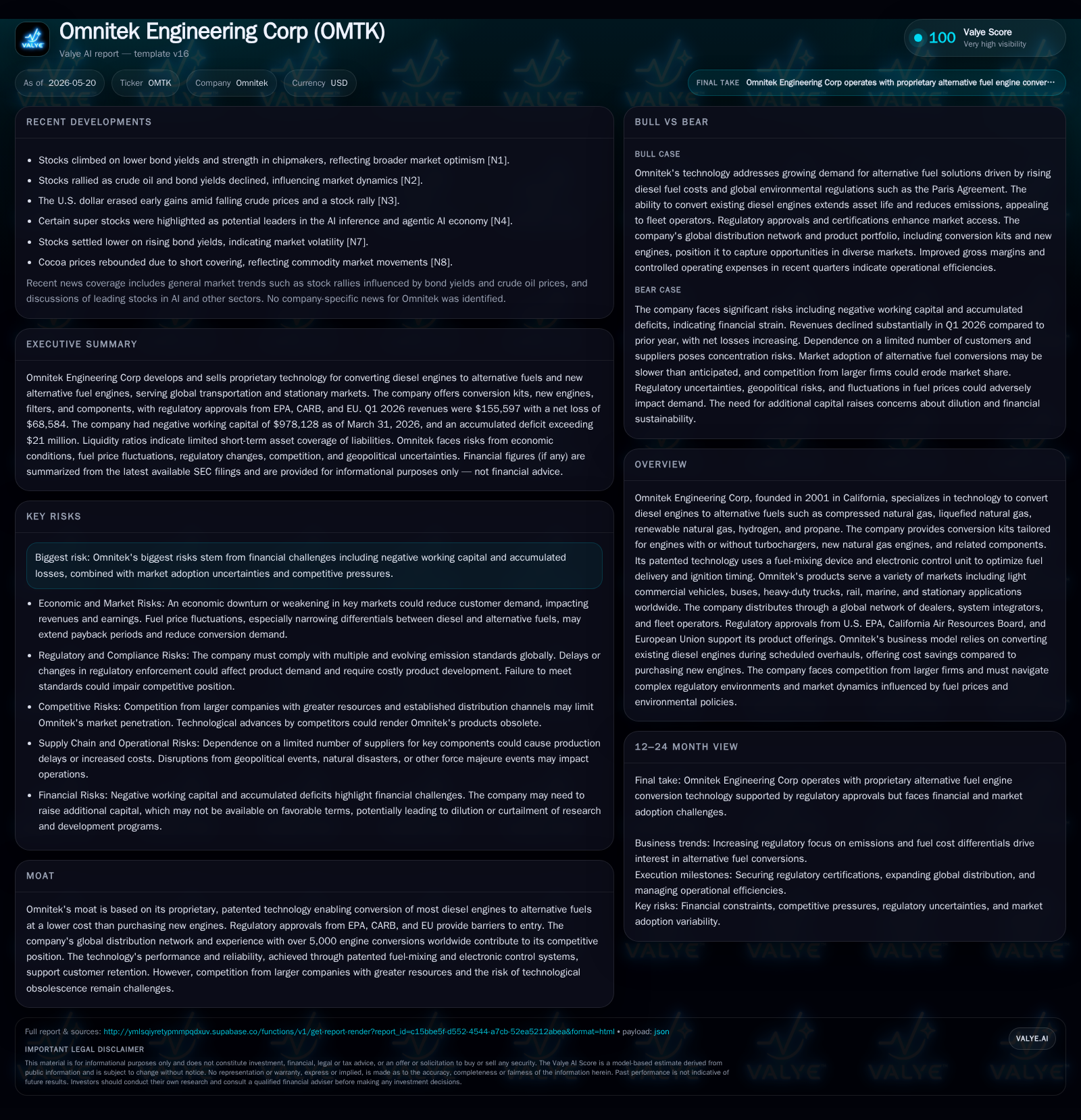
Omnitek Engineering Corp reported Q1 2026 revenues of $155,597, down from $359,746 in the prior year quarter, while gross margin improved to 52% from 39%, reflecting volume pressures offset by better cost management and product mix. The company’s patented diesel-to-alternative-fuel conversion kits and new natural gas engines serve diverse transportation and stationary markets under stringent EPA and CARB approvals. Despite structural growth drivers tied to fuel price differentials and emission regulations, Omnitek faces persistent negative working capital (current ratio ~0.46), accumulated losses exceeding $21 million, and reliance on equity financing for liquidity. Market adoption uncertainties, competitive pressures from larger firms, and fuel price volatility remain key risks as the company pursues expansion including hydrogen conversion technology development.
Latest Quarterly Operating Update
Omnitek Engineering Corp’s Q1 2026 results filed May 20, 2026 reveal revenues declined sharply to $155,597 from $359,746 in Q1 2025 [S2]. This represents a year-over-year drop of approximately 57%. Despite this decline in top-line sales, gross margin improved significantly to 52% compared to 39% in the prior year period. Cost of goods sold decreased proportionally less ($74,984 vs $218,778), suggesting either a shift towards higher-margin products or operational efficiencies.
Operating expenses also declined by about $21,000 year-over-year to $130,697. General and administrative expenses accounted for $112,947 of this total with notable reductions in professional fees and salaries compared to Q1 2025 [S2]. Research and development spending remained relatively steady at $16,786.
The company reported a net loss of $68,584 compared with a net loss of $26,660 in Q1 2025. Non-cash expenses including options/warrants valuation and depreciation/amortization totaled approximately $1,309 [S2]. Inventory valuation policies reflect prudence with provisions established for excess or obsolete stock during uncertain future demand.
The filing also references adoption of FASB’s ASU 2023-07 effective for annual periods beginning after December 15, 2023 which enhances segment reporting disclosures [S2]. This may improve transparency around expense allocations going forward.
Business Model Overview
Founded in California in 2001 as a spin-off from Nology Engineering Inc., Omnitek develops proprietary technology focused on converting diesel engines to operate on alternative fuels including compressed natural gas (CNG), liquefied natural gas (LNG), renewable natural gas (RNG), hydrogen (H2), and liquid petroleum gas (LPG) [S1]. The technology enables conversions at costs lower than purchasing new alternative fuel engines.
Key product lines include:
- Conversion Kits: Designed for both turbocharged and non-turbocharged diesel engines incorporating patented fuel-mixing devices coupled with electronic control units that optimize ignition timing and fuel delivery for efficient combustion.
- New Natural Gas Engines: Offered when conversions do not meet specific performance or regulatory requirements.
- Complementary Products: Such as high-pressure natural gas coalescing filters critical for engine longevity.
These are marketed globally across commercial vehicles (light trucks, buses, heavy-duty trucks), railroads, marine vessels, and stationary power applications. Conversion kits align strategically with diesel engine overhaul cycles providing fleet operators cost-effective repowering alternatives [S1].
Industry Context and Competitive Positioning
Omnitek operates within a regulated alternative fuels retrofit industry where EPA and CARB certifications are mandatory for U.S. sales; additional international approvals apply [S1]. These regulatory requirements create significant barriers protecting Omnitek’s patented technology.
Competition includes larger OEMs focused mainly on new engine production rather than retrofit kits. Omnitek leverages specialized kit engineering expertise combined with an established global dealer network supporting aftermarket installations [F1], [S1].
Governmental incentives promoting domestic natural gas use further underpin demand where indigenous supplies exist. Emission standards aligned with international climate commitments such as the Paris Agreement accelerate structural growth drivers favoring cleaner gaseous fuels over diesel.
Switching costs for customers include downtime during conversions and operator retraining; Omnitek designs solutions to minimize these disruptions via compatibility with existing engines.
Growth Drivers
Primary growth drivers are:
- Fuel Price Differentials: The economic attractiveness of conversions depends heavily on the price gap between diesel and gaseous fuels. Larger spreads shorten payback periods incentivizing fleet conversions [S1].
- Emissions Regulations: Tightening standards impose escalating compliance costs on diesel fleets encouraging retrofit or repower investments.
- Geographic Expansion: Emerging markets with abundant natural gas reserves offer growth opportunities as environmental regulations evolve.
- Technological Innovation: Progress in hydrogen-compatible conversion kits offers optionality aligned with decarbonization trends [S2]. Continuous software improvements enhance system robustness.
Risks and Watchpoints
Financially Omnitek faces:
- Liquidity Constraints: As of March 31, 2026, current assets stood at approximately $850K versus liabilities near $1.83M yielding a current ratio around 0.46 indicative of negative working capital [F1], [S2].
- Accumulated Losses: Exceeding $21 million limit access to low-cost capital markets.
- Funding Dependence: Reliance on equity raises to finance R&D and operations introduces dilution risk.
- Competitive Pressure: Larger firms possess deeper resources enabling broader technology portfolios beyond retrofit kits.
- Market Volatility: Fluctuations in oil/diesel prices can compress fuel spreads extending conversion ROI timelines potentially delaying customer uptake.
- Operational Risks: Geopolitical events may disrupt supply chains affecting production costs or timelines.
Near-Term Milestones to Monitor
Investors should watch:
- Quarterly revenue trends for signs of stabilization or recovery post recent declines.
- Implementation progress on ASU 2023-07 segment disclosure enhancements improving profit analysis granularity.
- Regulatory certification expansions into new territories or emission tiers indicating market acceptance.
- R&D advancements especially regarding hydrogen conversion technologies signaling strategic diversification.
- Strategic partnerships or dealer network expansions facilitating commercial scale-up.
Financial Overview
Omnitek maintains no bank debt per latest filings but operates with stretched liquidity marked by persistent negative working capital (~$978K deficit at March quarter-end) despite modest positive operating cash flow recently ($19K) [F1], [S2]. Cash inflows from financing activities remain essential given ongoing operating expenses relative to subdued revenues. Absence of fixed capital expenditure commitments provides discretionary flexibility though sustained equity funding is critical for research programs and commercialization efforts [S2].
Overall financial health reflects tension between intellectual property moats underpinning competitive positioning versus liquidity pressures requiring close monitoring for funding sufficiency impacting strategic execution.
This analysis is based exclusively on Omnitek Engineering Corp’s SEC filings dated May 20th, 2026 (10-Q), April 15th, 2026 (10-K), supplemented by companyfacts data without speculation beyond documented evidence. No investment research view is offered herein.
Disclaimer: This is research-only, informational analysis and not investment advice. It may include AI-generated interpretation and general industry context. Always verify important details using primary sources.

Comments