
ON Semiconductor’s Strategic Pivot at the Intersection of Electrification, AI, and Automation
A deep dive into ON Semiconductor’s recent earnings, segment dynamics, and strategic moves amid transformative industry trends.
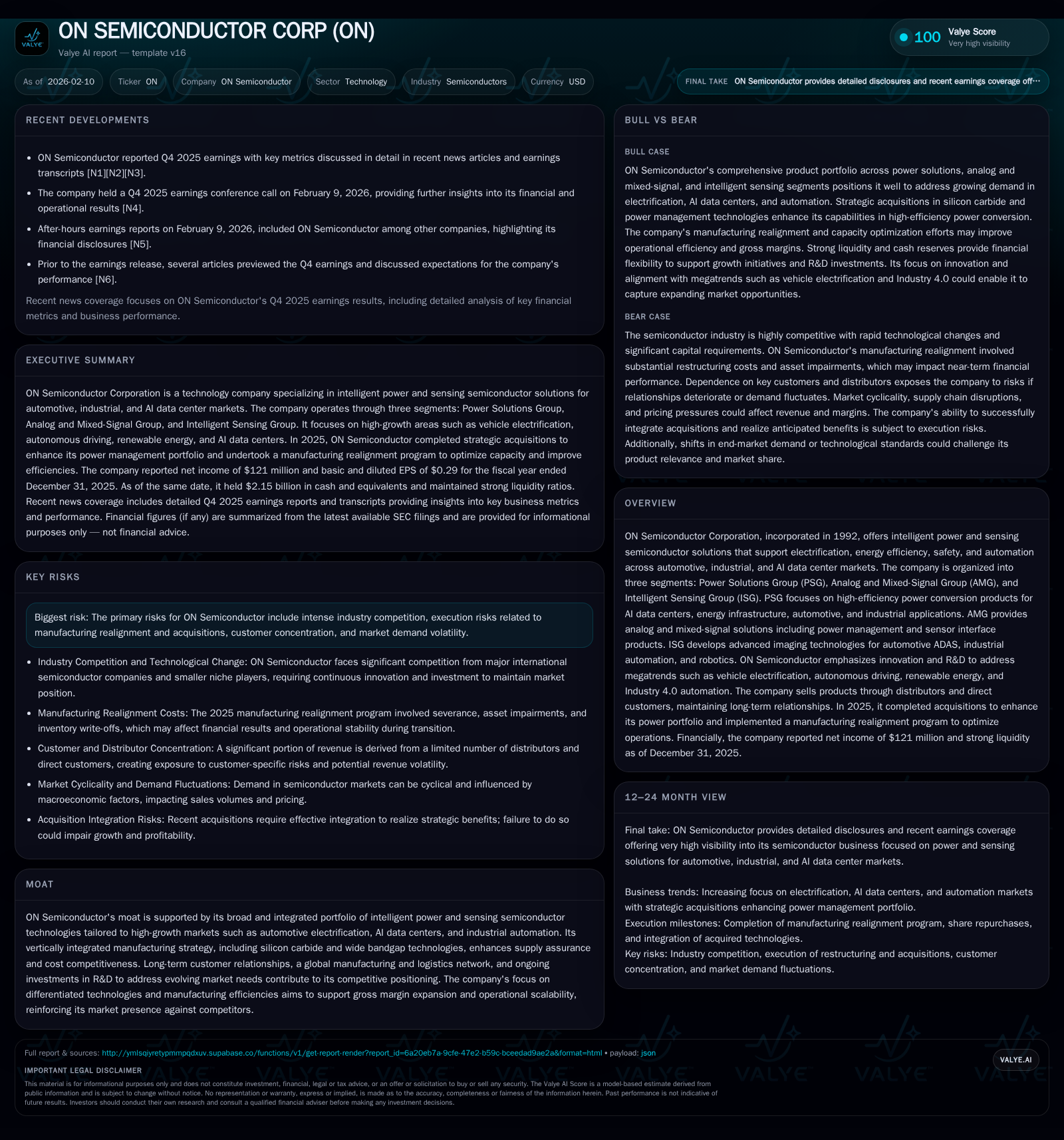
ON Semiconductor reported a Q4 2025 revenue beat despite a dip in net income reflecting profit margin pressures linked to integration and investment costs. The company’s diversified segments — Power Solutions Group (PSG), Analog and Mixed-Signal Group (AMG), and Intelligent Sensing Group (ISG) — each underpin exposure to high-growth markets such as automotive electrification, AI data centers, and industrial automation. Strategic acquisitions, notably the silicon carbide JFET unit in early 2025, reinforce ON’s technology moat centered on efficient power solutions essential for next-gen data centers and electric vehicles. While operational refinements and manufacturing footprint optimization seek margin expansion, competitors, execution risks, and demand cyclicality pose ongoing challenges.
Q4 2025 Earnings: Beyond the Headlines
In February 2026, ON Semiconductor released its Q4 results that struck a nuanced chord. The company posted revenues exceeding analyst expectations — a reaffirmation of its strong market penetration — yet net income declined year-over-year, highlighting underlying profitability pressures [N1][N3][N14][F1]. Management attributed the earnings mix to integration expenses tied to recent acquisitions alongside elevated R&D expenditures aimed at innovation acceleration [N2]. Markets are digesting this juxtaposition of robust topline traction with compressed margins as indicative of the company's aggressive reinvestment stance amid significant transformation.
Financially, ON closed fiscal 2025 with approximately $1.44 billion in revenues contrasted to a net income of around $121 million—marking a contraction versus prior periods yet underscoring continued profitability at scale [F1]. The company's liquidity remained healthy with cash reserves exceeding $2.1 billion supporting operational flexibility.
Segmented Strengths: PSG, AMG, and ISG Under the Microscope
The company’s tri-segment structure serves as the backbone for its technological outreach. The Power Solutions Group (PSG) commands particular attention due to its portfolio directed at high-efficiency power conversion components integral to AI data center racks as well as automotive electrification systems [S1]. PSG innovations are vital in developing lighter EV drivetrains with extended range capabilities through advanced silicon carbide (SiC) technologies.
Analog and Mixed-Signal Group (AMG) provides specialized chipsets that handle power management and sensor interfacing—components historically tougher to commoditize—positioning the segment in durable niches within automotive and industrial applications where precision analog functions are paramount.
Meanwhile, the Intelligent Sensing Group (ISG) drives forward-looking automotive safety technologies including ADAS imaging sensors critical for autonomous driving enablement along with robotics vision systems aimed at industrial IoT deployments. This segment's emphasis on reliability and performance aligns closely with megatrends reshaping transportation safety standards and factory automation growth paradigms [S1].
Together these segments capture converging tailwinds stemming from vehicle electrification’s rising electronics complexity, the proliferation of AI-driven data processing needs, and Industry 4.0 ambitions fueled by smarter sensing.
Strategic Acquisitions Powering Long-Term Growth
January 2025 marked a pivotal move when ON acquired Qorvo’s silicon carbide JFET technology business for roughly $119 million cash outlay aiming to expand the EliteSiC product suite housed under PSG [S1]. This inorganic addition is targeted at increasing power density output capabilities that are fundamentally necessary in AC-DC conversion stages powering next-generation AI servers.
This acquisition underscores ON’s strategy to deepen technological differentiation leveraging wide bandgap materials such as SiC that outperform traditional silicon by enabling faster switching speeds, lower thermal losses, and higher voltages.
Technological Moats: Silicon Carbide and Beyond
Beyond discrete acquisitions lies ON Semiconductor’s broader moat centered on vertically integrated manufacturing encompassing wide bandgap semiconductors—including SiC—that fortify supply assurance amidst global chip disruptions while simultaneously enhancing cost competitiveness through economies of scale [S1].
Control over production allows rigorous quality control and expedited iteration cycles essential for highly specialized applications where failure rates must be minimized.
Long-standing customer engagements across automotive OEMs, industrial consortia, and hyperscale cloud providers complement technical strengths—the combined effect improving barriers to entry for competitors who lack such breadth or integrated scale.
Automotive Electrification: Driving Future Revenues
Electrification of vehicles represents one of the most impactful shifts in transportation technology. ON plays an integral role by supplying intelligent power semiconductors that reduce module sizes while boosting efficiency—translating directly into longer EV ranges per battery charge—a critical consumer pain point [S1].
Concurrently, the increasing penetration of advanced driver assistance systems (ADAS) heightens demand for reliable sensing technologies from the ISG segment supporting autonomous driving paradigms. The growing electronic content per vehicle therefore compounds revenue opportunities amid regulatory push toward lower emissions.
AI Data Centers and the Energy Efficiency Imperative
ON Semiconductor is strategically positioned at another growth epicenter: AI data centers whose computational intensity fuels exponential rises in energy consumption. Hyperscalers’ ESG mandates compel suppliers like ON to provide highly efficient power modules across CPU/GPU racks thus reducing operational wastage – an area where the company touts a near-complete portfolio covering end-to-end power conversion stages within server infrastructure [S1].
This holistic 'power tree' coverage sets ON apart as it enables customers to optimize across multiple voltage domains seamlessly—a distinct advantage not easily replicated by less diversified competitors.
Manufacturing Footprint Optimization and Operational Efficiencies
Management articulated intentions to streamline capacity aligning manufacturing output closely with forecasted demand trajectories post-acquisitions while simultaneously seeking meaningful gross margin improvements through efficiency gains [S1].
Measures include consolidating overlapping facilities identified following M&A activity coupled with tighter control over operating expenses without compromising research investment commitments.
This strategy aims to sustain free cash flow generation critical amid volatile semiconductor market cycles characterized by fluctuations in capital intensity.
Risks on the Horizon: Competition, Execution, and Customer Dependencies
While innovation ambitions run high, ON faces notable risks reflective of semiconductor industry realities. Competitive pressures arise from well-capitalized rivals relentlessly pursuing similar end markets especially as power semiconductor adoption accelerates globally [S1]. Execution complexities manifest in integrating acquired businesses without diluting operational focus or incurring prolonged inefficiencies.
Customer concentration risk persists given reliance on key automotive OEMs or hyperscale cloud providers whose procurement changes could materially impact financial profiles. Further uncertainty in end-market demand cyclicality requires agile supply chain management amidst evolving macroeconomic conditions.
These factors temper enthusiasm while reinforcing the imperative for disciplined execution alongside continued technological leadership.
Valuation Implications and Market Sentiment Influence
Market sentiment surrounding ON Semiconductor reflects contrasting forces: short-term earnings pressure due primarily to integration costs juxtaposed against optimism for sustained growth driven by secular megatrends including auto electrification and cloud scaling [N6][N12][F1].
The stock experienced volatility around earnings release dates as investors balance immediate margin headwinds with confidence in ON's ability to leverage distinctive technologies like silicon carbide semiconductors at scale.
Continued updates from management clarifying pace of profitability recovery integrated with visible wins in new markets will be critical catalysts shaping investor perception going forward.
This analysis is provided solely for informational purposes without any recommendation regarding buying or selling securities. It is grounded in publicly available information as of the stated report date; readers should consider their own investment criteria before drawing conclusions.
Disclaimer: This is research-only, informational analysis and not investment advice. It may include AI-generated interpretation and general industry context. Always verify important details using primary sources.

Comments