
ONAR Holding Corp: AI-Driven Marketing Ambitions Collide with Integration and Liquidity Hurdles
ONAR’s bold strategy of acquiring and integrating specialist agencies under a proprietary AI-enabled platform has rapidly expanded its service scope and client base. But as the company absorbs the complex Advertise Purple acquisition and contends with acute working capital constraints, its ability to convert technological promise into sustainable profitability remains highly contingent on successful integration, operational discipline, and near-term capital access.
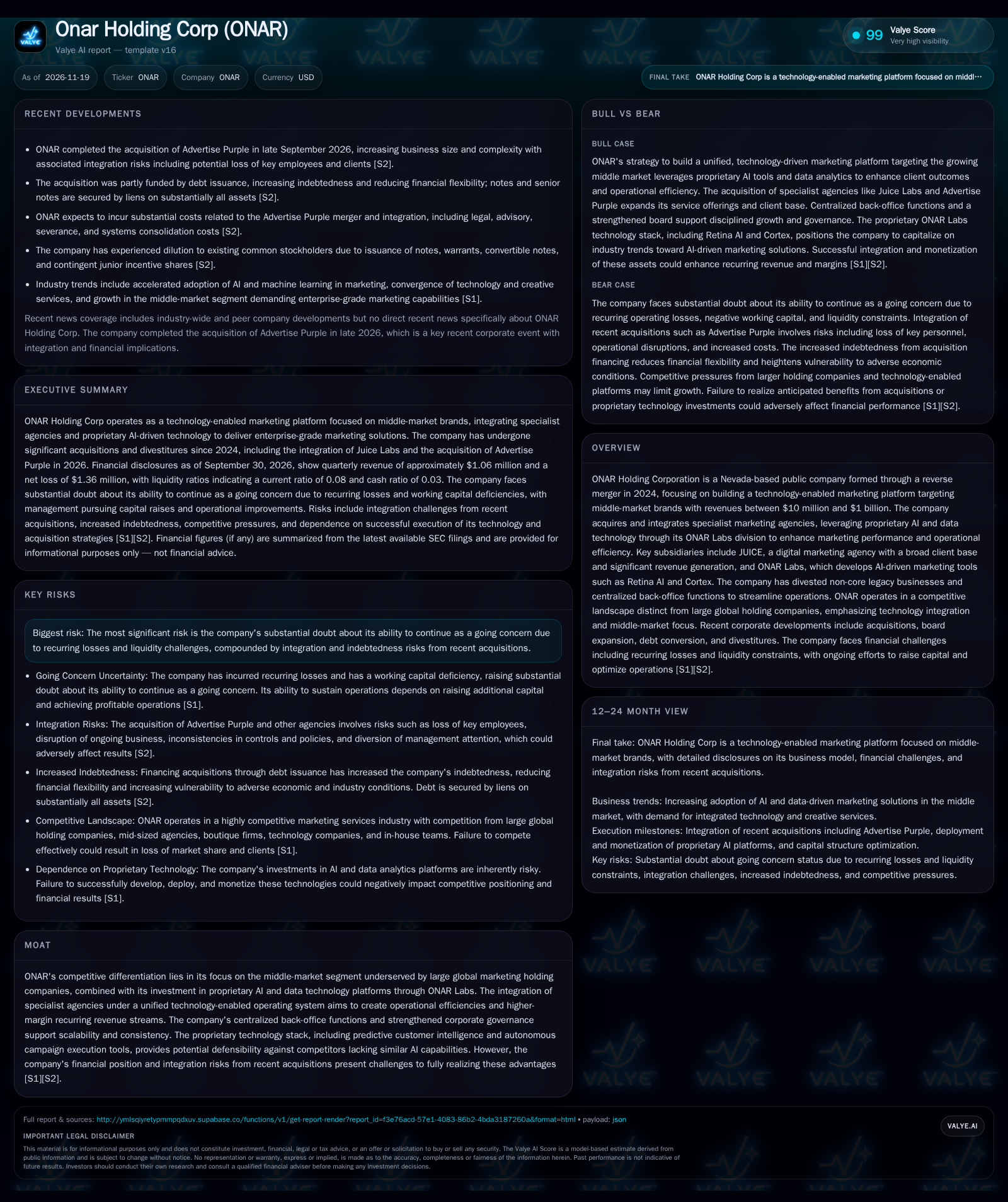
ONAR Holding Corp has transformed itself into a technology-centric marketing platform targeting the underserved middle market, leveraging AI and data analytics to differentiate from both traditional agencies and larger holding companies. Recent acquisitions, including Advertise Purple, have increased scale and complexity but introduced major integration and financial risks. The coming quarters will test whether ONAR’s technology and integration thesis can overcome these immediate pressures. [S1] [S2]
ONAR Holding Corp’s recent evolution has been rapid and ambitious: by acquiring and integrating specialist agencies—most notably the sizable Advertise Purple in late 2026—the company aspires to create a unified, AI-powered marketing platform serving the middle-market segment. Its proprietary technology stack and centralized operations are designed to deliver enterprise-grade solutions more efficiently than legacy holding companies. However, ONAR’s trajectory is now defined as much by its financial fragility as its strategic intent. With acute working capital deficits, mounting integration costs, and new debt burdens, the company’s ability to convert its platform vision into a viable, profitable enterprise will hinge on near-term execution, operational discipline, and access to external capital. [S1] [S2]
Acquisition-Driven Growth Meets Liquidity Stress and Integration Risks
ONAR’s acquisition of Advertise Purple in late September 2026 marked a major expansion in both business scale and complexity, bringing a leading affiliate and partnership marketing agency under its umbrella. This acquisition was funded in part through new debt secured by liens on nearly all company assets, increasing ONAR’s leverage and reducing its potential financial flexibility. [S2]
As of September 30, 2026, ONAR reported quarterly revenue of $1,060,651 but a net loss of $1,361,641. [S2]
Management has disclosed substantial doubt about ONAR’s ability to continue as a going concern, and the company expects to incur significant integration costs related to the Advertise Purple merger, including legal, advisory, severance, and systems consolidation expenses. [S2]
The company’s strategy to centralize back-office functions and deploy proprietary AI/data technology through ONAR Labs continues, but the immediate challenge is to extract synergies from recent acquisitions while stabilizing the balance sheet and retaining key talent. [S1] [S2]
How ONAR’s Platform Model Could Unlock Margin—If Integration Succeeds
ONAR’s business model is predicated on the acquisition and integration of specialist marketing agencies, unified by proprietary AI and data analytics platforms developed within ONAR Labs. The goal is to deliver enterprise-grade marketing outcomes for middle-market clients at a lower cost and reduced complexity relative to large global holding companies. [S1]
Revenue is generated primarily through agency services—performance marketing, affiliate and partnership marketing, and technology-enabled campaign execution. The addition of Advertise Purple brings a focus on performance-based, outcome-driven fee structures, which can potentially offer higher-margin, recurring revenue if client retention persists and technology integration reduces manual overhead. [S2]
The economic thesis relies heavily on operating leverage: centralizing back-office operations (finance, HR, compliance) is intended to reduce duplicated costs across acquired agencies, while proprietary AI and analytics tools (such as Retina AI, Cortex, and Agentic Ops) are designed to automate campaign management and reporting, further compressing variable labor costs and potentially increasing gross margins.
However, the upfront costs of acquisition, integration, and technology development are substantial. The recent debt-financed acquisition of Advertise Purple, combined with acute working capital deficits and recurring operating losses, raises the stakes: ONAR must rapidly realize cost synergies and cross-sell technology to its expanded client base, or risk being overwhelmed by integration costs and debt service. [S2]
Technology Depth Versus Boutique Agility: ONAR’s Place in a Fragmented Market
ONAR occupies a competitive niche between traditional regional/boutique agencies and the massive global holding companies. Its differentiation hinges on technology depth—proprietary AI and data analytics platforms—and the promise of integrated, enterprise-grade marketing for middle-market brands historically underserved by the largest agencies. [S1]
Competitors include mid-sized digital marketing firms, regional agencies, and emerging tech-enabled marketing platforms. These peers may lack ONAR’s technology stack but often possess local market knowledge, established relationships, and lower overhead. Meanwhile, the largest holding companies offer global reach but typically at higher cost and complexity, which may not suit middle-market clients.
ONAR’s ability to retain and expand its client base depends on the tangible value delivered by its AI tools, its ability to maintain service quality post-acquisition, and its success in cross-selling integrated solutions across a diverse set of acquired agencies. Switching costs for clients are not inherently high unless ONAR’s technology demonstrably improves outcomes or embeds itself in client workflows.
The rapid pace of industry change—particularly the convergence of AI, automation, and creative services—means that ONAR’s technology lead could be eroded if competitors accelerate their own digital transformation or if new entrants emerge with disruptive pricing or innovative models.
Synergy Realization and Technology Monetization Drive a Turnaround
The most favorable outcome for ONAR would see rapid, effective integration of Advertise Purple and other acquired agencies, with minimal loss of key employees or clients. Centralized operations would yield cost synergies, while proprietary AI platforms would automate campaign management, improve attribution, and deliver measurable ROI for clients—leading to higher retention and wallet share.
If ONAR can monetize its technology stack (Retina AI, Cortex, Agentic Ops) across its expanded client roster and perhaps as a standalone SaaS offering, recurring high-margin revenue could increase, offsetting integration costs and supporting sustainable profitability.
Evidence supporting this scenario would include stabilization or growth in client count and average contract value, improved gross and operating margins, and increased recurring or performance-based revenue. Additional external funding or successful capital raises would also be necessary to bridge working capital gaps and fund ongoing integration.
A key falsifier would be continued client or key employee attrition post-acquisition, failure to contain integration costs, or inability to demonstrate technology-driven performance improvements relative to peers.
Operational Strain and Financial Constraints Limit Strategic Progress
The most plausible near-term scenario is one of operational strain: ONAR faces persistent integration challenges from the Advertise Purple acquisition, with elevated legal, advisory, and severance costs eroding already thin margins. Liquidity remains extremely tight, forcing management to prioritize cash preservation over discretionary investment in technology or growth.
While centralized back-office functions may yield incremental efficiencies, the pace of synergy realization is likely slow given the complexity of merging disparate agency cultures, systems, and client relationships. Some client and key personnel attrition may occur, partially offset by incremental cross-selling or upselling of AI-driven services.
Revenue may grow modestly as the full-quarter impact of Advertise Purple is realized, but continued net losses and high debt service costs constrain ONAR’s ability to invest or scale. The company may pursue additional capital raises—potentially on dilutive terms—to stabilize operations.
Falsification would require clear evidence of rapid integration, margin improvement, and successful capital raising.
Integration Stumbles and Capital Shortfalls Threaten Continuity
A negative trajectory could unfold if ONAR fails to retain key Advertise Purple personnel or clients, leading to revenue attrition and eroded market credibility. Integration costs may exceed management’s projections, while operational disruptions distract from core client service delivery.
Dilutive emergency financings may be required, further depressing shareholder value and limiting future strategic options.
In this scenario, ONAR’s technology investments fail to generate sufficient incremental revenue or margin, and the company is unable to attract new clients at a pace that offsets attrition or declining average contract value.
Evidence for this scenario would be accelerating net losses, worsening liquidity ratios, public disclosures of client or employee departures, missed debt payments, or going-concern warnings escalating to restructuring or insolvency proceedings.
Milestones and Metrics That Will Test ONAR’s Acquisition and Integration Thesis
Quarterly client retention and net client growth rates across JUICE and Advertise Purple—if disclosed—will provide early signals on integration success and client satisfaction.
Gross and operating margin trends, particularly post-integration, will indicate whether centralized operations and AI-driven efficiencies are materializing.
Recurring versus project-based revenue mix: a shift toward recurring, performance-based contracts would validate the technology-enabled platform thesis.
Cash flow from operations and changes in liquidity ratios will reveal whether ONAR is stabilizing its working capital position or facing mounting shortfalls.
Staff turnover rates at newly acquired agencies—especially among key personnel—would help assess cultural integration and operational risk.
Progress on monetizing proprietary platforms (Retina AI, Cortex, Agentic Ops) as standalone products or as value-enhancers for agency clients.
Updates on debt service, refinancing, or capital raises (including terms and dilution impact) will be critical for assessing going-concern risk.
Disclaimer: This is research-only, informational analysis and not investment advice. It may include AI-generated interpretation and general industry context. Always verify important details using primary sources.

Comments