OneWater Marine’s Early 2026 Earnings Pressure Amid Strategic Shifts and Financial Scrutiny
A detailed examination of OneWater Marine Inc.’s Q1 2026 financial challenges, strategic divestitures, and evolving analyst viewpoints.
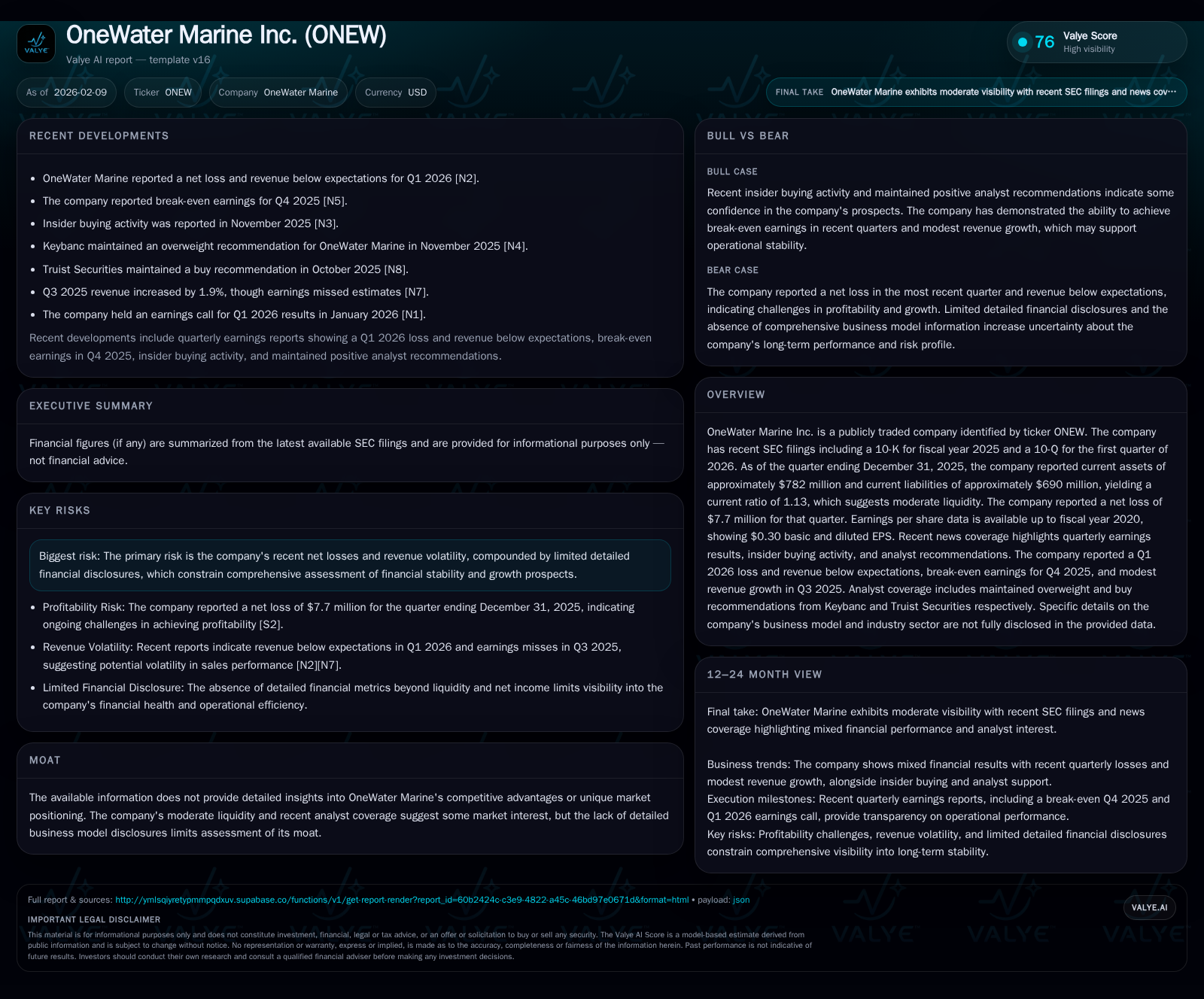
OneWater Marine started 2026 with a disappointing Q1 loss and revenue below market expectations, igniting scrutiny about its near-term financial resilience. The company’s moderate liquidity position, underscored by a current ratio of 1.13, points to manageable but slim short-term flexibility amid ongoing losses. Meanwhile, strategic moves such as the sale of Ocean Bio-Chem signal recalibration efforts that coincide with lowered revenue guidance. Despite operational headwinds, analyst sentiment remains cautiously optimistic, reflecting belief in longer-term recovery potential amid persistent uncertainties in competitive positioning and financial transparency.
Navigating Q1 2026: Missed Targets and Market Reactions
OneWater Marine's release of its January 2026 quarter results painted a mixed picture that set a challenging tone for the year ahead. The company reported a net loss totaling $7.7 million, accompanied by revenues that fell short of public estimates [N2][F1]. This earnings miss sparked notable market reactions and heightened investor scrutiny during the subsequent earnings call. Executives acknowledged revenue pressures while emphasizing ongoing efforts to stabilize operational performance [N1]. Yet, this transparency coexists uneasily with performance that necessitates deeper diligence on sustainability.
The gap between expected versus actual topline figures underscored recurring volatility themes within OneWater’s recent quarterly cadence. Investor nerves were palpable given the continuation of net losses after a patchwork of prior quarters showing incremental improvements yet lacking firm momentum. This sets the stage where confidence hinges not solely on quarterly snapshots but on management's strategic responses.
Liquidity Under the Lens: Assessing OneWater's Financial Cushion
Examining the balance sheet as of December 31, 2025, offers critical insight into how OneWater stands to meet near-term obligations amid these fiscal headwinds. Current assets stood at roughly $782 million against current liabilities of $690 million, yielding a current ratio—a standard liquidity indicator—of approximately 1.13 [F1][S2]. A current ratio above one signifies more assets than liabilities due within a year; however, sitting slightly above this baseline indicates only moderate liquidity.
In practical terms, this marginal cushion suggests OneWater does not face immediate solvency risk but possesses limited buffer to absorb further operational shocks without securing additional financing or generating positive cash flow. The maintenance of liquidity will require vigilant working capital management as losses persist.
Strategic Moves: Implications of the Ocean Bio-Chem Divestiture
Early February news brought clarity to one significant corporate maneuver: the completion of OneWater’s sale of Ocean Bio-Chem [N3]. This divestiture represents a deliberate refocusing away from ancillary operations towards core marine dealership activities. Such moves are often double-edged; while shedding non-core units can streamline operations and improve capital allocation, it may also temporarily depress revenue base.
Indeed, this transaction directly factored into OneWater lowering its full-year guidance for 2026 [N3]. Management portrayed the sale as an effort to concentrate resources post-divestiture on higher-margin segments with growth potential. The recalibration suggests recognition that prior diversification has not yielded expected stability or returns under prevailing market conditions.
Revenue Garden: Growth Spurts and Volatility Patterns
Tracing OneWater's sales trajectory through recent quarters reveals bumpy terrain rather than steady ascent. Q3 2025 saw modest revenue growth pockets indicating some demand resilience or effective tactical initiatives [S1][N2]. However, Q4 shifted gears toward break-even earnings territory—an improvement from prior losses but still reflective of underlying fragility.
Revenue volatility appears influenced by seasonality factors inherent to recreational boating alongside macroeconomic variables affecting discretionary consumer spending. In this light, OneWater's challenge lies in smoothing out these fluctuations through deeper market penetration or diversification inside core competencies rather than broad-based portfolio expansion.
Analyst Perspectives: Weighing Buy Ratings Against Execution Risks
Contrasting somewhat with headline results is the maintained positive tilt from analysts who cover OneWater Marine [N2][N1]. Overweight and buy recommendations remain prevalent in equity research circles despite recent earnings disappointments. This stance reflects calculated optimism rooted perhaps in perceived management competence or sector rebound narratives within marine retail and services.
Yet, these endorsements come paired with cautionary notes on execution risks tied to volatile top-line figures and ongoing net losses. Analysts appear to predicate bullish views on successful implementation of restructuring plans (such as the Ocean Bio-Chem sale) along with hoped-for margin expansions—factors yet unproven fully in reported results.
Risks Beyond Earnings: What SEC Filings Reveal About Future Uncertainties
A granular appraisal benefits from direct reference to risk disclosures contained within recent SEC filings—a reliable repository for corporate self-identified vulnerabilities [S1][S2]. Among prominent concerns are sustained revenue volatility linked to customer demand fluctuations across marine markets and dependence on cyclical economic conditions.
Additionally noted are risks stemming from limited financial disclosure granularity which hampers external stakeholders’ ability to conclusively gauge creditworthiness or operational resilience beyond headline numbers. Such opacity may constrain capital market access or elevate borrowing costs if losses continue absent demonstrable turnaround.
The Search for Moat: Competitive Positioning in an Unclear Landscape
OneWater’s public information offers scant elaboration on distinctive competitive advantages or defensible market niches that would imbue it with a durable moat [S1]. Without explicit strategic differentiators detailed in filings or investor materials, analysts and market observers must treat claims cautiously.
The lack of transparent articulation regarding scale benefits, exclusive distribution rights, proprietary technologies, or service models leaves interpretation open-ended. Any substantial moat would likely emerge from deep relationships with major boat brands, geographic dealership density, or superior customer service—a hypothesis awaiting more clarity.
Insider Insights: A Closer Look at Recent Insider Buying Activity
Recent disclosures include insider buying transactions during early 2026 periods [N1]. While specific volumes and timing details are less concretely documented here, such purchases typically signal internal conviction toward share valuation or corporate strategy viability.
Insider activity amid reported losses might reflect faith in underlying business fundamentals or confidence in management-led initiatives like portfolio realignment through divestitures. Nevertheless, prudent observers consider insider buying as one piece of an ensemble rather than definitive endorsement.
Forecasts Revised: Understanding the Lowered Guidance for 2026
Following strategic shifts including Ocean Bio-Chem’s disposal, management prudently revised full-year revenue expectations downward [N3]. This adjustment aligns with observed trailing quarter underperformance compounded by divestiture-related contraction effects.
Lowered guidance communicates tempered growth ambitions for the short term but also signals management’s realistic approach toward resetting investor expectations amid broader economic uncertainties impacting discretionary spending sectors such as recreational boating.
The Path Ahead: Potential Catalysts and Pitfalls
Synthesizing these multifaceted insights spotlights a company perched at an inflection point marked by operational strain yet pursuing decisive corrective steps. Key catalysts for potential recovery include stabilization of revenue streams post-divestiture, enhanced liquidity management enabling flexibility against ongoing losses, and execution success in refining focus toward marine dealerships.
Conversely, pitfalls loom around continued market cyclicality dampening demand spikes; unresolved transparency gaps restricting investor confidence; absence of unambiguous competitive advantages; and persistent net losses eroding capital reserves if gains do not materialize swiftly.
For stakeholders monitoring OneWater Marine in early 2026 and beyond, vigilance around quarterly updates will be vital. Evolving macroeconomic trends impacting leisure industries coupled with internal discipline on cost controls and portfolio streamlining will dictate whether today’s strains give way to structurally healthier performance or prolonged instability.
Disclaimer: This report is intended solely for informational purposes based on currently available data as of early February 2026. It does not constitute investment advice nor an endorsement of any security mentioned herein.
Disclaimer: This is research-only, informational analysis and not investment advice. It may include AI-generated interpretation and general industry context. Always verify important details using primary sources.

Comments