
Otis Worldwide Advances UpLift Transformation to Cement Global Elevator Leadership
Otis's first-quarter 2026 results underline progress in its UpLift transformation program and strengthen the strategic synergy between new equipment sales and service contract annuities.
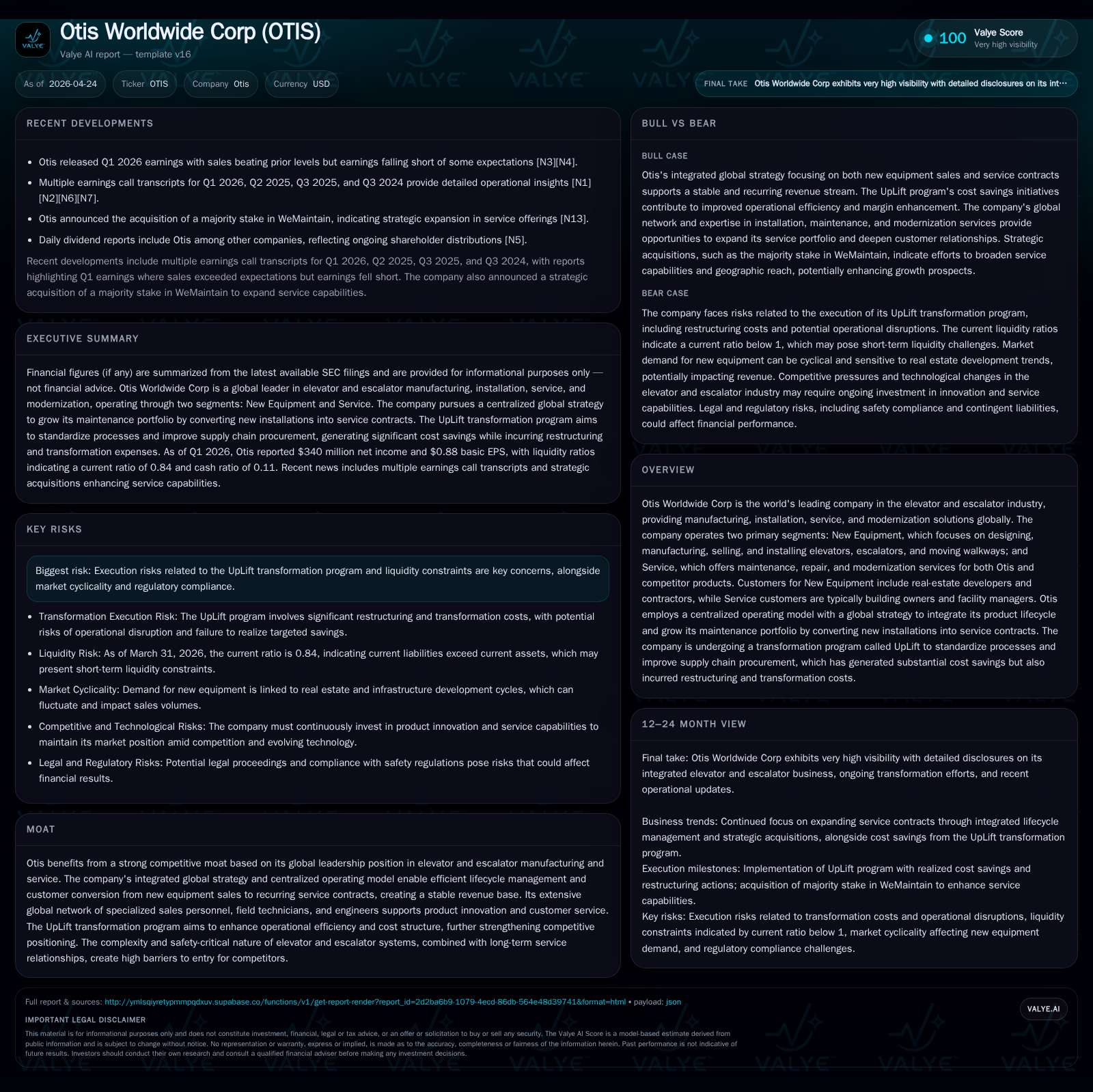
In Q1 2026, Otis Worldwide reported continuing operational momentum marked by increased run-rate savings from its UpLift transformation program and an improved conversion of new installations into recurring service contracts. The UpLift initiative now delivers approximately $200 million in annual run-rate savings, with trailing restructuring costs tapering off, underscoring steady execution on this multi-year expense-saving endeavor. Otis’s integrated business model leverages its global footprint and product lifecycle control to underpin a durable moat amidst cyclical demand patterns, driven by urbanization and building modernization trends. Key risks center on transformation execution and leverage management, with financials reflecting a solid cash flow profile against a sizeable debt load.
Latest Quarterly Operating Update: UpLift Progress and Market Signals Otis Worldwide’s Q1 2026 earnings filing [S2] details solid strides in the company’s multi-year UpLift transformation program, designed to standardize processes across its global operations and optimize supply chain procurement. The program now yields approximately $200 million in annual run-rate savings, up from $120 million at the end of 2024. These savings are primarily visible within selling, general, and administrative expenses as Otis consolidates organizational spans and layers and reduces digital technology costs. Trailing restructuring costs related to UpLift are declining, with only about $18 million expected in 2026 following total restructuring expenditures of roughly $132 million through prior periods. Transformation costs for consultants and third-party services supporting the redesign of the operating model remain material but controlled. Revenue trends in the quarter showed resilience: while exact figures for Q1 were not emphasized numerically in the filing, management commentary [N3][N6] suggests that new equipment sales held steady despite some geographic variability amid regulatory environments. Encouragingly, conversion rates converting new elevator installations into long-term maintenance service contracts remain robust — a key metric reflecting Otis’s success in expanding its recurring revenue base. Recent supply chain conditions appear stable without reported material disruptions, while regulatory compliance efforts continue to be stringent given the safety-sensitive nature of elevator systems globally. These operational factors underscore confidence in sustaining near-term momentum while completing the transformation program. ## Business Model and Product-Portfolios: New Equipment Meets Recurring Service Otis operates through two primary segments outlined fully in its 2025 annual report [S1][S5]:
- New Equipment: This segment encompasses design, manufacturing, sales, and installation of elevators, escalators, passenger conveyors (moving walkways), and freight elevators. Customers are predominantly real estate developers, general contractors, and infrastructure project owners pursuing vertical transportation solutions for residential, commercial, retail or mixed-use developments.
- Service: This segment generates revenue from maintenance contracts (roughly equating to annuity-like income streams), repairs, inspections ensuring regulatory code compliance, and modernization services that upgrade existing equipment. Typical customers include building owners and facility managers ranging from housing associations to government agencies. The strategic strength lies in Otis’s ability to integrate these segments across the product lifecycle globally under a centralized operating model. This ensures not just manufacturing excellence but efficient aftermarket support designed to retain customers over decades by converting every new installation into a service contract opportunity. Modernization plays a vital role here — beyond basic repairs — addressing aesthetic upgrades as well as high-complexity component refurbishments like machinery replacement or advanced safety system retrofits. Internally, specialized field technicians focus exclusively either on installation or service workloads complemented by globally coordinated engineering teams driving continuous R&D innovation critical for maintaining technological edge especially around energy efficiency and smart systems integration. ## Competitive Positioning within a Specialized Global Elevator Industry Otis’s competitive moat is durable due to several sector-specific factors (Valye Report Excerpt):
- Global Scale & Footprint: As the world leader in elevators/escalators with an extensive installed base spread over multiple continents, Otis benefits from broad market reach enabling economies of scale unmatched by smaller competitors.
- Safety-Critical Product Complexity: Elevators represent mission-critical infrastructure governed by rigorous safety standards worldwide — this complexity creates high technical barriers limiting new entrants.
- Installed Base Lock-in: Long-term service contracts tied to an expansive installed equipment portfolio provide significant switching costs for customers wary of compromising reliability or compliance.
- Centralized Operating Model: The UpLift initiative exemplifies efforts to sustain cost efficiencies via process standardization across regions maintaining competitiveness despite industry cyclicality. Pricing power is generally preserved under this structure since quality service adherence is non-negotiable for customers reliant on dependable vertical transportation in densely populated urban infrastructure. Regulatory compliance costs further entrench incumbents who have invested heavily in local certifications. While competitors exist regionally or in niche product subsets (some diversified industrial companies), Otis faces limited direct threats at scale owing to its integrated offering spanning both new equipment sales and global aftermarket service. ## Growth Catalysts and Operational Constraints Structural demand drivers underpin Otis’s growth prospects:
- Urbanization & Infrastructure Investment: Continued expansion of high-rise residential and commercial buildings globally stimulates sustained demand for new elevators/escalators — key markets remain Asia-Pacific mega-cities alongside developed regions upgrading old stock.
- Modernization Wave: Aging building infrastructure triggers large retrofit cycles focusing on energy-efficient technologies, enhanced safety features (e.g., seismic sensors), or modernization of interiors to enhance property value.
- Service Contract Expansion: Conversion efficacy from new installs into long-term maintenance agreements provides steady annuity-like cash flows cushioning cyclical volatility. Operational constraints highlight risks:
- Regulatory Hurdles: Differing national/state/local elevator codes require constant adaptation impacting installation timelines/costs; delays can compress margins.
- Supply Chain Inflation & Raw Material Costs: While supply issues have eased lately per recent filings [S2], prior years saw elevated input costs stressing margins temporarily.
- UpLift Execution Risk: The cost/benefit timeline for the transformation program introduces short-term incremental expenses which must be managed against targeted $200 million run-rate savings; any slippage could impair profitability metrics.
- Competitive Pricing Pressure: Despite moat safeguards pricing discipline can erode during downturns when customers push for cost reductions on large projects. Technological innovation pace also requires continued investment to keep products relevant particularly integrating smart IoT capabilities for predictive maintenance — an increasingly important differentiator for premium customers seeking operational reliability. ## Key Risks and Transformation Execution Challenges Otis faces several noteworthy risk categories underscored in recent filings [S4]:
- UpLift Program Delivery: With total cumulative spending nearing $300 million including restructuring ($132 million) and other transformation expenses ($150 million), failure to realize projected annual savings (~$200 million) would pressure margins; ongoing trailing restructuring expenses estimated at $18 million necessitate tight project control.
- Leverage Profile & Liquidity: As of March 31, 2026 ([F1]), Otis carried approximately $7.6 billion total debt with net debt near $6.8 billion against cash of $834 million. Close attention should focus on quarterly disclosures detailing progress milestones against UpLift targets plus debt maturity management plans. ## Financial Profile and Capital Structure Overview ### Historical performance (annual) | FY | Net ($mm) | CFO ($mm) | OpInc ($bn) | Capex ($mm) | Net YoY | | --- | :---: | :---: | :---: | :---: | :---: | | 2025 | 1384 | 1596 | 2.1 | 152 | -15.9% | | 2024 | 1645 | 1563 | 2.0 | 126 | +17.0% | | 2023 | 1406 | 1627 | 2.2 | 138 | +12.2% | | 2022 | 1253 | 1560 | 2.0 | 115 | | Source: SEC companyfacts cache [F1]. ### Capital returns and efficiency (annual) | FY | Div ($mm) | Buybacks ($mm) | FCF ($mm) | | --- | :---: | :---: | :---: | | 2025 | 647 | 809 | 1444 | | 2024 | 606 | 1007 | 1437 | | 2023 | 539 | 800 | 1489 | | 2022 | 465 | 850 | 1445 | Source: SEC companyfacts cache [F1]. According to the latest data as of Q1-end 2026 ([F1], [S2]):
- Liquidity & Leverage: Cash & equivalents stand at approximately $834 million with total debt weighted around $7.6 billion leading to a net debt position close to $6.8 billion. The current ratio of 0.84 points toward working capital constraints that require active balance sheet management alongside operational cash generation estimated at ~$1.6 billion annually as per FY2025 CFO figures ([F1]).
- Profitability Trends: Fiscal year 2025 reported operating income rising modestly (+6.2% YoY) to about $2.13 billion; however net income declined (-15.9%) year-over-year reflecting higher non-operating costs including restructuring charges tied to UpLift implementation ([F1]).
- Capital Expenditures & Investment: Capex increased moderately (+20% YoY) aligning with priorities on modernization investments aimed at sustaining installed base value rather than purely expansionary growth ([F1]).
- Shareholder Returns: Dividend payouts totaled around $647 million in FY2025 representing steady commitment alongside share repurchase moderation ($809 million vs prior year) consistent with preserving liquidity flexibility during transformation phase ([F1]). The negative equity noted primarily stems from financial structuring activities rather than operational distress but indicates limited cushion in adverse scenarios—prompting necessary vigilance on refinancing conditions over the coming years given upcoming notes maturities ([S3], [S6]). --- Disclaimer: This analysis is intended solely for informational purposes describing recent company developments, business models, industry context, risks, and financial profile without providing investment advice or recommendations.
Disclaimer: This is research-only, informational analysis and not investment advice. It may include AI-generated interpretation and general industry context. Always verify important details using primary sources.

Comments