
Pyrophyte Acquisition Corp. II Advances Toward Energy Sector Business Combination with $191M Trust Capital
Latest quarterly filing confirms ongoing search for an energy ecosystem target and highlights dilution risks from founder shares.
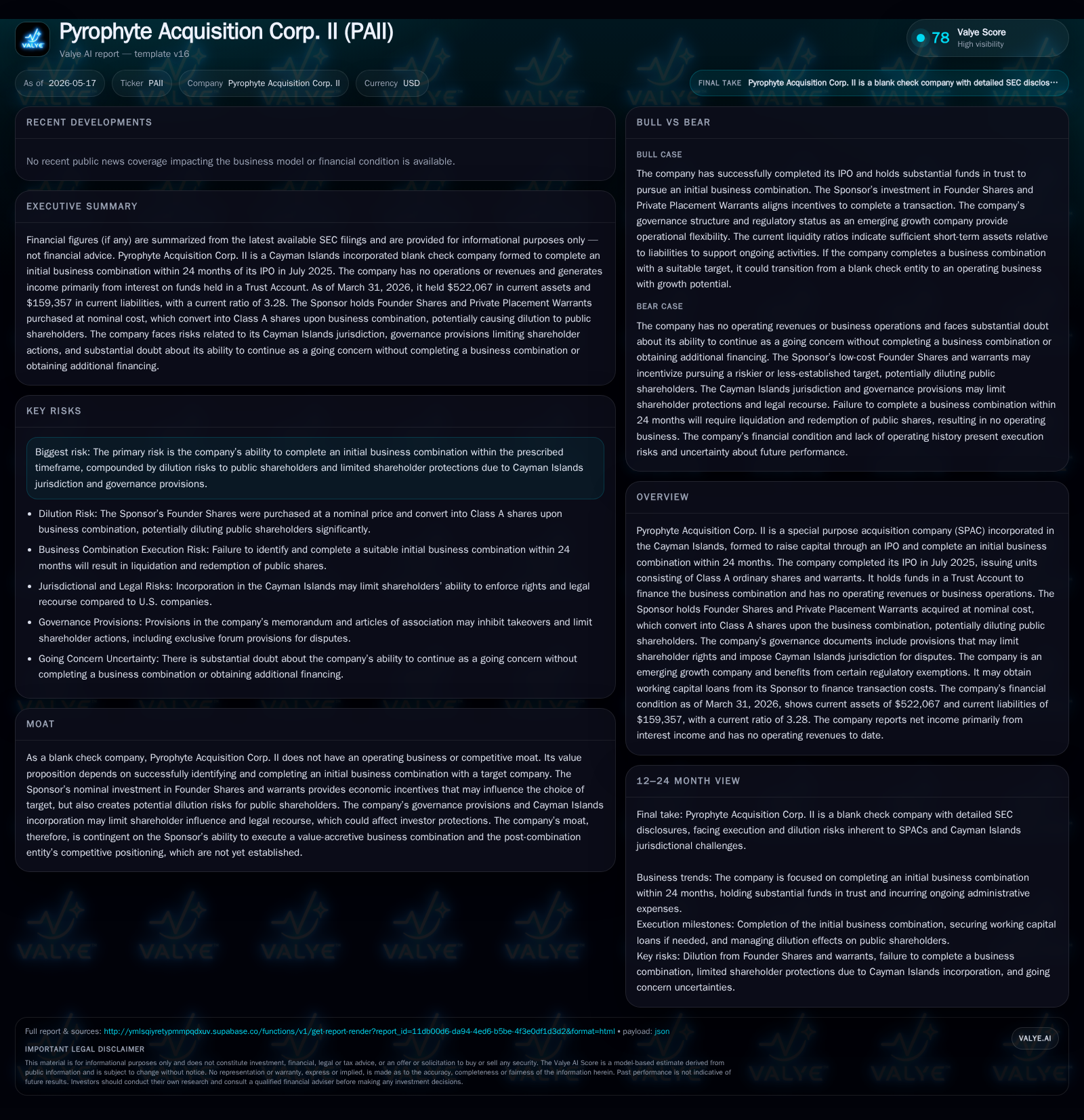
Pyrophyte Acquisition Corp. II (PAII), a Cayman Islands-incorporated SPAC formed in 2025, aims to complete a business combination within 24 months, targeting companies critical to the energy supply chain. The May 2026 quarterly filing confirms no operating revenues or target selection yet but reports $191 million held in trust to finance an acquisition. Public shareholders face dilution risks due to favorable terms for founder shares and governance structures limiting shareholder control. Growth depends entirely on successful deal execution focused on critical energy materials and technologies, while risks include deadline pressure and limited liquidity beyond trust funds.
Recent Operating Update
Pyrophyte Acquisition Corp. II's latest quarterly report filed May 15, 2026 ([S2]) confirms it remains in the pre-combination phase without operating revenues or identified acquisition targets as of March 31, 2026. There were no material changes in risk factors since the prior annual report ([S1]). The company continues its search focused on energy sector supply chain targets. Current assets total about $522,000 with liabilities near $159,000, yielding a current ratio around 3.28—indicative of sufficient short-term liquidity for operational needs ahead of a transaction ([F1]).
Administrative and due diligence expenses continue as expected for a publicly listed blank check vehicle preparing for a merger ([S5]). Dilution concerns persist around the Sponsor’s founder shares and private placement warrants acquired at nominal cost and convertible upon deal completion ([S1], [S7]).
Business Model
PAII operates as a Special Purpose Acquisition Company (SPAC) formed to raise capital via an IPO and complete a merger with an operational company within a fixed timeframe of 24 months ([S1]). Until consummation of this initial business combination, PAII generates revenue solely from interest on Trust Account proceeds; it has no operating revenues ([S1], [S5]).
Public investors purchase units consisting of Class A ordinary shares plus warrants at IPO pricing; meanwhile, the Sponsor’s nominal investment in founder shares results in significant dilution upon conversion post-merger ([S1]). The implied per-share value after combination is estimated at $7.01 compared to the original $10 investment price—reflecting nearly 30% dilution due primarily to transaction costs and equity issuance structure ([S7]).
The Sponsor’s mandate is to source targets primarily within the energy ecosystem—from traditional fossil fuel segments to renewable energy—with emphasis on businesses supplying critical minerals, equipment, or enabling technologies essential to evolving energy supply chains ([S1]). This focus aims to capitalize on structural shifts toward decarbonization and innovation across the sector.
The SPAC’s financial model separates capital formation from operating risk initially but transfers substantial execution risk onto successfully completing a synergistic combination within prescribed timelines. Governance provisions under Cayman Islands law provide flexibility but may restrict public shareholder influence until deal consummation ([S1]).
Industry Structure and Competitive Position
While PAII currently lacks operations or direct industry presence independently, its future prospects depend heavily on selecting an attractive target within the competitive but expanding energy sector niche.
Energy-focused SPACs have proliferated amid investor appetite for exposure to essential resources underpinning global energy transition trends—such as critical minerals (e.g., lithium), clean technology equipment manufacturers, or developers of energy efficiency solutions (). This subsector is fragmented with varying regulatory environments depending on geography and product focus.
PAII’s competitive advantage in deal sourcing will rely significantly on its management team’s expertise and network within energy markets alongside committed capital structured via its IPO package. Incorporation under Cayman Islands law grants operational flexibility but comparatively fewer shareholder protections than U.S.-domiciled peers—an important consideration relative to competing SPACs ([S1]). Thus, PAII's positioning among peers hinges predominantly on transaction execution capabilities rather than proprietary products or go-to-market strategies.
Growth Drivers
Growth depends entirely on identifying and completing an accretive initial business combination within the mandated 24-month window. Key success factors include:
- Target alignment with long-term secular trends favoring energy materials or enabling technologies benefiting from global decarbonization commitments.
- Ability to leverage IPO-raised capital alongside potential additional financing mechanisms such as forward purchase agreements or debt issuance structured during combination negotiations ([S1]).
- Efficient due diligence supported by sponsor resources to secure quality deals before competitors erode opportunities.
- Favorable market conditions supporting valuation uplifts post-combination that enhance equity value for both Sponsor and public shareholders.
KPIs signaling progress include public identification of target(s), announcement of definitive agreements, shareholder approval votes on combinations, redemption rates during proxy phases indicating investor sentiment, and structuring that minimizes dilution impact.
Risks / Watchpoints / Growth Constraints
Key risks encompass:
- Failure or delay in completing an initial business combination within the required period triggering mandatory liquidation payable from trust funds—potentially resulting in investment losses net of costs ([S1], [S8]).
- Dilution risk from founder shares acquired at nominal cost plus issuance of preferred stock or senior securities during combinations that may subordinate common equity claims ([S1]).
- Limited shareholder protections due to Cayman Islands jurisdiction combined with governance provisions potentially constraining shareholder activism or influence over strategic decisions ([S1]).
- Liquidity pressure as administrative expenses accrue without operating revenues prior to merger closure ([F1]).
- Macroeconomic volatility affecting valuations or availability/cost of incremental financing needed alongside trust assets.
- Potential adverse U.S. tax consequences if classified as a Passive Foreign Investment Company (PFIC) impacting U.S.-based investors ([S1]).
- Cybersecurity vulnerabilities given reliance on digital infrastructure that could disrupt transaction processes or compromise sensitive information pre-merger ([S13]).
What To Watch Next
Investors should monitor:
- Announcements regarding target identification or executed letters of intent/definitive agreements indicating material merger progress.
- Proxy statement filings soliciting shareholder votes on proposed transactions.
- Redemption election levels among public shareholders reflecting confidence or dissent toward prospective deals.
- Updates on supplemental financing arrangements beyond trust account proceeds such as forward purchase agreements or debt placements.
- Changes in corporate governance approvals that may affect minority shareholder rights.
- Market conditions impacting valuation premiums or discounts offered during proposed mergers.
- Approaching expiration milestones tied to the 24-month deadline after IPO that may trigger liquidation if no deal closes.
No explicit guidance has been provided beyond statutory deadlines; execution cadence remains critical.
Financial Profile Context
Though pre-operational with no revenues reported through March 31, 2026 ([F1]), PAII’s financial position centers on trust funds derived from IPO proceeds net of underwriting fees—approximately $191 million available for deployment ([S7], [F1]). Operating losses stem solely from administrative expenses totaling roughly $628 thousand through December 31, 2025 ([F1]). Current assets exceed liabilities by over three times (current ratio ~3.28), reflecting short-term solvency adequacy ([F1]). However, cash use is limited pending transaction execution; additional financing may be necessary via debt or sponsor-provided working capital loans up to $1.5 million if required ([S3]).
As an Emerging Growth Company under JOBS Act provisions, PAII benefits from reduced regulatory obligations but also faces disclosure limitations relative to more mature firms which could affect investor transparency ([S19]). Overall financials portray PAII strictly as a capital aggregator awaiting deployment rather than an independent earnings generator until a significant transaction occurs.
Disclaimer: This analysis is based solely on disclosed SEC filings and publicly available information up to May 17, 2026. It contains no investment advice or research views but aims solely at presenting fact-based corporate and industry context consistent with regulatory disclosures.
Disclaimer: This is research-only, informational analysis and not investment advice. It may include AI-generated interpretation and general industry context. Always verify important details using primary sources.

Comments