
Proficient Auto Logistics: Customer Concentration, Cyclical Headwinds, and the Challenge of Sustainable Margins
Proficient Auto Logistics faces a complex mix of concentrated revenue exposure, industry cyclicality, and tight liquidity, even as it invests in operational upgrades and secures industry recognition. The company’s ability to offset these vulnerabilities—through margin expansion, customer diversification, or operational efficiency—will define its trajectory in the coming quarters.
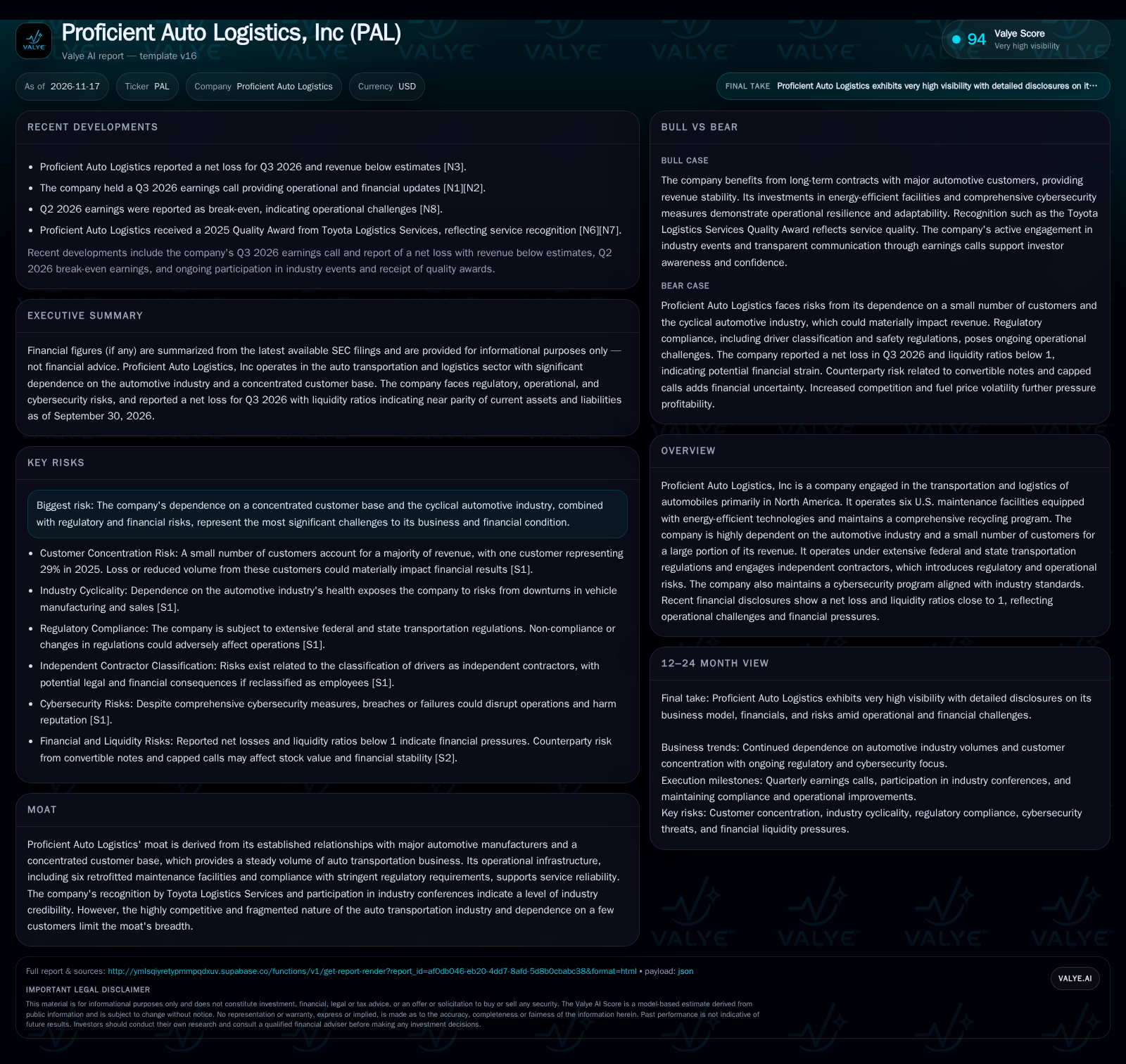
The business remains highly reliant on a small set of automotive customers, with one accounting for nearly a third of revenue. Operational risks tied to regulatory compliance, fuel costs, and contractor management heighten execution risk. While the company’s investments in energy-efficient facilities and industry recognition signal operational focus, its future hinges on mitigating customer concentration, stabilizing margins, and navigating automotive industry cycles. [S1] [S2] [N3]
Proficient Auto Logistics, Inc. operates at the intersection of automotive industry cycles and logistics execution risk. While investments in facility upgrades and recognition from top-tier clients like Toyota show operational intent, the company’s future will likely be determined by its ability to broaden its customer base, manage costs, and sustain compliance in a shifting regulatory environment. [S1] [S2] [N3]
Recent Results Underscore Margin Pressure and Customer Dependence
The most material recent fact is Proficient Auto Logistics’ Q3 2026 net loss of $9.95 million, with basic EPS of -$0.35, and revenue that fell short of expectations. This loss follows a break-even Q2, suggesting operational volatility rather than a steady improvement. The company reported cash and liquidity metrics for the period; these figures do not by themselves establish operating runway, investment capacity, financial flexibility, or financing capacity. This heightens the risk of financial strain if operating losses persist or unexpected expenses arise. [S2] [N3] [N8]
Another critical fact is the company’s high customer concentration: in 2025, the top five customers accounted for 59% of operating revenue, with a single customer contributing 29%. This exposure means any shift in OEM production, contract terms, or competitive dynamics could have an outsized impact on revenue and cash flow. [S1]
Finally, the company’s operational infrastructure—including six U.S. maintenance facilities with energy-efficient retrofits and a comprehensive recycling program—illustrates a commitment to cost management and sustainability, though the direct impact on margins is not quantified. [S1]
Revenue Streams, Cost Structure, and Leverage in Automotive Logistics
Proficient Auto Logistics generates revenue primarily by transporting new automobiles, SUVs, and light trucks for major OEMs and dealers across North America. Pricing is typically negotiated through contracts or bids, with volume dictated by auto production schedules and dealer demand. Given the reported customer concentration, contract terms with key OEMs may exert downward pressure on rates, especially if competition intensifies or production volumes decline.
On the cost side, fuel is a major variable expense, with price volatility directly impacting margins. The company’s use of independent contractors and third-party carriers introduces some flexibility, but also raises exposure to regulatory and reclassification risk—potentially increasing labor costs if contractors must be converted to employees. Fixed costs include facility leases, maintenance, and technology investments, while the company’s six energy-efficient facilities may help lower utility expenses and signal a defensive posture against rising input costs.
Operating leverage is a double-edged sword: when volumes rise, incremental revenue can flow through to margins if variable costs are controlled. But in downturns, fixed costs (facility, fleet, compliance) can quickly erode profitability.
Navigating a Fragmented Market with High Switching Costs and Thin Moats
The auto logistics sector is highly competitive and fragmented, populated by regional carriers, national logistics providers, and vertically integrated OEM logistics arms. Proficient Auto Logistics’ primary advantage appears to be established relationships with major automotive manufacturers, evidenced by its customer concentration and industry awards. These relationships may provide a degree of embeddedness and switching friction, as OEMs are risk-averse to service disruptions and may value operational reliability and compliance track records.
However, the company’s narrow moat is undermined by the transactional nature of many logistics contracts, the absence of proprietary technology platforms, and minimal switching costs in the absence of multi-year, volume-guaranteed contracts. Competitors can undercut on price, invest in newer fleets, or offer integrated digital tracking—features that can erode stickiness if Proficient Auto Logistics does not continuously invest in service and technology.
Regulatory compliance and safety records can serve as soft differentiators, but they are table stakes rather than true competitive barriers. Margin pressure from both competitors and OEM customers is likely to persist, particularly as logistics efficiency and cost transparency increase across the industry.
If Customer Diversification and Margin Expansion Materialize
The most favorable scenario for Proficient Auto Logistics would be a combination of automotive industry recovery (driving higher transport volumes), successful customer diversification, and operational margin expansion through cost controls and technology adoption. A pickup in U.S. vehicle production and sales—potentially spurred by new model launches, EV supply chain expansion, or recovery from cyclical troughs—would directly benefit shipment volumes and revenue.
If the company can convert recent industry recognition (such as the Toyota Logistics Services Quality Award) into new customer wins or expanded routes with existing OEMs, revenue concentration risk could be reduced. Margin expansion could come from increased asset utilization at its energy-efficient facilities, effective fuel hedging or pass-throughs, and tighter contractor management.
Evidence of this scenario would include sequential revenue growth outpacing industry averages, a declining share of revenue from the top five customers, and a return to operating profitability. New contract announcements with additional OEMs or large dealer groups, as well as sustained improvement in liquidity ratios, would further confirm the upside thesis.
Steady-State: Cyclical Recovery Balances Persistent Revenue Concentration
The most plausible trajectory is that Proficient Auto Logistics continues to track the broader automotive industry cycle, with modest revenue growth or contraction depending on OEM production schedules. Customer concentration remains high, as winning and onboarding new major automotive clients is slow and relationship-driven. The company may achieve incremental efficiency gains from its facility upgrades, but these are offset by ongoing cost volatility in fuel and contractor expenses.
Margins remain pressured, with break-even or modestly negative quarterly results in the absence of a major industry upturn. Regulatory and compliance costs persist as a drag on operating income, and while the company may maintain its industry reputation, it struggles to build true pricing power or reduce concentration risk meaningfully.
Confirmation of this scenario would be continued reporting of narrow losses or break-even quarters, little change in the proportion of revenue from top customers, and stable—but not substantially improved—liquidity and margin metrics.
Adverse Shocks: Loss of a Major Customer or Prolonged Industry Downturn
The primary risk is that one or more of Proficient Auto Logistics’ top customers reduce or terminate their business—whether due to contract renegotiation, insourcing, or a shift to competing providers. Given that a single customer contributed 29% of revenue in 2025, any disruption could lead to an immediate and material drop in revenue, compounding operational losses and liquidity stress.
A simultaneous downturn in automotive manufacturing—driven by macroeconomic slowdown, supply chain disruptions, or sustained declines in consumer demand—would further depress shipment volumes and intensify competition for remaining contracts. In this scenario, fixed costs become increasingly burdensome, and the company may need to seek external financing at unfavorable terms or consider asset sales and restructuring.
This adverse scenario would be confirmed by a sudden drop in quarterly revenue, widening losses, deteriorating liquidity ratios (current ratio well below 1), and possible disclosures of lost contracts or major customer volume reductions. Regulatory or legal setbacks related to contractor classification or safety compliance could further accelerate the downside.
Signals That Will Determine Proficient Auto Logistics’ Resilience and Trajectory
Quarterly revenue concentration: The proportion of revenue from the top five and top single customer each quarter—declining concentration would signal progress on diversification.
Sequential margin trends: Operating margin and net income trajectory—sustained improvement or further erosion will clarify cost control effectiveness. [S2]
Liquidity and working capital: Changes in current and cash ratios, and any new credit arrangements or drawdowns—persistent sub-1 ratios would heighten risk. [S2]
New contract wins or expansions: Announcements of new major OEM or dealer group contracts would demonstrate commercial traction and reduce concentration risk.
Fuel cost management: Evidence of effective fuel hedging, surcharges, or pass-through mechanisms to limit margin volatility.
Regulatory outcomes: Updates on any contractor classification litigation or regulatory compliance events, which could materially alter cost structure.
Facility utilization: Asset utilization rates at the company’s six maintenance locations—higher throughput would support margin improvement.
Industry cycle signals: Macro data on North American automotive production and sales, as these will drive underlying shipment volumes.
Disclaimer: This is research-only, informational analysis and not investment advice. It may include AI-generated interpretation and general industry context. Always verify important details using primary sources.

Comments