
PAVmed’s Commercial Expansion and Capital Challenges Shape Near-Term Outlook
PAVmed’s latest quarter highlights ongoing commercialization efforts across diagnostic and digital health subsidiaries amid persistent operating losses and capital needs.
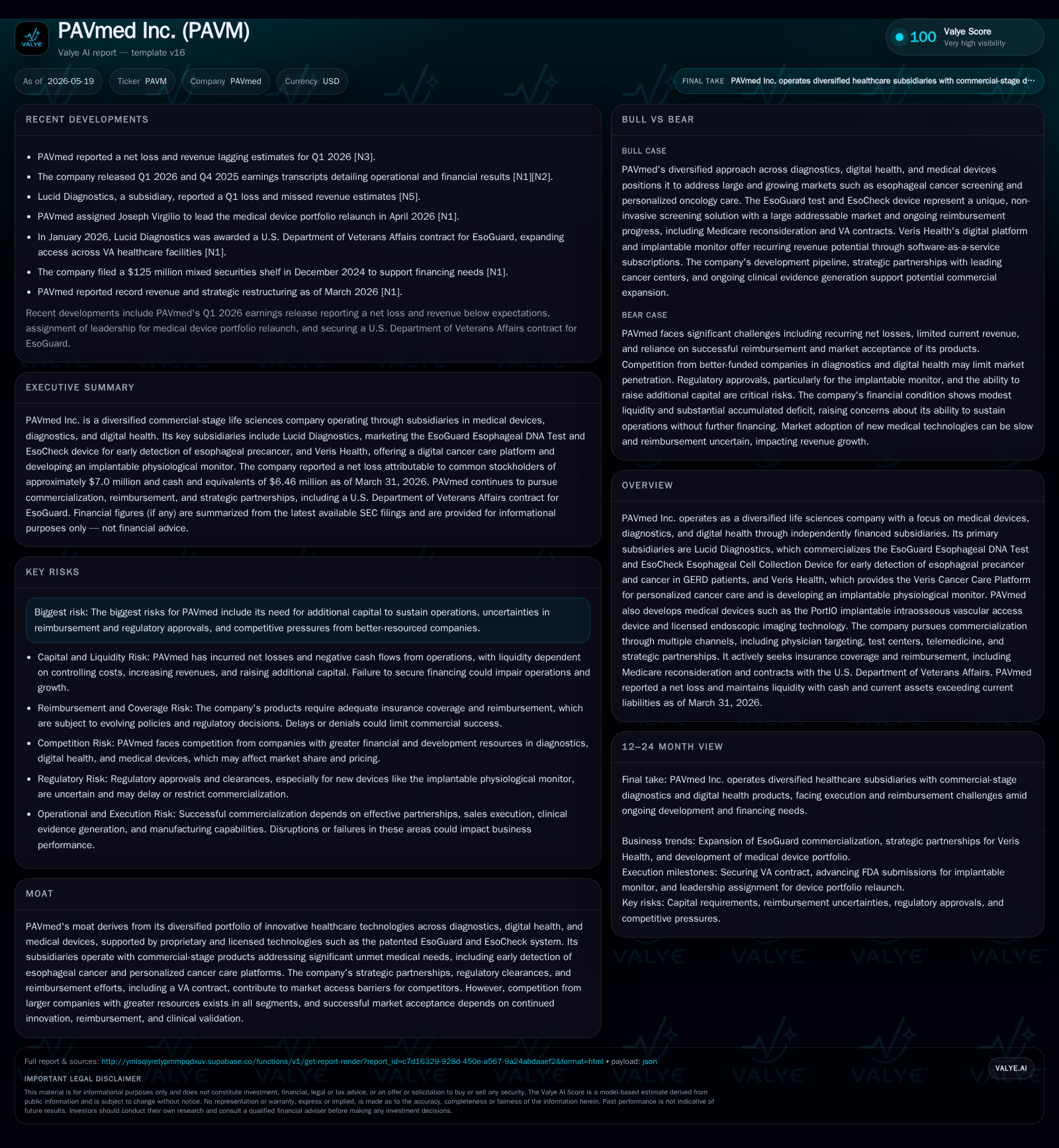
PAVmed Inc. remains focused on advancing its diversified portfolio of medical technologies through its subsidiaries, particularly Lucid Diagnostics’ EsoGuard test and Veris Health’s digital cancer care platform. Despite some modest revenue, the company reported a net loss of approximately $7 million in Q1 2026 and continues to generate negative cash flow, underscoring its dependence on external financing to sustain operations. PAVmed’s competitive moat arises from its proprietary diagnostic technologies and strategic partnerships, though it faces execution risk related to reimbursement, market adoption, and capital availability.
Recent Operating Update
In its Q1 2026 Form 10-Q filed May 14, 2026, PAVmed reported very limited revenue generation (less than $0.1 million) but incurred a significant net loss attributable to common stockholders of approximately $7 million [S2]. The company reiterates that sustaining operations beyond the near term is contingent on managing operating expenses tightly within amounts funded by management service contracts with subsidiaries (notably Lucid Diagnostics), growing revenues from the Veris Cancer Care Platform, and securing additional financing through equity or debt means or warrant exercises [S2]. The filing explicitly notes substantial doubt about the ability to continue as a going concern over the next year without such financing.
The subsequent day’s Form 8-K reiterated these financial results alongside a business update emphasizing ongoing commercialization efforts mainly at Lucid Diagnostics and Veris Health subsidiaries [S3]. Earnings transcripts from the same period echo flat revenue performance overshadowed by continued operating losses as the company advances early-stage commercialization initiatives [N1][N3].
Business Model Overview
PAVmed is structured as a diversified life sciences company operating primarily through multiple independently financed subsidiaries focused on medical devices, diagnostics, and digital health solutions. Its largest voting stake is in Lucid Diagnostics, which commercializes the EsoGuard Esophageal DNA Test performed on samples collected via the FDA-cleared EsoCheck Esophageal Cell Collection Device for early detection of esophageal precancer in patients suffering from GERD—a significant risk population for esophageal adenocarcinoma (EAC) [S1]. This product suite represents a first-to-market targeted next-generation sequencing assay measuring methylation markers (VIM and CCNA1 genes), offering both high sensitivity and specificity in clinical studies.
Another majority-owned subsidiary is Veris Health, which develops and commercializes digital healthcare platforms aimed at personalizing cancer care during treatment and survivorship phases. Veris is also progressing on an implantable physiological monitor designed to interface with its cancer care software ecosystem to improve patient management outcomes [S1].
Beyond these core subsidiaries, PAVmed maintains development programs in other device categories such as PortIO—a novel implantable intraosseous vascular access device—and recently acquired licensed endoscopic imaging technologies from Duke University to expand its clinical footprint across procedural domains [S1].
The business model relies heavily on advancing these innovative products through regulatory clearances and insurance reimbursement pathways while leveraging strategic partnerships—including VA contracts—to scale market access. However, most products remain early in commercialization resulting in current top-line generation still at nascent levels.
Industry Structure and Competitive Position
PAVmed operates in highly regulated sectors characterized by long product development cycles due to extensive FDA oversight for medical devices and diagnostics. Reimbursement complexity poses a key industry hurdle; third-party payor decisions directly impact adoption rates for clinically innovative yet higher-cost diagnostic tests like EsoGuard or emerging digital therapeutics platforms like Veris Health’s software suites.
Competitively, PAVmed faces rivalries from larger entrenched medical device firms with broader sales infrastructure and deeper pockets for clinical validation investments. Yet it maintains differentiation rooted in proprietary molecular diagnostic assays protected by patents, FDA-cleared noninvasive sampling methods (EsoCheck), and an integrated digital health approach targeting personalized oncology care management.
The shared services subsidiary model reflects industry-wide trends toward flexible financing structures allowing operational focus while managing capital allocation efficiently across early-stage assets requiring discrete clinical development pathways.
Growth Drivers
Key near-term growth catalysts center on expanding EsoGuard adoption among gastroenterologists treating GERD patients who represent an under-screened demographic for esophageal cancer prevention. The product’s noninvasive nature paired with ongoing insurance coverage efforts—including pursuing Medicare reimbursement—may unlock broader volume if physicians perceive favorable cost-benefit dynamics compared with endoscopic biopsy surveillance programs [S1][N1]. Deployment channels include direct physician office targeting, test center partnerships, telemedicine integrations facilitating sample collection logistics, and strategic alliances.
Veris Health’s digital platform offers an incremental expansion opportunity in oncology survivorship management where precision medicine demands scalable data-driven tools. Commercial traction depends on securing insurance coverage for software components plus demonstrating meaningful clinical utility via prospective outcomes studies.
Meanwhile, the implantable physiological monitor under development could represent a longer-term structural growth driver expanding Veris’ ecosystem into continuous biometric monitoring post-treatment—a segment witnessing growing investor interest due to remote patient monitoring trends exacerbated by shifts toward value-based care.[S1]
Expansion of PAVmed’s medical device portfolio via internal innovation or licensing deals (such as the recent Duke-derived endoscopy imaging tech acquisition) could also provide fresh revenues if successfully commercialized; however, timelines remain uncertain given regulatory paths.[S13]
Risks and Constraints
The most salient risks center around persistent capital constraints that limit PAVmed's ability to fund R&D expenditures adequately or scale commercial activities rapidly enough to generate self-sustaining cash flow [S2]. The company acknowledges substantial doubt about continuing operations without new financing arrangements
Reimbursement uncertainties create another critical barrier; without widespread third-party payor acceptance at adequate rates for EsoGuard or Veris offerings, customer adoption may stagnate given out-of-pocket cost sensitivities for patients or provider reluctance due to budget pressures.[S5]
Manufacturing scalability poses challenges as well: clinical testing volumes need dedicated laboratory capacity expansion; any disruption in processing capabilities would adversely affect customer satisfaction and revenue generation [S5]
Regulatory risks persist throughout all stages: FDA approvals or clearances require costly clinical trials that may not yield successful outcomes; ongoing compliance burdens entail substantial operational expense; product recalls or safety issues could impact reputation severely.[S6][S11]
Competition with well-capitalized incumbents possessing broader distribution networks may slow PAVmed’s market penetration unless proprietary technologies maintain clear superiority supported by peer-reviewed evidence.[S1]
Lastly, being subject to healthcare laws including anti-kickback statutes and data privacy regimes necessitates comprehensive compliance frameworks failure of which might result in penalties or reputational damage.[S5]
What to Watch Next
Critical upcoming milestones include:
- Demonstrable ramp in EsoGuard sales volumes supported by continued insurance coding achievements and expanded physician engagement.
- Regulatory progress regarding Veris Health's implantable physiological monitor including initiation of pivotal trials or FDA submissions.
- Execution of strategic partnerships or licensing agreements that broaden distribution or embed PAVmed’s technologies into broader oncological care pathways.
- Capital raising events—equity offerings or debt refinancing—that shore up runway past the next twelve months given existing net leverage (~$8.54 million) relative to available cash ($6.46 million) reported at quarter-end[S2][F1].
- Clinical validation publications enhancing credibility among payors and providers potentially accelerating reimbursement uptake.
- Manufacturing capacity enhancements ensuring ability to meet increased demand without compromising turnaround times.
- Monitoring developments related to Vidacare acquisition integration (PortIO device) rollout progress.
Financial Profile Summary
As of March 31, 2026, PAVmed held approximately $6.46 million in cash against total debt near $15 million translating into net debt estimated at about $8.54 million [F1], reflecting high leverage levels typical of early commercial-stage biopharma/device ventures reliant on financing rounds. The current ratio hovered around 2.02 indicating short-term asset coverage over liabilities but does not alleviate concerns about sustainability absent revenue growth or new funding [F1][S2]. Operating expenses continued outpacing revenues resulting in recurring losses (~$7 million net loss Q1 2026) illustrating persistent cash burn dynamics [S2].
Management emphasizes reliance on proceeds from equity issuances—common stock, preferred stock—and warrants alongside potential debt refinancings or conversions to underpin liquidity going forward [S2]. This profile situates PAVmed firmly within developmental stage enterprises balancing R&D investment against nascent commercial returns under tight funding conditions.
Disclaimer
This analysis is based solely on disclosed SEC filings as of May 19, 2026, supplemented by recent public earnings call transcripts where cited. It contains no investment advice or research views but serves as an objective examination of PAVmed Inc.’s operational developments, business model context, competitive landscape positioning, growth prospects and associated risks within its sector framework.
Disclaimer: This is research-only, informational analysis and not investment advice. It may include AI-generated interpretation and general industry context. Always verify important details using primary sources.

Comments