
PagerDuty, Inc. (PD) — AI-Driven Digital Operations Management Navigating Growth and Restructuring
PagerDuty’s cloud-based platform integrates AI-powered automation across 700+ enterprise tools, driving operational resilience. Recent profitability and expanded AI capabilities underpin growth potential amid restructuring and leadership changes.
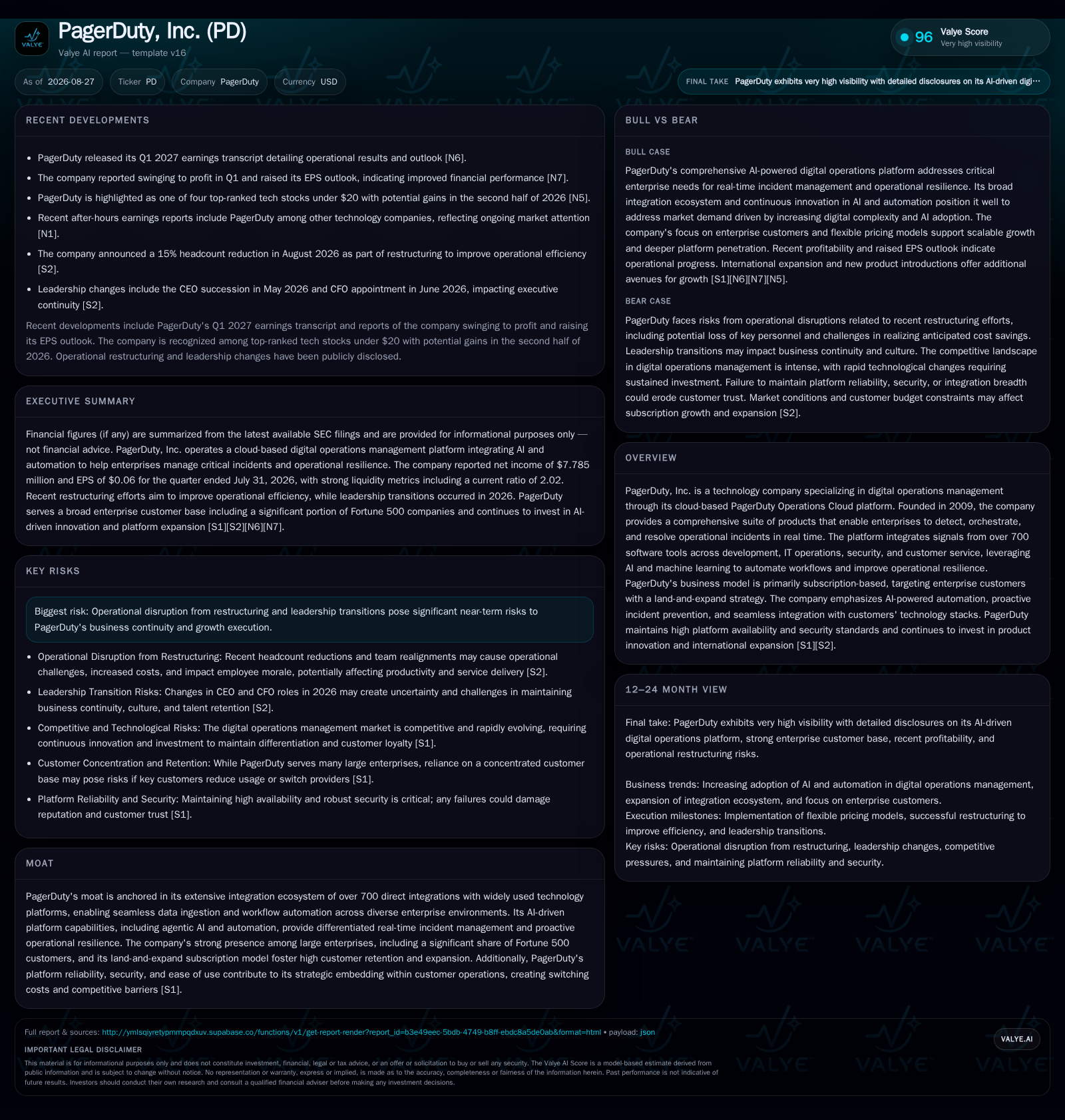
PagerDuty leverages a broad integration ecosystem and AI-driven incident management to serve large enterprises with a subscription-based, land-and-expand model. Recent profitability and raised EPS outlook signal operational progress, but restructuring and leadership transitions pose short-term risks. Durable competitive advantages stem from deep integrations, AI capabilities, and enterprise customer relationships. Key growth drivers include international expansion and AI innovation, balanced against competitive pressures and execution challenges.
PagerDuty operates a sophisticated cloud-based digital operations management platform that blends AI-powered automation with extensive integrations to help enterprises detect, orchestrate, and resolve incidents in real time. The company’s recent swing to profitability and raised EPS outlook reflect operational improvements amid a challenging macro environment. However, a 15% reduction in headcount and executive leadership changes introduce uncertainty in execution. PagerDuty’s core strengths lie in its expansive integration ecosystem and AI capabilities, which underpin a subscription-based, land-and-expand model focused on large enterprises. Whether the company can capitalize on rising demand for AI-driven operational resilience while navigating restructuring will shape its medium-term trajectory.
Latest Operating Snapshot
PagerDuty reported net income of $7.785 million and diluted EPS of $0.06 for the quarter ended July 31, 2026, marking a profitable quarter after prior periods of losses [S1]. This profitability milestone is significant as it indicates operational leverage beginning to materialize alongside revenue growth. The company also maintains a healthy liquidity profile, with a current ratio of 2.02, providing potential financial flexibility to invest in growth initiatives [S2].
In August 2026, PagerDuty undertook a restructuring that included a 15% reduction in headcount aimed at improving operational efficiency, signaling management’s focus on cost discipline amid evolving market conditions [S2]. Additionally, leadership transitions occurred in 2026 with a new CEO appointed in May and a new CFO in June, which could influence strategic direction and execution dynamics [S2]. PagerDuty continues to serve a broad enterprise customer base, including a substantial portion of Fortune 500 companies, and integrates signals from over 700 software tools spanning development, IT operations, security, and customer service [S1].
Business Model and Unit Economics
PagerDuty primarily generates revenue through subscriptions to its cloud-based digital operations management platform. Its land-and-expand strategy targets large enterprises, initially onboarding clients with core monitoring and incident management capabilities and then expanding usage into adjacent functions such as security and customer service orchestration. This approach leverages existing customer relationships to grow account value over time, allowing PagerDuty to increase pricing via volume and feature adoption. The company’s pricing likely combines per-user or per-device fees with tiered service levels, balancing volume-based scale with value capture from AI-driven automation features [S1].
Operating economics depend on maintaining high platform availability and rapid integration capabilities across a wide ecosystem of over 700 software tools, which entails ongoing development and cloud infrastructure costs. The business exhibits a mix of fixed costs—such as platform engineering, AI R&D, and data center expenses—and variable costs linked to customer acquisition and support. The 15% workforce reduction aims to improve operating leverage by cutting fixed costs, but the risk is that service quality or innovation velocity could be affected. Capital intensity remains moderate as a software-as-a-service (SaaS) provider, with investments focused on AI innovation and international market expansion. If PagerDuty can scale revenue faster than fixed costs, particularly through upselling in existing accounts, operating margin expansion should follow.
Moat, Competition and Counterforces
PagerDuty’s competitive moat primarily rests on its extensive integration ecosystem of over 700 direct connections to widely used enterprise software spanning development, IT operations, security, and customer service. This breadth enables seamless data ingestion and workflow automation across complex, heterogeneous technology stacks, creating switching friction as customers embed PagerDuty deeply into their operational workflows. Additionally, PagerDuty’s AI-driven capabilities—such as agentic automation and proactive incident prevention—differentiate its platform by reducing manual toil and minimizing downtime, which are critical value propositions for large enterprises [S1].
The company’s strong penetration among Fortune 500 customers, coupled with a subscription-based land-and-expand model, fosters high retention and expanding average revenue per user. However, competition is intense from legacy IT operations management providers, emerging AI-driven startups, and large cloud platform vendors seeking to bundle incident management with broader cloud services. Rapid technological change and evolving customer demands require PagerDuty to continuously innovate to maintain differentiation. Counterforces include potential customer concentration risk, operational disruption from restructuring, and leadership transitions that could affect execution speed and culture [S2]. Maintaining platform reliability and security is another critical moat element, as failures would quickly erode customer trust.
Bull Case
In the bull scenario, PagerDuty capitalizes on growing enterprise demand for AI-powered operational resilience amid increasing IT complexity and digital transformation. The company’s comprehensive integration ecosystem and AI innovation, including agentic automation capabilities, position it as a go-to platform for real-time incident management across IT, security, and customer service domains. Continuous expansion of integrations and international market penetration fuel top-line growth, while the land-and-expand subscription model drives strong account-level revenue scaling and improved unit economics. Operational restructuring achieves targeted cost efficiencies without impairing innovation or customer service, enabling sustained margin expansion.
Confirmation of this scenario includes consistent quarterly revenue growth accelerating beyond market averages, expanding gross and operating margins, and rising customer counts within Fortune 500 accounts. The raised EPS outlook and recent profitability serve as early indicators. Successful leadership transitions stabilize the company’s strategic execution and culture. Falsification would occur if customer churn rises, integration breadth stagnates, or AI innovation fails to deliver meaningful differentiation, leading to pricing pressure or slower adoption in key markets.
Base Case
Under the base case, PagerDuty navigates the restructuring and leadership changes with moderate disruption but remains largely on its growth trajectory. Revenue growth continues at a steady, single-digit to low double-digit rate, driven primarily by upselling within existing enterprise customers and measured new customer acquisition. The company maintains profitability with modest margin improvements, balancing ongoing AI investments with cost discipline. The integration ecosystem expands incrementally, preserving the company’s competitive position but without major breakthroughs in new geographies or product categories.
In this scenario, operational efficiencies from headcount reductions are partially realized but offset by some temporary setbacks in innovation speed or customer support. Leadership transitions bring some cultural adjustment but no material strategic shifts. The competitive environment remains challenging but PagerDuty maintains its core customer base and platform reliability. Key metrics such as subscription continued-adoption indicators, net dollar retention, and expansion bookings show stability but no outsized acceleration. A falsification of the base case would be either sustained operational disruption causing revenue stagnation or a strong market rebound leading to accelerated growth.
Bear Case
The bear case sees PagerDuty suffering significant operational disruption from its restructuring and leadership transitions, leading to loss of key personnel, degraded service quality, and slower innovation. Competitive pressures intensify as rivals gain traction with more comprehensive or cost-effective digital operations solutions, eroding PagerDuty’s market share. The company struggles to maintain platform reliability and security, resulting in customer dissatisfaction and increased churn, particularly among large enterprise clients. Customer budget constraints due to macroeconomic factors further constrain subscription growth and expansion opportunities.
Confirmation of this downside includes sequential declines or flattening in revenue, deteriorating gross or operating margins, increased customer churn, and failure to meet raised EPS guidance. Any negative signals from integration delays, security incidents, or client defections would reinforce this scenario. Falsification would come from rapid recovery of growth rates, successful stabilization of operations, and renewed customer wins indicating resilience and competitive strength.
What Matters Next
Key metrics and milestones to monitor include quarterly revenue growth rates and net income trends to assess whether profitability gains are sustainable and scaling. Monitoring gross and operating margin trajectories will reveal if restructuring delivers durable cost benefits without impairing growth investments. Subscription metrics such as net dollar retention rates and customer expansion bookings will indicate success of the land-and-expand strategy within large enterprises.
Other critical KPIs are customer churn rates, particularly among Fortune 500 accounts, and integration velocity measured by the number of new software tools supported or depth of existing integrations. Leadership stability and organizational morale post-restructuring can be gauged through management commentary and employee turnover data. Finally, progress in international expansion and successful launches of AI-driven product enhancements will be important leading indicators of future growth potential.
Disclaimer: This is research-only, informational analysis and not investment advice. It may include AI-generated interpretation and general industry context. Always verify important details using primary sources.

Comments