
PDS Biotechnology’s Pivotal Bet on PDS0301: Pipeline Concentration, Partnership Stakes, and the Road to Clinical Validation
PDS Biotechnology Corp has narrowed its focus to the tumor-targeted immunocytokine PDS0301, discontinuing internal development of PDS0101 and heightening its dependence on a single clinical asset. With no approved products, ongoing losses, and Nasdaq listing risk, the company’s future hinges on clinical milestones, capital access, and its ability to secure partnerships for sidelined pipeline programs.
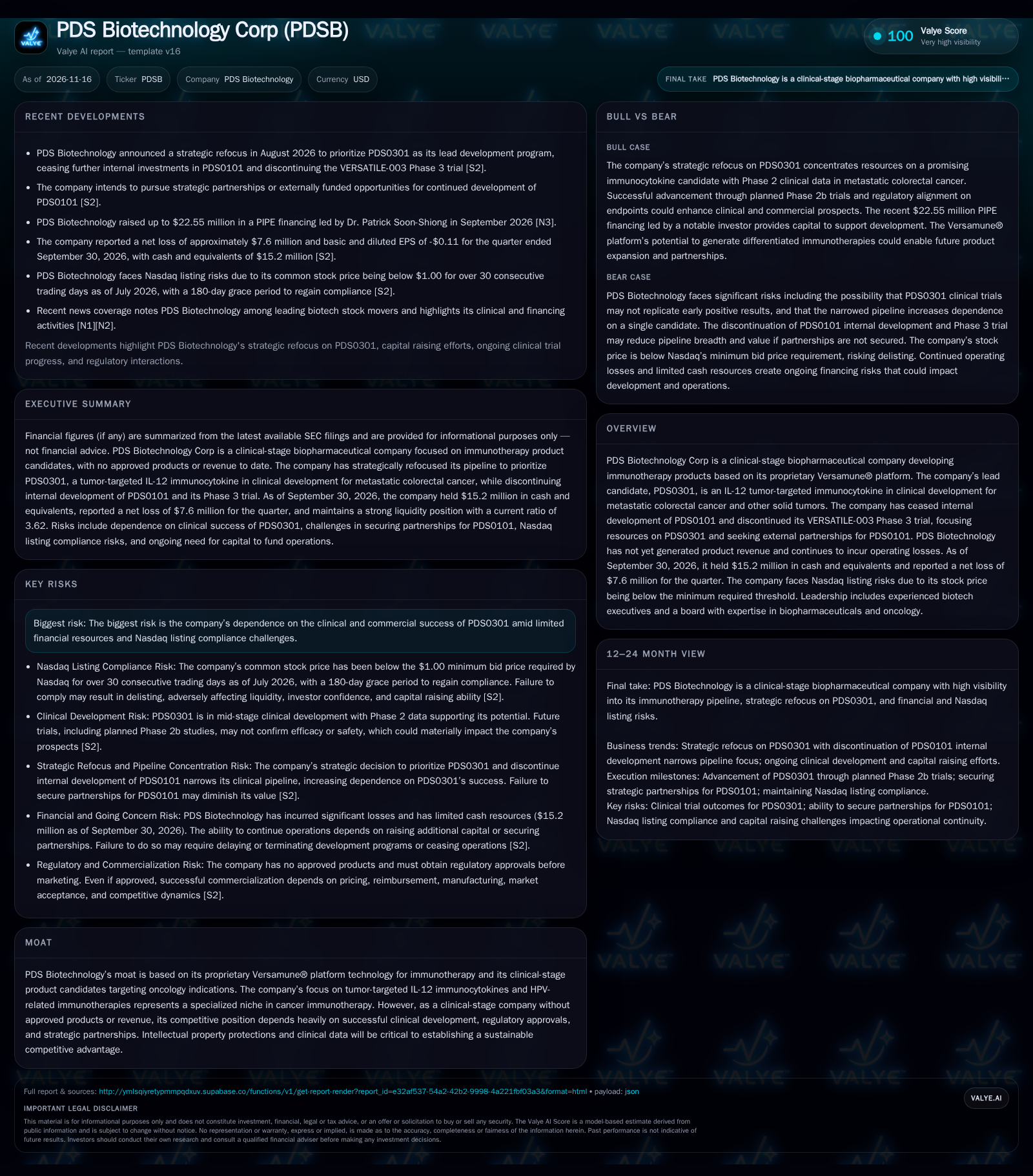
PDS Biotechnology now relies on PDS0301 as its sole internally funded clinical asset after discontinuing PDS0101 development. With $15.2 million in cash and persistent losses, the company faces Nasdaq compliance risks and depends on clinical success and external deals to extend its runway and unlock value. The next 12-24 months will be defined by PDS0301’s trial outcomes, partnership traction, and capital-raising ability. [S2]
PDS Biotechnology Corp stands at a critical inflection point after an August 2026 strategic pivot that concentrated its pipeline around PDS0301, a tumor-targeted IL-12 immunocytokine. With PDS0101’s internal development and pivotal trial discontinued, the company’s prospects are now almost entirely tied to the clinical, regulatory, and commercial trajectory of its lead candidate. This focus, while potentially sharpening execution, magnifies risk: PDS Biotechnology has no product revenue, persistent operating losses, and faces Nasdaq delisting if its share price does not recover. The coming quarters will test whether PDS0301’s promise—and partnership ambitions for other assets—can overcome these structural challenges and secure a sustainable future.
Pipeline Narrowing and Listing Pressure Define the Present Stakes
The most consequential recent development for PDS Biotechnology is its August 2026 decision to cease internal investment in PDS0101 and discontinue the VERSATILE-003 Phase 3 trial, consolidating its resources behind PDS0301 as the lead program in metastatic colorectal cancer and other solid tumors [S2]. This strategic refocus leaves the company with a single internally funded clinical-stage asset, heightening both the potential upside and the concentration risk.
As of September 30, 2026, PDS Biotechnology reported $15.2 million in cash and equivalents, a current ratio of 3.62, and a net loss of $7.6 million for the quarter, with an accumulated deficit of $241.3 million [S2]. The company remains pre-commercial, with no approved products or product revenue to date [S2].
A further source of near-term uncertainty is the Nasdaq listing risk: PDSB’s stock price has traded below $1.00 for over 30 consecutive trading days as of July 2026, triggering a 180-day grace period to regain compliance [S2]. This adds urgency to both clinical progress and any strategic actions that might boost investor sentiment or access to capital.
Immunotherapy Economics: High-Risk, High-Reward, and Cash-Burning Until Validation
PDS Biotechnology’s current business model is typical of clinical-stage biotech: it is a high fixed-cost, negative cash-flow operation entirely dependent on external funding until (and unless) a candidate is approved. With the pipeline narrowed to PDS0301, all value creation is tied to successful clinical progression and eventual regulatory approval, which could unlock high-margin, premium pricing opportunities if the therapy demonstrates superior efficacy and safety in a competitive oncology landscape.
The economics of immunocytokine therapies, especially those that can target solid tumors with differentiated mechanisms (such as IL-12 delivery), suggest attractive pricing potential if significant clinical benefit is proven. However, absent product revenue, PDS Biotechnology’s expense base is dominated by R&D, clinical trial costs, and overhead—largely fixed in the near term, with variable costs scaling only if commercial manufacturing or sales begin.
Operating leverage may materialize post-approval, but in the current phase, each clinical setback or delay could force a capital raise or program delay. The cessation of PDS0101 internal development may reduce near-term burn, but also sacrifices potential diversification benefits. The company reported cash and liquidity metrics for the period; these figures do not by themselves establish operating runway, investment capacity, financial flexibility, or financing capacity. [S2]
Betting on Versamune®: Differentiation Claims Versus Oncology’s Crowded Field
PDS Biotechnology’s core claimed advantage is its proprietary Versamune® platform, which enables targeted delivery of immunomodulatory payloads like IL-12 directly to tumors. In theory, this could enhance anti-tumor immunity while reducing systemic toxicity—a key challenge in cytokine-based immunotherapies.
However, the company occupies a highly competitive and rapidly evolving oncology landscape, with numerous large and emerging players pursuing immunotherapies for solid tumors. Competing modalities include checkpoint inhibitors, CAR-T, bispecific antibodies, and other cytokine-based approaches. Without conclusive late-stage clinical data or validated commercial partnerships, PDS Biotechnology’s competitive moat remains largely theoretical.
Intellectual property around Versamune® may provide some protection, but barriers to entry in oncology are often more about clinical data, regulatory execution, and commercial partnerships than platform patents alone. The company’s ability to secure external funding or licensing deals for PDS0101 will be a key test of its perceived differentiation.
If PDS0301 Delivers Strong Phase 2b Data, Value Inflection Is Possible
The clearest path to value creation for PDS Biotechnology is positive, statistically significant Phase 2b data for PDS0301 in metastatic colorectal cancer or another solid tumor indication. If the ongoing or planned studies confirm robust efficacy, safety, and a differentiated profile relative to existing immunotherapies, the company could attract partnership interest, non-dilutive funding, or even acquisition attention from larger oncology players.
Evidence confirming this upside would include: publication or presentation of compelling clinical data, initiation of partnering discussions or deals, and a sustained share price recovery above $1.00.
Falsification would come from inconclusive or negative trial results, regulatory delays, or failure to generate external interest in the platform despite positive data.
Execution on a Single-Asset Strategy: Incremental Progress, Persistent Funding Needs
The most plausible scenario is incremental progress in PDS0301’s clinical development, with ongoing data generation but no near-term registration-enabling readout. In this scenario, PDS Biotechnology continues to report modestly positive updates from mid-stage trials, manages its cash burn through disciplined spending, and seeks external partnerships for PDS0101 without immediate success.
The company likely remains reliant on periodic capital raises—potentially at dilutive terms if share price remains depressed—while navigating Nasdaq compliance risk. Confirmation would come from continued trial enrollment, regular safety and interim efficacy updates, and announcements of partnership discussions (even if not finalized).
Falsification of this scenario would involve clinical setbacks, inability to raise new capital, or a forced delisting from Nasdaq that further impairs liquidity and access to institutional investors.
Clinical or Funding Setbacks Could Trigger a Downward Spiral
The most acute risk is that PDS0301 fails to demonstrate efficacy or safety in ongoing trials, leading to program discontinuation or indefinite delay. Given the company’s single-asset focus, such an outcome would leave PDS Biotechnology without a viable lead program, likely forcing it to suspend operations, seek a distressed sale, or liquidate assets.
In parallel, if capital markets remain unreceptive or the company is unable to maintain its Nasdaq listing, PDS Biotechnology could face immediate liquidity constraints, further limiting its ability to fund trials, retain staff, or attract partners. Confirmation of this downside would include negative or halted clinical updates, SEC filings signaling going concern issues, and a formal delisting notice from Nasdaq.
Partial mitigation could come from last-resort partnership deals or asset sales, but these would likely come at unfavorable terms in a distressed context.
Milestones That Will Make or Break the PDS Biotechnology Thesis
Progress and results from ongoing or planned Phase 2b clinical trials of PDS0301, including interim efficacy and safety data releases.
Updates on the process and outcome of partnership or licensing discussions for PDS0101—deal announcements or term sheets would be concrete signals.
Nasdaq listing status: formal notifications, grace period milestones, or any reverse split or corporate actions to regain compliance.
Board or management commentary on strategic alternatives, including potential mergers, asset sales, or wind-down scenarios if clinical or financial setbacks occur.
Regulatory interactions or feedback, such as FDA guidance on trial endpoints or design, that could accelerate or delay PDS0301’s path to approval.
Announcements of new equity, debt, or non-dilutive funding arrangements that materially extend the operating runway.
Disclaimer: This is research-only, informational analysis and not investment advice. It may include AI-generated interpretation and general industry context. Always verify important details using primary sources.

Comments