
Pfizer Faces Revenue Pressure Amid Patent Expiries and Pricing Reforms in 2025
Pfizer’s 2025 results reflect modest revenue decline, sustained operating cash flows, and ongoing risks from regulatory and market dynamics.
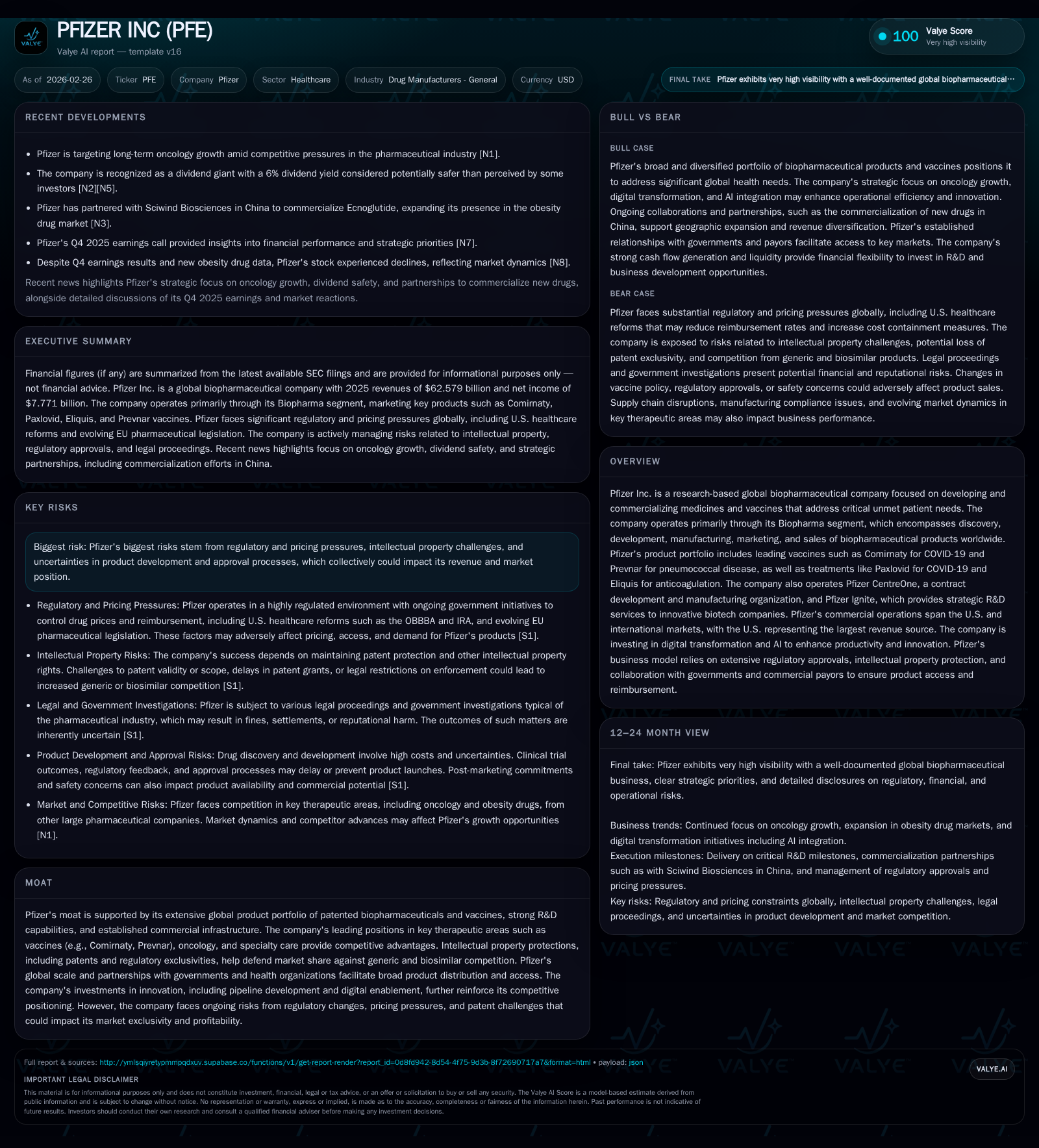
Pfizer Inc reported $62.6 billion in revenue for 2025, down slightly from 2024's $63.6 billion, reflecting patent challenges and pricing pressures. Net income declined to $7.8 billion with free cash flow near $9.1 billion supporting capital allocation without buybacks in recent years. The company operates through its global Biopharma segment, maintaining leadership in vaccines and specialty medicines while navigating intensified regulatory scrutiny and evolving drug pricing policies. Pipeline innovations and international vaccine contracts underpin growth prospects but the upcoming years pose headwinds as exclusivity losses accelerate.
Historical Performance
Pfizer's revenue trajectory over the past four years reveals a peak of approximately $100.3 billion in FY2022, bolstered largely by extraordinary COVID-19 vaccine sales. However, this elevated base has since contracted significantly due to normalization post-pandemic. Revenues decreased to $58.5 billion in FY2023 before partially rebounding to $63.6 billion in 2024 and marginally declining by 1.6% to $62.6 billion in FY2025 [F1]. Correspondingly, net income surged from just over $2.1 billion in 2023 to $8 billion in 2024, reflecting a recovery phase, before easing slightly by 3.2% to about $7.7 billion in 2025.
Operating cash flows have remained robust, albeit reduced from the pandemic peak of nearly $29.3 billion in FY2022 to $11.7 billion by FY2025 — still more than double pre-pandemic levels [F1]. Capital expenditures have been prudently scaled down from a high of around $3.9 billion in FY2023 to $2.6 billion most recently, underscoring a shift toward efficiency and selectivity in investments while managing legacy assets [F1]. Notably, Pfizer suspended buybacks entirely over the past two years following a modest repurchase of about $2 billion in FY2022 [F1], likely reflecting cautious capital deployment during patent expiries and regulatory uncertainties.
Historical performance (annual)
| FY | Rev ($bn) | Net ($bn) | CFO ($bn) | Capex ($bn) | Rev YoY | Net YoY |
|---|---|---|---|---|---|---|
| 2025 | 62.6 | 7.8 | 11.7 | 2.6 | -1.6% | -3.2% |
| 2024 | 63.6 | 8.0 | 12.7 | 2.9 | +8.8% | +279.0% |
| 2023 | 58.5 | 2.1 | 8.7 | 3.9 | -41.7% | -93.2% |
| 2022 | 100.3 | 31.4 | 29.3 | 3.2 |
Source: SEC companyfacts cache [F1].
Capital returns and efficiency (annual)
| FY | Buybacks ($bn) | FCF ($bn) | ROE% |
|---|---|---|---|
| 2025 | 9.1 | 9.0 | |
| 2024 | 0.0 | 9.8 | 9.1 |
| 2023 | 0.0 | 4.8 | 2.4 |
| 2022 | 2.0 | 26.0 | 32.8 |
Source: SEC companyfacts cache [F1].
Note: Dividend data not explicitly available; buybacks resumed only intermittently.
Business Overview & Moat
Pfizer Inc operates predominantly through its Biopharma segment, comprising discovery, development, manufacturing, marketing, and sales of biopharmaceutical products worldwide . Core assets include blockbuster vaccines such as Comirnaty (COVID-19) and Prevnar (pneumococcal), alongside specialty therapeutics like Paxlovid for COVID-19 treatment and Eliquis for anticoagulation.
The company's moat derives from an extensive portfolio of patented biologics combined with strong R&D capabilities enabling pipeline replenishment and lifecycle management . Intellectual property protections provide exclusivity windows that defend revenue streams against biosimilar competition; however, these are increasingly challenged with many expirations anticipated to accelerate between now and the end of the decade [S7][S16]. Pfizer’s well-established global marketing infrastructure facilitates broad access especially amid partnerships with governments on vaccine supply agreements internationally—including flexible contract amendments facilitating dose deliveries through at least 2026 across regions such as the EU [S21].
Furthermore, strategic units like Pfizer CentreOne offer contract development and manufacturing expertise servicing external biotech innovators while Pfizer Ignite extends strategic R&D services—a diversification that complements core commercial operations and underscores the company's innovation ecosystem engagement .
Regulatory & Pricing Environment Risks
Pfizer faces intensifying regulatory scrutiny on several fronts: drug approval processes require rigorous demonstration of efficacy and safety; pharmacovigilance obligations continue throughout product lifecycles; compliance with anti-kickback laws as well as federal price regulations are imperative [S1][S16]. Pricing is particularly sensitive given public and governmental pressure for affordability.
Key policy changes include the U.S.'s 'Most-Favored Nation' (MFN) drug pricing initiatives aimed at lowering costs by reference to prices paid internationally—a program Pfizer is adapting to following executive orders issued mid-2025 [S1][S15]. In Europe, sweeping pharmaceutical legislation reforms set to become effective post-2028 will reshape market access pathways including joint health technology assessments potentially impacting reimbursement decisions at scale [S1][S22].
Despite these challenges, Pfizer maintains significant negotiation leverage given its unique vaccine offerings incorporated into national immunization programs globally, although competition via tenders remains an ongoing commercial risk [S1][S21]. Consolidation trends amongst payors—pharmacy chains, wholesalers and PBMs—further concentrate bargaining power against drug manufacturers contributing additional price pressure.[S18]
Legal Challenges & Litigation Contingencies
Pfizer has exposure across multiple legal fronts typical for pharmaceutical multinationals including patent infringement actions—as exemplified by its suit against Azurity Pharmaceuticals over generic apixaban formulations—and product liability claims such as those related to former entities' asbestos-containing products or alleged adverse effects tied to oncology drugs like Docetaxel [S11][S13][S14].
Government investigations focusing on manufacturing practices especially in international sites also add compliance risk layers alongside class action suits linked to products like Chantix following voluntary recalls due to nitrosamine impurities [S11][S19]. While management assesses existing legal reserves as sufficient based on reasonable estimates informed by counsel advice, these matters inherently involve uncertainty that could impact financials depending on outcomes or settlements finalized over time.
Growth Prospects & Outlook
Pfizer reasserted its full-year outlook for FY26 following Q4 results that met or exceeded estimates across revenues and earnings indicators despite stock-market volatility stemming from mixed perceptions around obesity drug clinical data releases among other factors [N2][N10]. Future growth drivers include:
- Continued rollouts of adapted COVID-19 vaccines under amended supply agreements providing volume flexibility through at least next half-decade across developed markets including Europe and emerging countries;
- Expansion efforts around novel specialty care medicines targeting oncology, inflammation/immunology segments alongside incremental launches leveraging digital health technologies;
- Strategic partnerships accelerating innovation pipeline productivity supported by Pfizer Ignite service offerings capturing R&D outsourcing demand among biotech partners.
Potential constraints center mainly on accelerated loss of exclusivities projected at about $1.5 billion impact for patent expirations in calendar year 2026 alone; compounded by ongoing regulatory reform pressures tightening pricing frameworks both domestically and abroad [S7][N10]. Market access challenges may intensify as biosimilars gain foothold within formularies incentivized by cost containment programs.
Monitoring upcoming regulatory milestones such as EU Pharma Package enactment timing along with FDA approvals for next-generation biologics will be critical milestones for assessing sustained growth trajectories.
Capital Allocation & Financial Returns
With approximately a 9% return on equity based on trailing net income relative to shareholder equity, Pfizer demonstrates moderate profitability consistent with large-cap biopharmaceutical peers facing similar lifecycle maturity stages for key franchises [F1]. Free cash flow generation remains solid at roughly $9.1 billion annually providing substantial internal funds to support R&D spending alongside dividends.
Pfizer has largely paused share repurchases since the pandemic wind-down period—likely allocating capital toward pipeline advancement amid patent cliffs rather than aggressive stock return strategies observed pre-crisis; though dividend payout details were not explicit within the most recent filings examined here [F1]. Maintaining liquidity above immediate debt obligations illustrates prudent balance sheet management amidst volatile operational environments.[S6]
Conclusion
Pfizer’s current operational landscape reflects a balance between leveraging durable franchise assets in vaccines and specialty medicines while concurrently managing headwinds from patent expirations, intensified regulatory frameworks, pricing reforms especially in the U.S., and litigation exposures inherent to its industry footprint.
Success hinges on sustaining innovation momentum complemented by contractual agility in global vaccine supply arrangements and adept navigation of evolving healthcare policies shaping market access globally.
Investors should observe upcoming quarterly operating results for developments around pipeline progress updates along with regulatory milestone clearances or adverse rulings that could materially influence near- to medium-term performance outlooks.
This analysis is provided solely for informational purposes without any investment recommendation or advice intended or implied.
Disclaimer: This is research-only, informational analysis and not investment advice. It may include AI-generated interpretation and general industry context. Always verify important details using primary sources.

Comments