
Procter & Gamble's Strategic Pivot Amid Global Challenges and Market Restructuring
P&G navigates a complex global landscape by reshaping its portfolio, bolstering health-focused offerings, and optimizing operational efficiency.
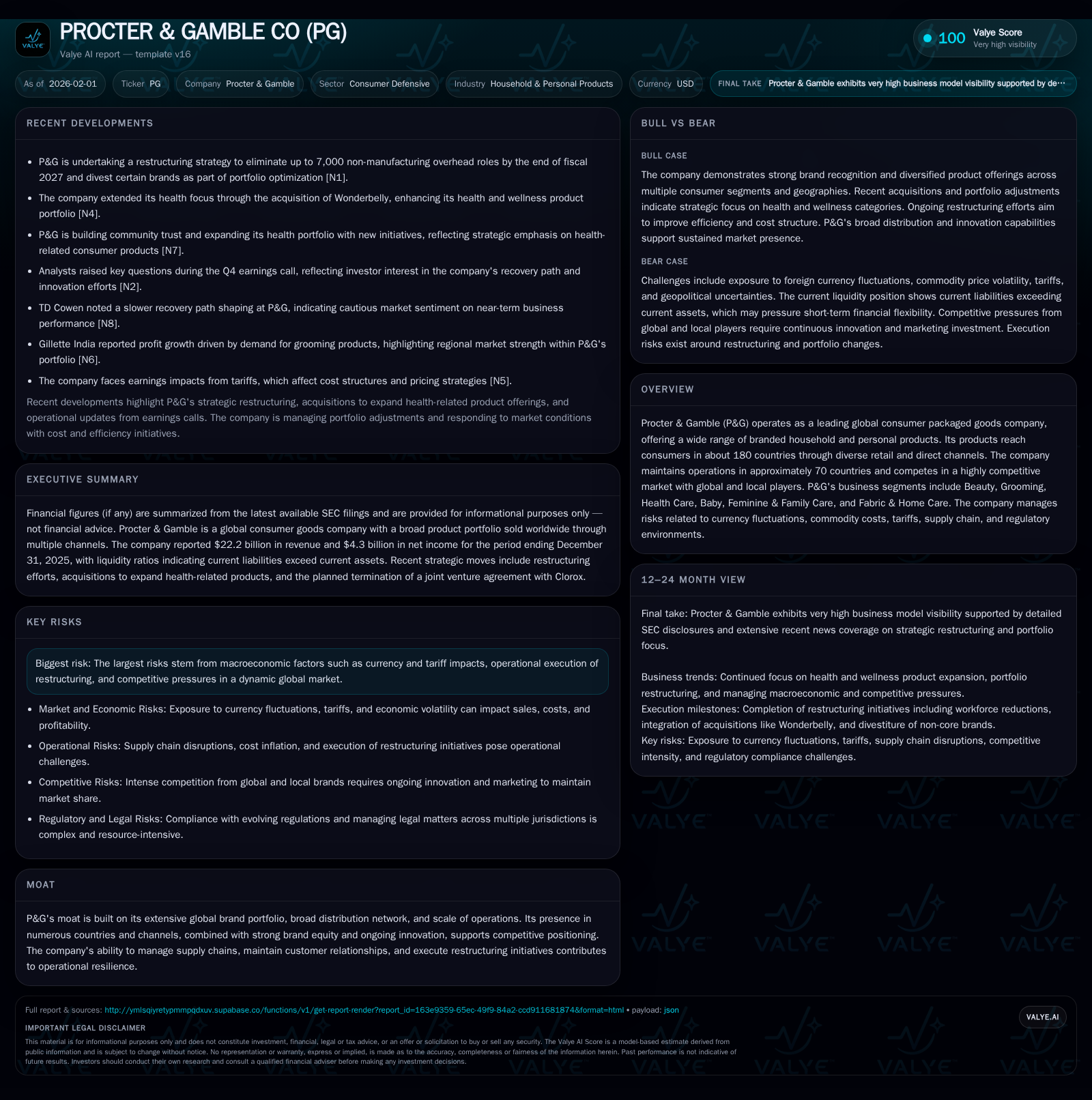
Procter & Gamble (P&G) remains a dominant global player in consumer packaged goods, leveraging its extensive brand portfolio and distribution footprint across approximately 180 countries. Recent developments include a focused restructuring initiative involving workforce reduction and brand divestitures, leadership transition, and an increased emphasis on health-related product expansion. While macroeconomic headwinds such as tariffs, commodity inflation, and currency fluctuations continue to pressure margins, P&G’s scale and productivity efforts provide a buffer. The competitive landscape is intensifying, especially in emerging markets and premium segments, requiring strategic agility and innovation investments.
What Changed Recently
Procter & Gamble has initiated a limited but impactful restructuring strategy aimed at reducing overhead and divesting non-core brands. This program includes the elimination of approximately 7,000 non-manufacturing roles by the end of fiscal 2027, signaling a push towards leaner operations and greater focus on core growth areas [N13][S15]. The company also decided not to renew its Glad joint venture with Clorox, which will result in Clorox purchasing P&G's minority stake. This move is expected to generate around $500 million in cash proceeds and a post-tax gain of $250 to $300 million within fiscal 2026, enabling capital redeployment to higher-growth segments [S15].
In parallel, P&G is expanding its health and wellness footprint through acquisitions such as Wonderbelly, reflecting a strategic pivot towards consumer health products amid growing demand for preventive and functional wellness solutions [N5][N8]. Leadership continuity is maintained with COO Shailesh Jejurikar set to succeed Jon Moeller as CEO, underscoring a leadership transition that prioritizes operational execution and strategic renewal [N7].
Despite these proactive initiatives, P&G confronts persistent headwinds from tariffs and inflationary cost pressures. Price increases have been implemented but remain a delicate balancing act to avoid dampening volume growth and consumer demand [N1][S10]. The company’s recent earnings call highlighted cautious optimism but also flagged a slower recovery path, particularly in mature markets where competitive intensity and economic uncertainty persist [N9].
Business Model as a System
At its core, Procter & Gamble operates as a highly integrated global manufacturer and marketer of branded consumer packaged goods, spanning categories such as Beauty, Grooming, Health Care, Baby, Feminine & Family Care, and Fabric & Home Care. Their products reach roughly 180 countries, sold through a diverse array of channels including mass merchandisers, grocery, e-commerce, drug stores, and professional outlets [S1]. This broad distribution network combined with on-the-ground operations in about 70 countries creates both scale advantages and complexity.
P&G’s business model relies on continuous innovation to maintain brand leadership and justify premium pricing. The company manages product lifecycle and portfolio mix actively, leveraging acquisitions and divestitures to optimize segment exposure and growth potential [S2]. Unit volume growth, organic sales increases, and pricing strategies are key performance levers monitored closely by management [S1].
Cost management is critical given exposure to volatile commodity prices, tariffs, and supply chain disruptions. P&G employs productivity initiatives, supply chain optimization, and targeted pricing to mitigate cost inflation. However, gross margins are sensitive to product mix shifts, tariff costs, and investment in packaging and product innovation [S10][S11]. SG&A expense discipline, especially in marketing, can create operating leverage that supports margin expansion when sales scale up [S2].
Financially, P&G maintains a strong liquidity position, with operating cash flow enabling capital expenditures, acquisitions, and shareholder returns, while managing debt maturities prudently [S6][S12]. The company uses adjusted non-GAAP measures to gauge underlying business trends, excluding restructuring and other non-core charges [S6][S15].
Industry Map & Competitive Battlefield
P&G competes in the fast-moving consumer goods (FMCG) sector, a landscape characterized by intense competition from multinational conglomerates like Unilever, Colgate-Palmolive, Johnson & Johnson, and regional/local players that can be nimble and price-sensitive. The household and personal products industry is highly fragmented, with consumers increasingly demanding sustainable, health-conscious, and premiumized offerings.
Emerging market growth is a key battleground, with P&G seeing robust volume gains in Latin America and Europe but facing challenges in North America and parts of Asia where market saturation and competitive pressures are higher [S2]. Local competitors often have better cost structures and distribution intimacy, requiring P&G to tailor products and innovate to meet diverse consumer needs.
Distribution channel evolution, especially the rise of e-commerce and social commerce, demands agility in digital marketing and logistics. P&G’s strong presence across traditional and emerging channels is a competitive moat but requires continuous investment and adaptation [S1].
Tariffs and geopolitical tensions add complexity to global supply chains and cost bases, with P&G exposed to risks from trade disputes and currency volatility. Regulatory scrutiny on product safety, environmental impact, and social governance further intensifies the competitive environment [S19].
Where the Economics Become Real
P&G’s unit economics hinge on balancing volume growth, pricing power, and cost control. Organic volume growth is a key driver, measured excluding acquisitions and divestitures to assess true consumer demand trends [S1]. However, volume growth can be pressured by competitive discounting and market contraction, as seen in some grooming segments where global market share declined by 0.8 points [S2].
Pricing actions have partially offset commodity inflation and tariff costs, but the gross margin has experienced compression due to unfavorable product mix and investments in innovation and packaging—estimated at roughly 100 basis points and 70 basis points impact respectively [S10]. This points to a trade-off between protecting margins and sustaining brand relevance.
Marketing spend reduction has improved SG&A leverage, but long-term growth depends on judicious reinvestment in brand equity and consumer engagement [S2]. Operating income margins remain in the mid-20% range, reflecting scale efficiencies but also the cost challenges of premiumization and supply chain complexity [S11].
Capital allocation prioritizes free cash flow generation, with adjusted free cash flow productivity exceeding 100%, underscoring effective cash conversion and the ability to fund restructuring, acquisitions, and dividends [S6][S18]. The restructuring program’s upfront charges are expected to yield cost savings and operational simplification over time, enhancing profitability [N13][S15].
Diligence Questions / Disconfirming Signals
- How effectively can P&G sustain pricing power without materially eroding volume in the face of inflationary pressures and competitive discounting?
- What are the potential risks and timelines associated with the planned workforce reductions and brand divestitures—could these disrupt operations or consumer perceptions?
- How significant is the impact of the Glad joint venture exit on overall category presence and customer relationships in relevant channels?
- Will the health and wellness portfolio expansion, such as the Wonderbelly acquisition, translate into meaningful growth and margin improvement or remain a niche play?
- How resilient is P&G in managing currency fluctuations and geopolitical risks, especially in markets with macroeconomic instability like Argentina and Nigeria where restructuring occurred?
- Are there early signs of margin pressure in core categories due to increased investment in packaging and innovation, and how sustainable are these investments?
- How is P&G adapting to shifts in consumer purchasing behavior toward e-commerce and direct-to-consumer channels, and what are the margin implications?
- What is the competitive risk from emerging local players in key markets where P&G has historically had scale advantages?
This analysis is based solely on publicly available information, including recent news articles and excerpts from Procter & Gamble’s SEC filings. It does not constitute investment advice or a recommendation to buy or sell securities. The evolving macroeconomic environment and competitive dynamics warrant continuous monitoring.
Disclaimer: This is research-only, informational analysis and not investment advice. It may include AI-generated interpretation and general industry context. Always verify important details using primary sources.

Comments