
PATRIOT GOLD CORP Reports Persistent Losses and Severe Liquidity Constraints in Latest Quarter
The May 2026 quarterly filing highlights ongoing operational dormancy, sustained net losses, and critical short-term liquidity challenges for PATRIOT GOLD CORP, consistent with a junior resource explorer’s typical financial profile.
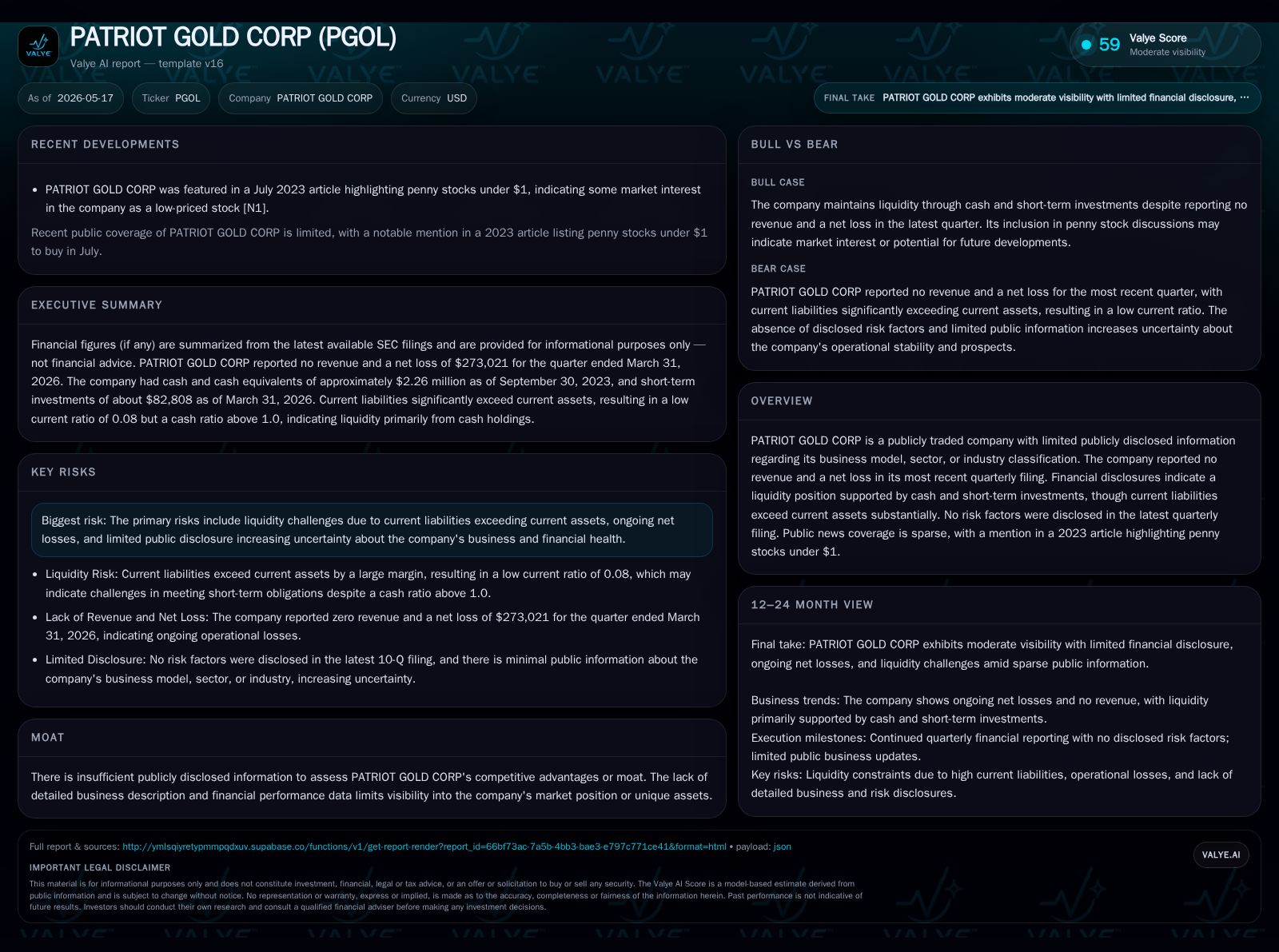
PATRIOT GOLD CORP’s May 15, 2026 10-Q reveals zero revenues and continued net losses amid a liquidity position marked by current liabilities greatly exceeding current assets, resulting in a current ratio near 0.08 [S2], [F1]. The company remains non-revenue generating with no new operating developments disclosed. This financial fragility aligns with junior gold exploration firms reliant on external capital and speculative resource assets. Key risks include severe liquidity pressure, ongoing losses, limited strategic clarity, and potential shareholder dilution through future financings. Investors should monitor upcoming filings for signs of operational progress, capital raises, or improved disclosures to assess any shift in the company’s outlook.
Latest Quarterly Filing: Operational Dormancy and Financial Fragility
PATRIOT GOLD CORP’s May 15, 2026 quarterly report (10-Q) confirms continued operational inactivity with zero revenue recorded and sustained net losses consistent with historical trends [S2]. The filing notably lacks any updates to risk factor disclosures seen in prior annual reports, indicating minimal change in corporate risk posture.
Current assets stood at roughly $178,000 against $2.3 million in current liabilities ([F1]), resulting in an exceptionally low current ratio near 0.08. This imbalance signals significant short-term solvency challenges absent new capital inflows or asset disposals.
Overall, PGOL remains a non-revenue generating entity without disclosed near-term operational catalysts.
Business Model Overview: Junior Resource Exploration Profile
The April 10, 2026 annual filing provides limited insight into PATRIOT GOLD’s value creation mechanism but confirms the absence of active revenue streams [S1]. The company’s sparse disclosure and lack of operating assets align with typical junior gold exploration firms engaged primarily in holding mineral rights or conducting early-stage exploration.
Such entities generally rely on serial equity financings to fund costly exploration activities rather than generating internal cash flow.
Industry Context: Challenges Facing Junior Gold Explorers
Junior gold explorers like PATRIOT GOLD operate within a sector marked by prolonged periods without revenue while awaiting resource validation or strategic transactions. These companies depend heavily on capital markets to finance geological surveys and drilling programs.
Valuations tend to be volatile due to commodity price fluctuations and investor sentiment toward speculative mining ventures. Liquidity pressures frequently lead to dilutive equity issuances to sustain operations.
PGOL’s financial profile—persistent losses combined with constrained liquidity—is characteristic of this high-risk segment lacking immediate production assets.
Growth Drivers: Hypothetical Amid Limited Disclosure
Standard growth catalysts for junior explorers include successful resource discoveries leading to feasibility studies or mergers/acquisitions that enhance asset bases [S1]. Strategic partnerships with established miners could also provide technical expertise and capital access.
However, PATRIOT GOLD’s filings contain no evidence of such developments at present. Without announcements of exploration progress or financing events, growth prospects remain speculative.
Investors should monitor future disclosures for drilling results, property acquisitions, joint ventures, or capital raises that typically serve as value inflection points in this industry.
Risks: Acute Liquidity Pressure and Execution Uncertainty
The company’s most immediate risk arises from its precarious liquidity position; current liabilities exceed current assets by over tenfold ([F1]). Persistent operating losses exacerbate funding needs while limited disclosure clouds management’s strategy for addressing these issues.
Junior resource companies often resort to dilutive equity financings under such conditions, posing dilution risks to shareholders absent clear growth pathways.
Additional sector risks include commodity price volatility impacting project economics and regulatory hurdles affecting exploration permits; however, these are not explicitly discussed by PATRIOT GOLD [S1].
Watchpoints: Critical Indicators to Monitor Going Forward
Key metrics and events for investors to track include:
- Initiation of revenue-generating operations or significant asset sales providing cash inflows.
- Capital raises improving liquidity ratios and reducing solvency pressures.
- Exploration milestones such as drilling assay results indicating resource potential.
- Announcements of strategic partnerships or joint ventures enhancing operational capabilities.
- Updates to risk factor disclosures reflecting evolving governance or risk management practices.
Given recent operational silence beyond financial distress signals [S2], these indicators will be pivotal for reassessing the company’s outlook.
Financial Summary: Liquidity and Profitability Snapshot
This financial snapshot underscores PATRIOT GOLD’s acute short-term liquidity challenges alongside persistent negative earnings—hallmarks of an OTC junior explorer yet to transition toward sustainable operations.
This analysis is based exclusively on publicly available SEC filings and recognized industry characteristics pertinent to junior resource companies. It aims to clarify PATRIOT GOLD CORP's disclosed operating status within its sector context without constituting investment advice.
Disclaimer: This is research-only, informational analysis and not investment advice. It may include AI-generated interpretation and general industry context. Always verify important details using primary sources.

Comments