
Alpine Income Property Trust Expands Capital Access with Equity Programs Amid Steady Net Lease Portfolio Performance
Latest quarterly filings reveal new at-the-market equity programs supplementing Alpine Income’s stable net leased asset operations.
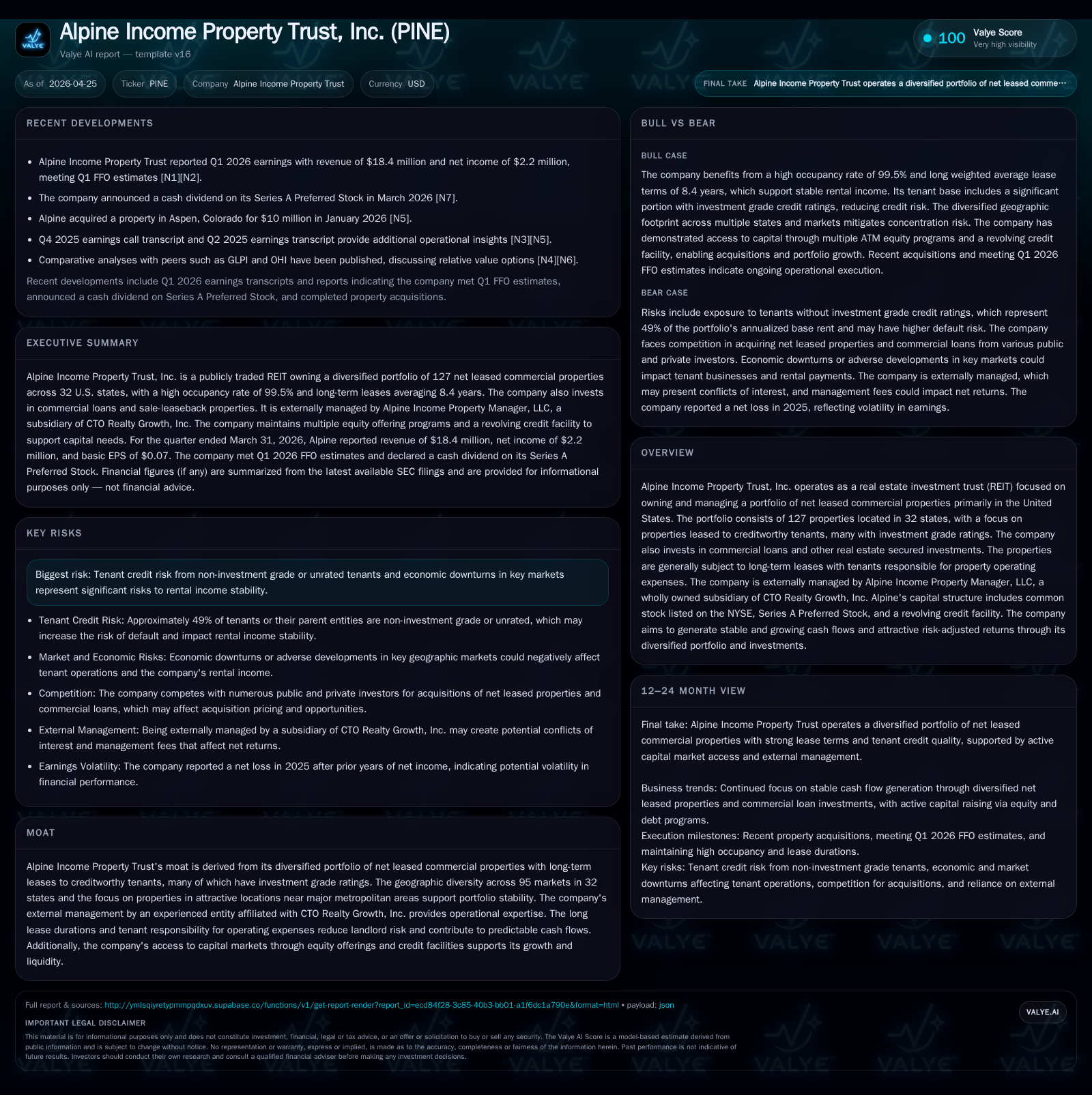
Alpine Income Property Trust, Inc. (PINE), a REIT focused on net leased commercial properties in the U.S., reported consistent portfolio occupancy and lease terms in its Q1 2026 filing. The company enhanced its capital strategies by launching preferred and common stock at-the-market (ATM) equity offerings, potentially supporting further acquisitions or loan investments. Alpine’s externally managed structure under CTO Realty Growth supports operational expertise across a diversified portfolio spanning 32 states with predominantly investment-grade tenants. While growth prospects remain structurally sound due to long-term lease structures and tenant credit quality, watch for execution on capital deployment from these new equity programs and loan portfolio expansions.
Recent Operating Update: Capital Raises Complement Stable Portfolio
In its latest quarterly filing dated April 23, 2026 [S2], Alpine Income Property Trust reported maintaining a strong occupancy rate of 99.5% across its portfolio of 127 net leased properties with a weighted average lease term of approximately 8.4 years based on annualized base rent [S1]. This extended lease duration under long-term net leases—where tenants bear operating expenses such as taxes and maintenance—solidifies Alpine's position in generating steady cash flows.
Crucially, the company filed an 8-K on April 24, 2026 [S3] revealing the launch of new at-the-market (ATM) equity distribution agreements for its Series A Preferred Stock totaling up to $35 million and common stock offerings aggregating up to $150 million [S11][S12][S23][S25]. Sales agents expanded to include Cantor Fitzgerald, Huntington Securities, Lucid Capital Markets, UBS, AGP, Colliers among others, reflecting a strategic broadening of Alpine’s capital raising capabilities to finance future property acquisitions or commercial loan originations [S3]. These fresh capital programs indicate management’s intention to aggressively pursue growth opportunities leveraging their already sizable balance sheet.
Business Model: Net Lease REIT with Loan Investment Integration
Alpine operates as a Real Estate Investment Trust specializing in owning and managing high-quality commercial net leased properties located primarily in U.S. metropolitan statistical areas (MSAs). The portfolio boasts geographic diversification with assets spanning 32 states and nearly 100 distinct markets [S1]. The core business derives income mostly from rental payments made under long-term leases with tenants responsible for operating expenses that limit landlord exposure.
Additionally, Alpine supplements property ownership income through a growing segment invested in commercial loans secured by real estate or equity interest pledges [S1]. This dual-segment approach allows the company to capture yield from direct property rent streams while participating in structured real estate financing arrangements which can offer higher returns albeit at increased risk.
The REIT is externally managed by Alpine Income Property Manager LLC—a subsidiary wholly owned by CTO Realty Growth (CTO)—which administers all day-to-day operations. This outsourcing model provides access to operational expertise without the overhead of an internal management team while aligning incentives via management fees linked to total equity values [S21][S24].
Industry Structure and Competitive Position
The net lease sector is characterized by intensive competition for attractive assets priced based on yield benchmarks relative to tenant credit risk, lease length, and property location. Alpine competes against a mix of public REITs, private equity funds, institutional investors, and individual buyers all vying for similar net leased retail or commercial properties [S10]. Transaction price sensitivity is paramount; sellers favor buyers who offer deal certainty and favorable structures.
Where Alpine differentiates itself is through its focused portfolio composition emphasizing tenants with strong credit profiles and locations within major MSAs where economic conditions support tenant stability [S1]. Its external management by CTO adds operational discipline. Furthermore, tenant responsibility for many operating costs reduces landlord risk.
Growth Drivers and Constraints
Alpine’s growth trajectory rests heavily on incremental acquisitions funded by recently expanded ATM offerings alongside leveraged credit facilities [S7][F1]. The company acquired multiple properties in recent years totaling over $100 million in purchases during FY2025 and is actively expanding commercial loan investments [S19][F1]. The newly launched $35 million preferred stock ATM program and enhanced common stock ATM capacity augment financial flexibility for timely capital deployment [S3].
Long-term leases averaging over eight years underpin recurring revenue visibility; however, the maturity ladder requires ongoing renewal efforts to avoid vacancy risks tied to tenant turnover [S1]. Economic downturns or deteriorating tenant credit profiles present downside risks given their potential impact on rental income continuity [S1][S9]. Pricing power appears modest given industry competitive pressures but is buttressed somewhat by tenant quality.
From an operational standpoint, limits are placed by availability of suitable acquisition targets that meet strict underwriting criteria encompassing location desirability and tenant creditworthiness. Macro factors such as rising interest rates may heighten borrowing costs but are partly mitigated via sustainability-linked pricing adjustments documented in their credit agreements [S18].
What To Watch Next
Key milestones for monitoring Alpine include:
- Utilization pace and financial terms from newly instituted preferred and common ATM issuances altering dilution or funding cost profiles.
- Execution on identified acquisition pipelines or commercial loan origination volumes acting as tangible evidence for growth utilization.
- Tenant leasing renewals or credit rating migration trends impacting occupancy stability.
- Interest rate movements affecting future borrowing costs on the revolving facility or term loans.
- Quarterly earnings updates regarding same-store rent growth or any impairments.
- Potential shifts in management performance incentives based on total stockholder return hurdles detailed within the Management Agreement [S21][S24].
Maintaining steady occupancy alongside successful capital deployment will be critical markers of the company’s ability to sustain risk-adjusted returns.
Financial Profile Summary
Historical performance (annual)
|
| FY | Rev ($mm) | Net ($mm) | CFO ($mm) | OpInc ($mm) | Rev YoY | Net YoY |
|---|---|---|---|---|---|---|
| 2025 | 61 | -3 | 26 | 13 | +15.9% | -228.6% |
| 2024 | 52 | 2 | 26 | 14 | +14.4% | -29.2% |
| 2023 | 46 | 3 | 26 | 13 | +1.0% | -90.2% |
| 2022 | 45 | 30 | 25 | 43 |
Source: SEC companyfacts cache [F1].
Capital returns and efficiency (annual)
|
| FY | Div ($mm) | Buybacks ($mm) | FCF ($mm) |
|---|---|---|---|
| 2025 | 18 | 9 | -219 |
| 2024 | 17 | 1 | -107 |
| 2023 | 17 | 15 | -94 |
| 2022 | 15 | 5 |
Source: SEC companyfacts cache [F1].
Alpine’s FY2025 financials show revenue reaching approximately $60.5 million with operating income slightly declining to about $13.1 million amidst elevated expenses related to acquisitions and loan activities [F1]. Net income turned negative due chiefly to non-cash charges bringing it to roughly -$2.7 million. Operating cash flow remained robust at nearly $25.8 million but was insufficient against substantial capital expenditures reflecting aggressive investment activity ($244 million capex) resulting in negative free cash flow [$218 million approximately] [F1].
Balance sheet wise, total debt stood near $361.5 million end Q1 2026 with cash reserves around $2.6 million yielding net debt close to $359 million [F1]. Dividend policies emphasize quarterly distributions adhering to REIT requirements mandating payout of most taxable income while discerning discretionary elements pending cash flow sufficiency [S4][S8]. Share repurchase programs have been modest historically but may fluctuate based on market opportunities [F1][S28].
|
| FY | Revenue (USD m) | OpInc (USD m) | NetInc (USD m) | CFO (USD m) | Capex (USD m) | Dividends Paid (USD m) | Buybacks (USD m) |
|---|---|---|---|---|---|---|---|
| 2025 | 60.5 | 13.1 | -2.7 | 25.8 | 244 | 17.7 | 8.8 |
| 2024 | 52.2 | 14.0 | 2.1 | 25.6 | 132 | 16.8 | 0.8 |
| 2023 | 45.6 | 13.1 | 2.9 | 25.6 | 120 | 17.0 | 14.6 |
This dynamic underscores Alpine’s strategy: balancing aggressive asset growth fueled partly through equity raises against maintaining stable underlying cash generation through its disciplined tenancy focus.
Disclaimer: This analysis is provided for informational purposes only, synthesizing publicly available filings and reports without offering investment advice.
Disclaimer: This is research-only, informational analysis and not investment advice. It may include AI-generated interpretation and general industry context. Always verify important details using primary sources.

Comments