
Planet Labs PBC Q1 Results: Revenue Growth Challenges Profitability Path
The latest quarter highlights robust revenue expansion driven by AI-enhanced satellite data yet persistent losses underscore ongoing operational scaling challenges.
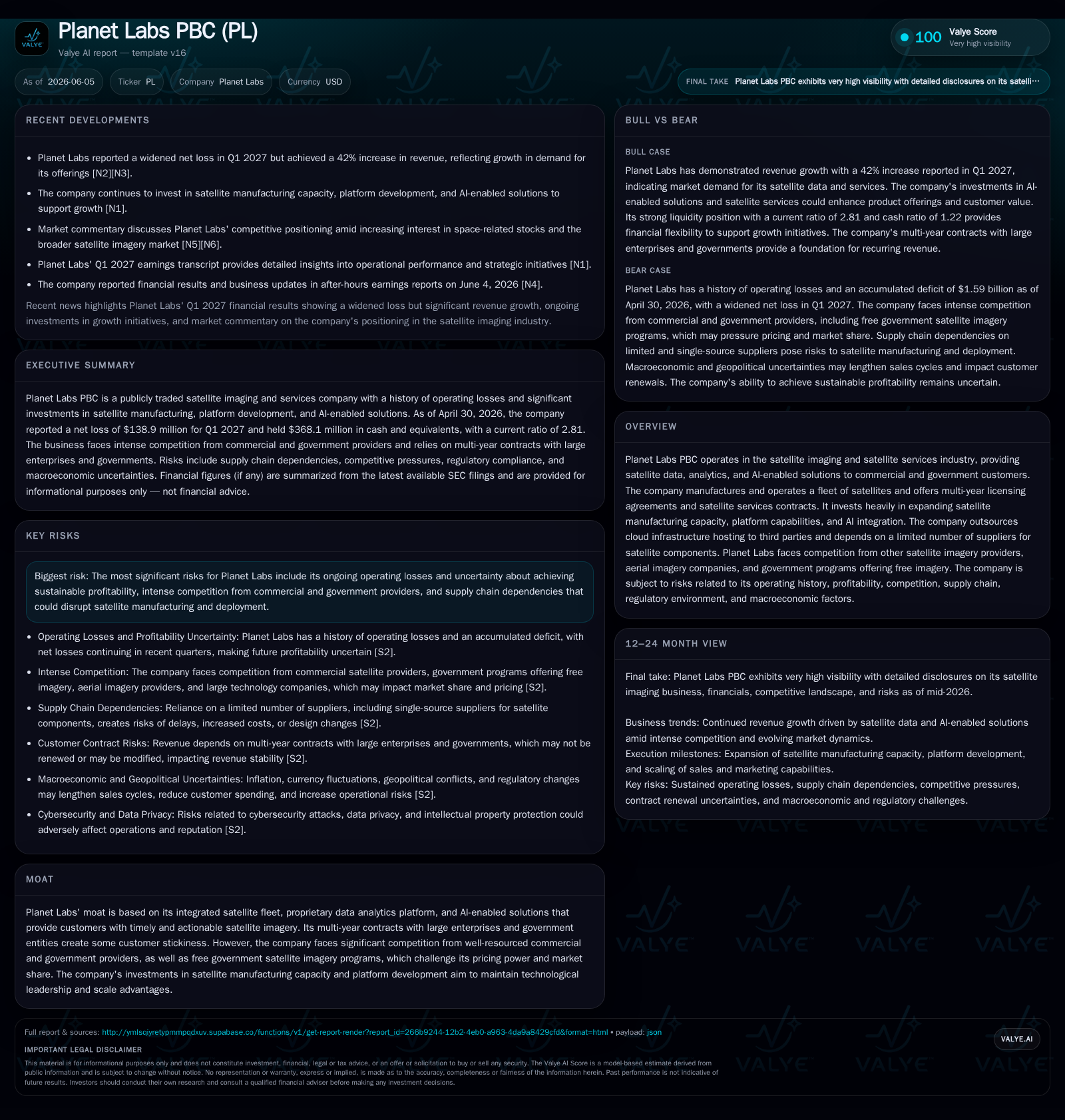
Planet Labs PBC reported a 42% revenue increase in its first fiscal quarter of 2027, fueled by expanding multi-year contracts and growing demand for AI-enabled satellite imagery services. Despite top-line acceleration, net losses widened as the company continues to invest heavily in satellite manufacturing capacity and platform development. The business model centers on recurring revenues from enterprise and government clients, subject to substantial customer concentration and seasonal usage variability. Competitive pressures from both commercial peers and free government imagery programs challenge pricing power, necessitating ongoing innovation particularly in AI analytics integration. Liquidity remains strong with a current ratio near 2.8x, supporting further growth investments amid profitability headwinds.
Q1 Fiscal 2027 Operating Recap: Revenue Growth and Loss Trends
Planet Labs’ latest quarterly report [S2][S3] reveals a significant revenue surge of 42% year-over-year, underscoring strong customer uptake of its satellite imagery and analytics offerings. This growth is attributed primarily to the company's multi-year licensing agreements coupled with elevated usage levels aligned with seasonal demand cycles prevalent in agriculture and commodity sectors [S8]. However, these top-line gains coexist with expanded net losses as Planet continues to deploy capital aggressively toward satellite manufacturing scale-up, research and development (especially around integrating AI capabilities), and broadening its salesforce [N2][N3]. This dynamic indicates a business still in the investment phase seeking operational scale before profitability inflection.
Core Satellite Imaging Platform: Revenue Model and Customer Engagement
Planet's core operating model fuses hardware — an extensive proprietary satellite constellation — with software services that deliver geospatial data products under contract structures blending recurring subscriptions backed by multi-year commitments with variable components driven by actual data consumption [S1][S8]. These usage-based elements introduce seasonality to revenue flows due to customer activity spikes during peak agricultural monitoring seasons or geopolitical events requiring intensive surveillance [S8]. This hybrid ARR profile offers a base of stability combined with upside from fluctuating consumption but introduces forecasting complexity. Customer concentration amplifies this effect; two customers combined accounted for roughly 26% of Q1 revenues, while one represented about a third of accounts receivable at quarter-end [S8]. Such reliance accentuates revenue volatility risks tied to those key clients’ discretionary spend decisions.
Sector Competitive Forces: Market Share Dynamics and Pricing Challenges
Planet operates within an intensely competitive satellite imaging market where well-funded commercial entities vie alongside aerial imagery companies while freely available government-operated satellites supply baseline data sets [S10]. This ecosystem curtails Planet's pricing power despite its fleet integration advantage, as customers weigh cost against timeliness, resolution quality, and analytic value-adds. The requirement for continuous innovation is acute; failure to advance platform capabilities risks market share erosion or pressure on contracted pricing terms. Thus, maintaining differentiation through technological leadership in capturing higher frequency data and enriching it with AI-driven analytics is paramount for sustaining competitive positioning.
AI-Enabled Analytics: Enhancing Product Differentiation
Investment into AI integration constitutes a strategic axis for Planet aimed at extending its footprint beyond pure image delivery into actionable insights that increase customer reliance on its platform [N1]. By layering machine learning algorithms onto raw imagery, Planet enhances temporal change detection, anomaly identification, and predictive analytics which improve decision-making outcomes for enterprises and governments alike. These capabilities generate switching costs through embedded workflows and drive incremental contractual commitments [S1]. Continued R&D heavy lifting supports this technology moat alongside leveraging scale economies from an expanding satellite constellation.
Customer Concentration and Seasonality: Impact on Demand Stability
With substantial dependency on few large enterprise clients—two customers responsible for approximately one quarter of revenues in Q1—and one constituent constituting roughly a third of accounts receivable [S8], Planet faces meaningful revenue concentration risk. This is compounded by seasonally cyclical demand patterns inherent to its primary verticals such as agriculture monitoring where data consumption intensifies during planting or harvest periods followed by quieter intervals [S8]. Commodity price swings or natural disaster events can cause episodic spikes in usage but also lead to subsequent pullbacks. Managing this dual volatility component requires operational agility in sales cycles, contract structuring, and capacity provisioning.
Risks and Limitations to Growth: Profitability, Supply Chain, Competition
The company’s ongoing unprofitability despite rising revenues illustrates the steep operating leverage challenges from high fixed costs tied to satellite manufacturing infrastructure expansion and iterative R&D investments including AI platform development [S2]. Supply chain dependencies on specialized spacecraft components sourced from limited suppliers represent critical execution risks that could delay launches or escalate costs materially. Furthermore, the competitive landscape exerts significant downward pressure on achievable pricing with publicly funded government imagery programs offering baseline alternatives that blunt Planet’s pricing premium potential [S10]. Regulatory risks stemming from NOAA licensing constraints add an additional layer of operational uncertainty given possible service interruptions related to national security considerations [S23].
Outlook: Key Milestones and Execution Variables to Monitor
Looking ahead, several execution factors will influence Planet’s trajectory toward sustainable profitability: effectiveness in expanding its salesforce productivity to acquire new customers cost-efficiently; cadence of new satellite launches enhancing constellation density; monetization progress of AI analytics capabilities underpinning margin improvements; renewal rates particularly among large enterprise/government clients securing recurring contracted revenues; plus regulatory license renewals under NOAA oversight affecting operating continuity [N1][N13][S2]. Monitoring pipeline bookings versus usage growth will offer important signals around demand durability amidst cyclical influences.
Financial Position Snapshot: Liquidity Amid Operating Investments
Planet maintains a healthy liquidity position supported by $368 million in cash and equivalents as of April 30, 2026, complemented by a solid current ratio near 2.8x reflecting prudent working capital management [F1]. This buffer affords capacity to sustain aggressive capital expenditure outlays required for satellite manufacturing expansion and continued investment in platform enhancements alongside absorbing ongoing operating losses while scaling contractually committed revenues. The balance sheet strength mitigates near-term refinancing risks notwithstanding material losses being reported [F1][S2].
Disclaimer: This analysis reflects information up to the first quarter ended April 30, 2026 based on public SEC filings ([S1], [S2], [S3]) and news reports ([N1]-[N3]). It does not constitute investment advice or research views. Readers should consider all risks disclosed by Planet Labs PBC before forming their own judgments.
Disclaimer: This is research-only, informational analysis and not investment advice. It may include AI-generated interpretation and general industry context. Always verify important details using primary sources.

Comments