
Philip Morris International’s Progress and Challenges in Smoke-Free Innovation and Global Market Leadership
PMI’s latest quarterly report highlights advances in smoke-free product adoption alongside rising intellectual property and regulatory complexities.
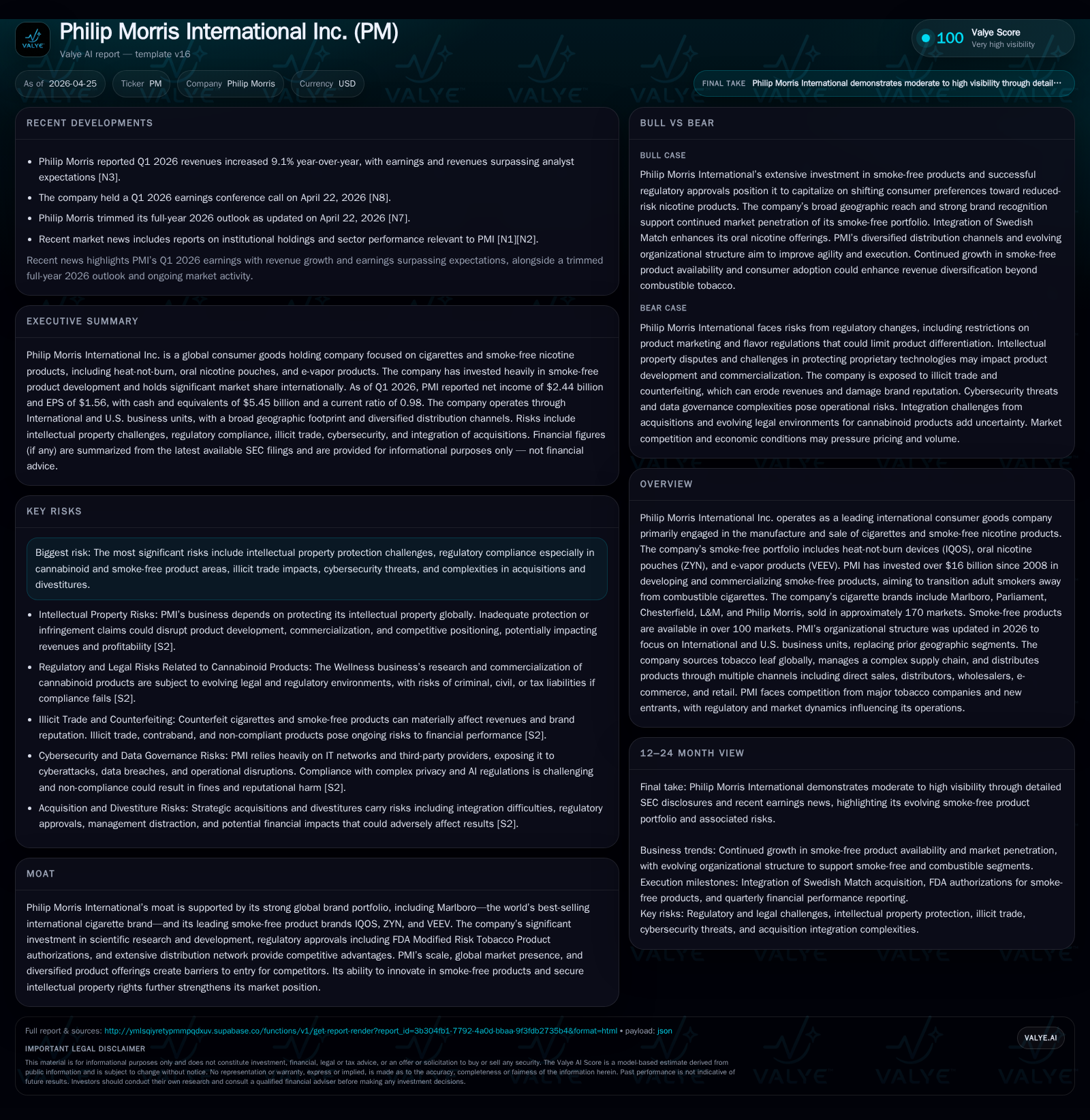
Philip Morris International (PMI) continues to expand its smoke-free product offerings globally, demonstrating solid revenue growth driven by adult smoker conversion and brand strength. However, its latest 10-Q filing reveals mounting legal, regulatory, and cybersecurity risks, particularly in cannabinoid product commercialization and intellectual property enforcement. PMI’s competitive moat remains anchored by sizable R&D investment, FDA Modified Risk Tobacco Product (MRTP) authorizations, and a broad global footprint, but evolving regulations and illicit trade present critical constraints. Near-term execution risks are reflected in FY26 guidance reductions amidst ongoing efforts to scale wellness initiatives and protect market share.
Latest Quarterly Operating Update Highlights Emerging Risks
Philip Morris International’s (PMI) most recent quarterly filing dated April 24, 2026 (10-Q) underscores a nuanced operating environment where commercial progress in smoke-free products is tempered by heightened risk factors [S2]. Notably, PMI’s Wellness segment activities around research, development, and limited commercialization of non-recreational cannabinoid products—including cannabidiol (CBD)—expose the company to significant legal, regulatory, reputational, and operational uncertainties given the evolving patchwork of jurisdictional rules [S2], [S24]. The company explicitly acknowledges that successful commercialization depends on navigating this complex terrain without incurring material adverse effects.
Simultaneously, the filing reveals intensified concerns around intellectual property (IP) rights enforcement. Despite vigilant efforts to patent and protect trademarks internationally for key assets like IQOS devices and ZYN nicotine pouches, PMI notes variability in IP protection efficacy across markets. This exposes the company to potential infringement or misappropriation claims that might disrupt manufacturing or sales operations and hinder its adult smoker conversion strategy via smoke-free product offerings [S2], [S13], [S21].
Adding another operational layer is the recognition of cybersecurity risk escalated by increased incorporation of artificial intelligence (AI) technologies into PMI’s information technology ecosystems. Cyber threats compounded by AI vulnerabilities pose reputational and financial risks through disruptions or breaches affecting data integrity and privacy compliance globally [S2], [S19], [S21]. While PMI maintains insurance coverages and risk management programs targeting these exposures, the dynamic threat landscape remains a material consideration.
Evolving Business Model: Cigarettes to Smoke-Free and Wellness Innovation
PMI operates with a core business model centered on the manufacture and sale of cigarettes alongside an expanding portfolio of smoke-free products (SFPs), which encompass heat-not-burn tobacco devices (IQOS), oral nicotine pouches (ZYN), e-vapor products (VEEV), plus ancillary consumer items [S1],. The transition reflects strategic prioritization given global declines in combustible cigarette consumption driven by health awareness and tightening regulations.
Since acquiring Swedish Match AB in 2022—a leader in oral nicotine delivery—PMI has integrated complementary product lines under an enlarged smoke-free umbrella aimed at providing adult smokers alternatives with potentially reduced health risks. The suite of SFPs spans scientific substantiation via clinical research programs supporting FDA Modified Risk Tobacco Product (MRTP) authorizations for multiple product variants [S1]. This regulatory endorsement differentiates PMI’s SFPs from competitors by affirming lower exposure to harmful chemicals compared to combustibles.
Wellness innovation forms an aspirational growth vector beyond nicotine products. Through its Aspeya unit focused on medical/pharmaceutical cannabinoids and non-recreational CBD offerings compliant with jurisdictional statutes, PMI seeks to penetrate burgeoning wellness markets. However, near-term revenue contribution here remains exploratory and minor relative to core tobacco/nicotine segments [S2], [S24],.
Revenue generation remains concentrated on consumer sales of cigarettes primarily through established brands like Marlboro—the world’s best-selling international cigarette brand—and growth-oriented SFP brands across 170+ countries for cigarettes and over 100 markets for SFPs. Distribution relies on a sophisticated supply chain sourcing tobacco leaf globally aligned with comprehensive marketing support encompassing brand recognition, loyalty programs, pricing strategies tailored per market norms, and retailer partnerships [S1],.
Industry Structure and Competitive Moat Strength from Brand and R&D
Philip Morris International occupies a dominant position within the global tobacco industry marked by several viable competitive moats. Foremost is its globally recognized brand portfolio anchored by Marlboro cigarettes complemented by top-tier smoke-free brands including IQOS heat-not-burn units, ZYN oral nicotine pouches, and VEEV e-vapor devices. The cross-category breadth enables resilience amid shifting consumer preferences.
The company has allocated over $16 billion since 2008 towards R&D dedicated to scientifically backed harm reduction technologies integrated into SFP development cycles—this includes pre-clinical toxicological evaluations to post-market behavioral studies that are critical for securing MRTP orders from authorities such as the U.S. FDA [S1],. Such regulatory endorsements form significant barriers for entrants lacking similar science-driven credentials.
Additionally, PMI controls an extensive intellectual property portfolio comprising patents related to device design/technology as well as trademarks protecting brand identity worldwide. Although protection is not uniformly enforceable across all jurisdictions—as evidenced by recent patent disputes in Japan escalating customs import challenges—maintaining this portfolio erects substantial entry barriers while enabling premium pricing power for innovative products [S2], [S13],.
The company's scale translates into dataset advantages for consumer insights as well as giving it leverage over suppliers optimized through a complex international supply chain managing agricultural sourcing of tobacco leaf combined with technical production capabilities for highly engineered heat-not-burn devices and consumables. Marketing campaign investments reinforce brand prestige while segment managers optimize regional profitability across geographies now structured under International and U.S. business units instead of prior geographic segmentation reporting frameworks [S1],.
Growth Drivers in Smoke-Free Product Adoption and Market Expansion
PMI's primary growth engine is accelerating adult smoker transition from combustible cigarettes towards SFPs—a structural shift driven both by evolving consumer awareness regarding harm reduction alternatives as well as regulators endorsing reduced exposure claims through MRTP authorizations [N1], [N2],. Expansion of SFP availability into over 100 markets benefits from successful rollouts of IQOS systems exhibiting strong uptake especially in Asia-Pacific regions coupled with scaled distribution of oral nicotine pouches leveraging Swedish Match acquisition synergies.
Product innovation fuels this growth including diversification within heat-not-burn consumables allowing improved device-user experiences along with premiumization strategies targeting specific demographic cohorts willing to pay higher price points. Segmentation benefits arise where adult smokers choose between flavored e-vapor variations or tobacco-derived heated units depending on local taste preferences or price sensitivity profiles ensuring portfolio flexibility.
Regulatory milestones function as catalysts by verifying product safety profiles which help deactivate skeptical consumers hesitating due to health concerns or lingering stigma associated with traditional smoking behaviors. In parallel, wellness initiatives centered on cannabinoid development are positioned for longer-cycle optionality offering incremental avenues if medical research validates therapeutic benefits within stringent compliance landscapes although near-term revenue remains negligible per disclosures [S2],.
Constraints from Regulatory, IP, and Illicit Trade Challenges
Alongside growth momentum are persistent constraints arising from intricate jurisdiction-specific regulation regimes governing tobacco products broadly including specialized oversight relating to novel cannabinoids that challenge clinical substantiation requirements while exposing PMI to potential criminal or tax liabilities if non-compliance occurs—risks explicitly underscored in the latest filings [S2], [S24].
Intellectual property enforcement inconsistencies globally raise material risks wherein patent disputes—such as those unfolding in Japan involving competitors challenging imports of IQOS accessories—could disrupt supply continuity or elevate costs through protracted litigation settlements or injunctions restricting sales channels [S16]. Counterfeiters undermine brand integrity particularly given Marlboro's status as heavily counterfeited internationally; counterfeit SFPs lack scientific validation potentially tarnishing consumer trust while depressing legitimate revenues indirectly via lost market share or illicit competition [S2], [S24].
Illicit trade volumes remain large despite anti-contraband initiatives lowering product taxation gaps; unregulated non-tax-paid cigarette volumes erode official shipments impacting stated revenues adversely. This illicit ecosystem complicates the regulatory compliance landscape further driving management focus towards enforcement partnerships involving customs authorities as part of corporate risk mitigation.
Cybersecurity also introduces operational vulnerability exposed by increasing reliance on integrated network systems augmented by AI-based tools whose flaws or misconfigurations can cause data breaches or comply failures undermining stakeholder confidence or resulting in punitive fines according to GDPR-like directives enacted worldwide—an emerging frontier requiring vigilant investment into governance protocols set forth in recent disclosures [S19], [S21].
Strategic Outlook: What To Monitor in Near-Term Execution
Key upcoming milestones shape investor attention including:
- FDA regulatory announcements related to new product approvals extending MRTP scope or signaling commitments towards broader acceptance of alternative nicotine delivery systems impacting rollout velocity.
- Market penetration metrics signaling continual adult smoker conversion rates especially within high-growth Asia-Pacific corridors critical for scalability ambitions.
- Commercial viability evidence regarding cannabinoid-based wellness initiatives which while currently nascent could shift long-term revenue mix depending on scientific outcomes plus evolving legalization dynamics.
- Effectiveness of cybersecurity enhancements incorporating AI risk management protocols addressing past vulnerabilities documented earlier maintaining operational resilience.
- Watch for updates following the April earnings events where FY26 guidance was trimmed suggesting measured caution on external pressures potentially disrupting forecasted trajectories albeit offset by solid Q1 earnings beating estimates (+9.1% revenue growth year-over-year) indicating strong underlying demand fundamentals balanced against cost inflation/policy headwinds noted during calls [N1], [N11].
Supporting Financial Review: Liquidity, Capital Structure, and Profitability
Financially, Philip Morris International closes Q1/2026 with approximately $5.45 billion in cash equivalents providing ample liquidity buffers amid capital expenditure commitments totaling nearly $1.57 billion annually reflecting ongoing investment into product innovation capacity expansions alongside marketing support structures ([F1]; latest quarter). Total debt stands near $49 billion per year-end 2025 figures demonstrating stable leveraging consistent with long-term maturities weighted around seven years facilitating manageable refinancing risks ([F1]). The current ratio slightly below unity at 0.98 reflects tightly balanced short-term asset-liability positioning requiring prudent working capital management but not indicating immediate liquidity strain ([F1]).
Profitability metrics have improved markedly reflected in net income rising over 60% year-over-year reaching $11.35 billion bolstered by operational efficiencies even amid rising input cost pressures ([F1]). Operating cash flow runs strong above $12 billion annually while free cash flow approximates $10.66 billion supporting dividend distributions exceeding $8.6 billion paid out during fiscal 2025 underpinning shareholder capital return commitment ([F1]). Negative equity recorded (-$9.99 billion) warrants monitoring though largely attributable to accumulated treasury stock repurchases rather than fundamental solvency issues ([F1]). Capital structure retains investment-grade credit ratings underpinning favorable borrowing costs essential for sustaining innovation funding pipelines ([S1]).
Historical performance (annual)
|
| FY | Net ($bn) | CFO ($bn) | OpInc ($bn) | Capex ($mm) | Net YoY |
|---|---|---|---|---|---|
| 2025 | 11.3 | 12.2 | 14.9 | 1569 | +60.8% |
| 2024 | 7.1 | 12.2 | 13.4 | 1444 | -9.7% |
| 2023 | 7.8 | 9.2 | 11.6 | 1321 | -13.6% |
| 2022 | 9.0 | 10.8 | 12.2 | 1077 |
Source: SEC companyfacts cache [F1].
Capital returns and efficiency (annual)
|
| FY | Div ($bn) | Buybacks ($mm) | FCF ($bn) |
|---|---|---|---|
| 2025 | 8.6 | 10.7 | |
| 2024 | 8.2 | 0 | 10.8 |
| 2023 | 8.0 | 0 | 7.9 |
| 2022 | 7.8 | 209 | 9.7 |
Source: SEC companyfacts cache [F1].
| Year | Revenue ($B) | Operating Income ($B) | Net Income ($B) | CFO ($B) | Capex ($B) |
|---|---|---|---|---|---|
| 2023 | 35.17 | 11.56 | 7.81 | 9.20 | 1.32 |
| 2024 | 37.88 | 13.40 | 7.06 | 12.22 | 1.44 |
| 2025 | 40.65 | 14.89 | 11.35 | 12.23 | 1.57 |
In summary, Philip Morris International demonstrates robust financial resources matching its strategic intent to lead the evolving global nicotine market through science-based innovation while cautiously navigating intensifying legal/regulatory constraints inherent to its industry transformation journey.
This analysis is intended solely for informational purposes reflecting public disclosures; it does not constitute investment advice.
Disclaimer: This is research-only, informational analysis and not investment advice. It may include AI-generated interpretation and general industry context. Always verify important details using primary sources.

Comments