
PrimeEnergy Resources Strengthens Liquidity While Managing Commodity Price Pressures
PrimeEnergy maintains strong financial flexibility in Q1 2026 through an undrawn $115 million credit facility, balancing operational growth and industry headwinds.
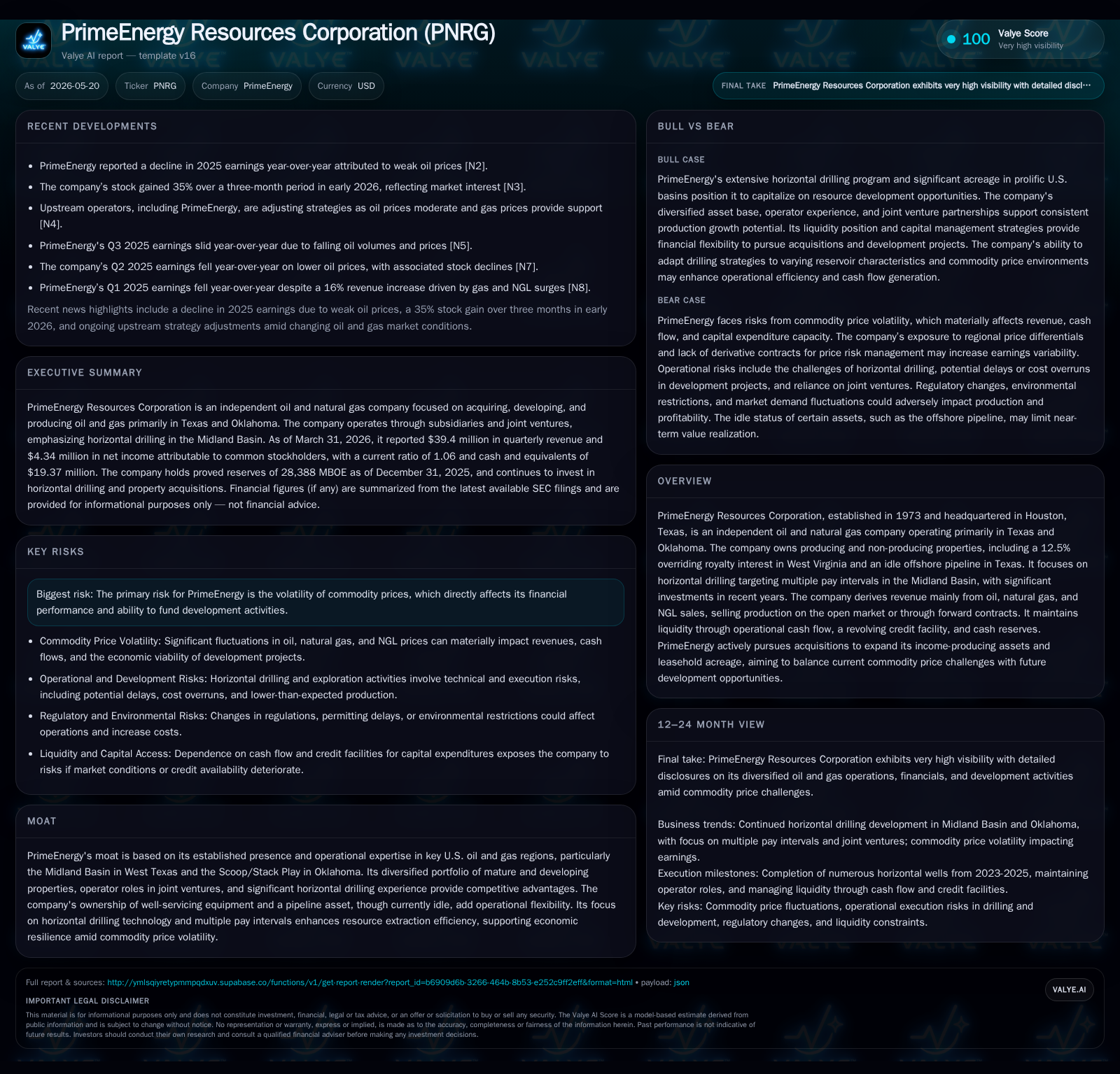
In its latest quarterly filing, PrimeEnergy reaffirmed a $115 million borrowing base with no outstanding borrowings, signaling disciplined liquidity management amid volatile commodity prices. The company’s strategic focus on horizontal drilling in Texas and Oklahoma underpins its asset development approach, complemented by a diversified portfolio that includes producing and non-producing assets. While commodity price volatility remains a key risk factor, PrimeEnergy’s strong balance sheet and operational expertise position it to execute capital programs prudently. Watch for upcoming borrowing base redeterminations, capital expenditure adjustments, and exploration activity as indicators of execution momentum.
Latest Quarterly Operating Performance: Balance Sheet Strength Amidst Price Volatility
PrimeEnergy Resources’ Q1 2026 Form 10-Q filing dated May 20, 2026 [S2] highlights continued financial discipline amid ongoing commodity price uncertainties. The company’s revolving credit facility borrowing base was reaffirmed at $115 million following the Fifth Amendment to the 2022 Credit Agreement in February 2026. This line remains fully undrawn as of March 31, 2026, demonstrating conservative capital structure management with zero outstanding borrowings against this substantial liquidity reserve [S2]. The prime rate applicable to any new borrowings stands at 6.75%, plus utilization spreads outlined in the credit agreement.
The company identifies risks including geopolitical instability impacting global supply chains, supply-demand imbalances, and evolving regulations that could constrain development or elevate operating costs. Despite these challenges, PrimeEnergy emphasizes maintaining operational flexibility through approximately $19 million cash reserves at quarter-end combined with prudent capital deployment strategies [F1][S2]
Business Model: Horizontal Drilling Focus and Diversified Asset Portfolio
Founded in 1973 and headquartered in Houston, Texas, PrimeEnergy Resources Corp is an independent upstream operator focused primarily on producing and non-producing properties in Texas and Oklahoma [S1][S16]. Revenue is principally derived from the sale of oil, natural gas, and natural gas liquids (NGLs), with sales executed either on open markets or via forward contracts to mitigate price volatility risks [S1].
Horizontal drilling forms the core of PrimeEnergy's strategy, targeting multiple pay zones—referred to as benches—in prolific formations such as the Wolfcamp D through Middle Spraberry intervals within the Midland Basin [S15]. This approach enhances reservoir contact per well pad footprint compared to vertical wells, yielding superior economic outcomes. Subsidiaries like Prime Operating Company and EOWS Midland Company provide in-house well-servicing capabilities that enhance operational control and potentially improve margin management relative to third-party service providers [S16].
The asset base combines mature producing properties with exploratory lands including a 12.5% overriding royalty interest covering over 30,000 acres in West Virginia where development has not yet begun [S1]. Additionally, the company owns an idle offshore pipeline off Texas which may offer future strategic value [S1]. This diversification reduces exposure to single-basin risks while positioning the company for upside from future development activities.
Industry Context: Independent Operators in U.S. Onshore Oil & Gas
Within the independent operator segment focused on core Permian Basin plays like Texas’s Midland sub-basin and Oklahoma’s Scoop/Stack areas, competition centers on acreage quality, horizontal drilling expertise, operational efficiency, and access to completion services. PrimeEnergy leverages decades of operating experience as operator for joint venture properties alongside ownership of well-servicing equipment—advantages that reduce reliance on external vendors especially during peak activity cycles.
The portfolio's mix of producing units with undeveloped acreage provides resilience against localized commodity price downturns or regulatory delays impacting specific plays. However, transportation constraints remain intermittent challenges particularly for gas production due to infrastructure bottlenecks; notably the idle offshore pipeline could become strategically important if regional transport tightens [S16]. Environmental regulations increasingly impact operating costs through potential restrictions on produced water disposal sites or permit timing delays causing temporary shut-ins or curtailed volumes during seasonal demand fluctuations [S1][S2].
Growth Drivers: Horizontal Well Development and Strategic Acquisitions
PrimeEnergy’s growth depends largely on organic expansion through horizontal drilling across multiple reservoir benches delivering enhanced recovery metrics per well [S15]. The company also pursues acquisitions aimed at increasing producing assets or expanding leasehold positions within operationally familiar plays [S16]. Joint ventures with partners such as Double Eagle and Vital have historically spread exploration risk while providing access to complementary acreage [S15]. Multi-pay interval horizontal wells provide spacing efficiencies that optimize capital use.
Risks and Constraints: Commodity Price Volatility and Regulatory Environment
Commodity price fluctuations remain the primary systemic risk affecting revenue streams and capital investment capacity [S1]. Extended price declines can render some projects uneconomic leading to deferrals or reduced drilling activity. Cyclical supply-demand imbalances have historically caused gas shut-ins during low summer demand periods reducing field income where PrimeEnergy acts as operator [S1].
Regulatory uncertainty presents additional constraints including potential environmental legislation changes restricting development practices or imposing new taxes increasing costs. Challenges obtaining timely permits for drilling or disposal activities alongside emerging produced water handling regulations could delay projects or reduce output temporarily [S2][S28]. Geopolitical tensions add unpredictability complicating pricing forecasts.
Key Milestones Ahead: Borrowing Base Redetermination and Operational Updates
Investors should monitor PrimeEnergy’s mid-2026 semi-annual borrowing base review which will determine credit facility availability based on updated reserve estimates and financial performance trends [S2]
Updates on horizontal drilling success across target benches will indicate organic growth momentum while announcements regarding joint ventures or asset divestitures will reveal shifts in capital deployment strategies responsive to market or regulatory changes.
Management has expressed readiness to adjust capital spending throughout the year in response to cash flow variability—making capital program guidance a key watchpoint following April 2026 budget disclosures [S1][S15]
Financial Position Summary: Strong Liquidity Underpins Strategic Flexibility
As of March 31, 2026, PrimeEnergy held approximately $19 million in cash equivalents with minimal total debt reported near $1.4 million at December 31, 2025 resulting in an effectively negative net debt position underscoring low leverage [F1]. The fully available $115 million revolving credit facility remains undrawn providing substantial liquidity backstop for opportunistic investments or bridging short-term cash flow variability while maintaining compliance with covenants requiring minimum current ratio levels (~1.06) [F1][S2].
This robust liquidity profile supports ongoing horizontal well developments alongside selective acquisitions executed within disciplined capital frameworks aligned with evolving market signals.
Disclaimer: This analysis is based exclusively on specified SEC filings up to May 20, 2026 supported by validated financial data; it does not constitute investment advice but aims to deliver an objective assessment grounded in publicly available information.
Disclaimer: This is research-only, informational analysis and not investment advice. It may include AI-generated interpretation and general industry context. Always verify important details using primary sources.

Comments