
Powell Industries: reported balance sheet position and Profitability, But Market Volatility and Business Transparency Are in Focus
Powell Industries exits fiscal 2026 with reported liquidity position, solid earnings, and continued investor interest—yet its stock price shows heightened sensitivity to market swings and limited segment-level visibility, leaving open questions on growth durability and competitive differentiation.
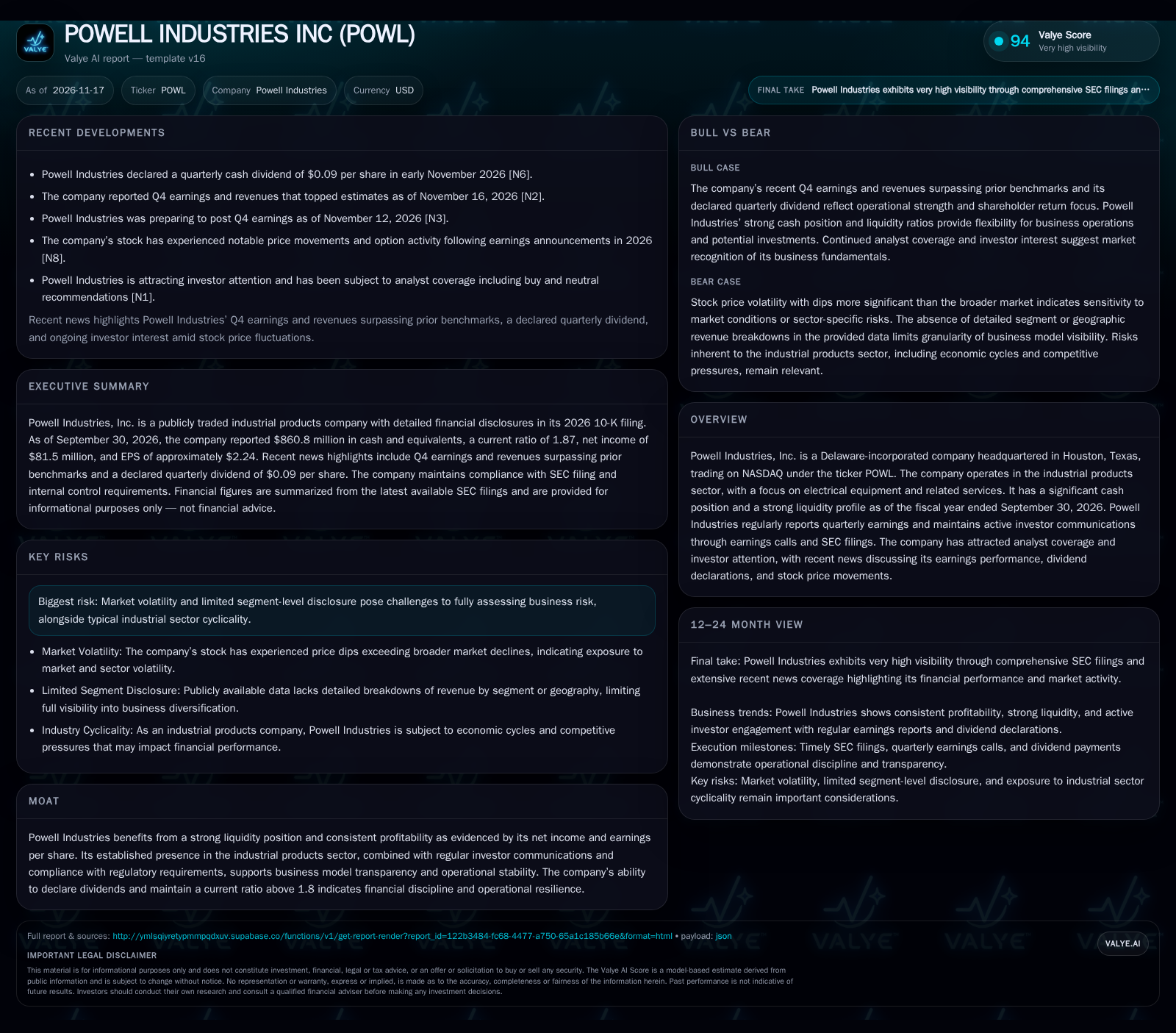
Powell Industries reported $860.8 million in cash and $81.5 million in net income for the fiscal year ended September 30, 2026, maintaining a current ratio of 1.87 and paying a quarterly dividend. While financial strength supports operational flexibility, the company’s shares have shown outsized volatility and segment disclosures remain limited, making it harder to assess the sustainability and drivers of future growth in a competitive, cyclical sector. [S1] [N1] [N2] [N6]
Powell Industries, a Houston-based electrical equipment and industrial products company, stands out for its reported cash position and solid earnings heading into 2027. However, the company’s shares have exhibited notable volatility—at times falling more than the market—and a lack of granular segment disclosure clouds the underlying story. As the industrial sector faces both cyclical and competitive headwinds, investors must weigh Powell’s financial resilience against persistent uncertainties about growth drivers, competitive edge, and long-term trajectory.
Financial Strength and Market Volatility Define Powell’s Current State
Powell Industries closed its fiscal year on September 30, 2026, with $860.8 million in cash and cash equivalents, supporting a current ratio of 1.87 and a cash ratio of 1.08. The company reported cash and liquidity metrics for the period; these figures do not by themselves establish operating runway, investment capacity, financial flexibility, or financing capacity. Net income for the year was $81.5 million, translating to diluted EPS of $2.23. The cited source reports dividend-related activity; that disclosure alone does not establish dividend-policy continuity, management confidence, or a material constraint on capital flexibility. Despite these financial strengths, Powell’s shares have shown more pronounced declines than the broader market at several points in 2026, underlining a disconnect between operating performance and market sentiment. Analyst coverage remains active, but rating divergence signals uncertainty over future performance. [S1] [N1] [N2] [N3] [N6]
Additionally, market volatility reflected in share price fluctuations may stem from investor uncertainty about Powell's ability to convert financial strength into consistent growth amid sector cyclicality and evolving customer demands.
How Powell Industries Could Leverage Scale and Capital for Profitable Growth
Powell’s business model centers on the design, manufacture, and service of electrical equipment and systems for industrial end-markets—a sector where project-based revenues, long sales cycles, and customer relationships often drive top-line performance. Pricing power in this segment is typically constrained by competition and customer procurement practices, but value-added engineering, customization, and aftermarket services can support margin resilience.
Fixed costs in manufacturing and engineering create the potential for operating leverage if revenue growth persists, but exposure to input cost variability and project delays can mute this effect. Without segment disclosures, it is unclear how much of Powell’s profit is driven by higher-margin service contracts versus traditional equipment sales. Capital needs are manageable in the near term, but future growth could require investments in automation, digitalization, or adjacent product lines to maintain competitiveness.
The potential for operating leverage in Powell’s business model hinges on its ability to scale project execution and service offerings without commensurate increases in fixed costs. If the company can increase the proportion of recurring service revenues, which typically carry higher margins and more predictable cash flows, it may better absorb input cost fluctuations and mitigate project timing risks. However, the capital intensity of upgrading manufacturing capabilities or integrating digital technologies could pressure free cash flow in the near term, especially if revenue growth is uneven. Strategic prioritization of investments will be critical; for instance, focusing on automation might reduce long-term costs and improve quality, but only if market demand justifies the upfront expenditure.
Competitive Landscape: Powell’s Place Among Industrial Heavyweights
Powell Industries operates in a highly competitive space, with peers ranging from global conglomerates like Emerson Electric and Eaton to specialized electrical equipment suppliers. Larger competitors typically benefit from global scale, broader product portfolios, and greater R&D capacity, allowing them to weather downturns and invest in next-generation solutions. Powell’s established presence and reputation for reliable equipment and service may help it secure recurring business, particularly where deep customer relationships or project expertise are valued.
However, the lack of detailed segment or geographic revenue data makes it difficult to assess whether Powell is carving out defensible niches or is more exposed to price-based competition. Technology shifts—such as the rise of smart grids, electrification, and industrial automation—could create both threats and opportunities, depending on Powell’s ability to innovate and adapt. Switching costs in this sector are often moderate: large industrial customers may resist changing suppliers for mission-critical systems, but price and technical advances can drive periodic vendor reassessment.
Powell’s competitive positioning also depends on its agility in responding to technological shifts shaping the industrial landscape. The adoption of smart grid technologies and increased electrification demand suppliers who can offer integrated, technologically advanced solutions. If Powell can leverage its engineering expertise to innovate or partner effectively, it may enhance its differentiation and customer retention. Conversely, failure to keep pace with such trends risks commoditization and margin erosion. The moderate switching costs in this sector imply that maintaining strong customer relationships and demonstrating technical superiority are essential to defend market share against larger, more diversified competitors who can bundle offerings or underprice on scale.
Unlocking Value Through Capital Deployment and Market Expansion
If Powell can demonstrate sustained revenue growth—especially from higher-margin service contracts or new product lines—while maintaining or expanding margins, the company could command a higher valuation multiple and reduce share price volatility.
Confirmation of this scenario would require evidence of above-industry growth rates, successful execution of capital projects, or strategic acquisitions that are accretive to earnings. Disclosures showing a rising proportion of service or recurring revenue, or announcements of large, multi-year contracts in new end-markets, would also support the upside case. Conversely, if excess cash remains idle or is returned solely through dividends without organic or inorganic growth, the upside potential may remain capped.
Sustained Profitability Amid Cyclical and Competitive Pressures
A plausible middle path for Powell is continued steady profitability, supported by repeat business in core markets and judicious cost management. The company may continue to generate positive earnings and maintain its dividend, with periodic share price volatility reflecting broader industrial sector cycles. Growth may track overall industrial demand, with incremental gains from process improvements or selective project wins.
Falsification would occur if profit margins erode due to intensifying competition, or if project delays and cost overruns begin to materially impact results. Further, continued lack of segment disclosure would keep investors cautious about the durability and composition of earnings.
Earnings Sensitivity to Market Shocks and Transparency Gaps
An adverse scenario could materialize if Powell faces a sharp downturn in industrial spending, leading to revenue contraction and underutilized capacity. Heightened competition from larger or more technologically advanced peers could compress margins, while project delays or cancellations could create earnings volatility. Limited visibility into business drivers may exacerbate market concern, amplifying share price declines.
This scenario would be confirmed by declining revenues, falling margins, or negative earnings surprises, especially if accompanied by persistent stock price underperformance relative to peers. Persistent lack of segment or geographic detail would hinder investors’ ability to assess where risks are concentrated.
What Could Shift the Powell Industries Thesis in 2027 and Beyond
Trends in project backlog or new order intake, if disclosed, would clarify near-term revenue visibility and test the durability of demand.
Any breakdown of revenue or margin by segment, product line, or geography would help assess whether growth is coming from sustainable, high-margin sources.
Evidence of increased service or recurring revenue—such as long-term maintenance contracts—would signal improved earnings quality and potential margin expansion.
Capital deployment decisions: announcements of acquisitions, major capital investments, or new business line launches would reveal management’s growth priorities.
Gross margin and operating margin trends relative to peers would indicate whether Powell is maintaining pricing power, improving operational efficiency, or facing cost pressures.
Stock price performance versus industrial peers after earnings releases or macro shocks would show if volatility is subsiding or worsening.
Disclaimer: This is research-only, informational analysis and not investment advice. It may include AI-generated interpretation and general industry context. Always verify important details using primary sources.

Comments