
Pioneer Power Solutions: Microgrid Ambition Meets the Realities of Customer Concentration and Operational Losses
Pioneer Power Solutions is betting on its PRYMUS mobile microgrid platform to serve the evolving needs of data centers and industrial customers, but continued operating losses, a highly concentrated customer base, and uncertain market demand for decentralized energy solutions present persistent hurdles.
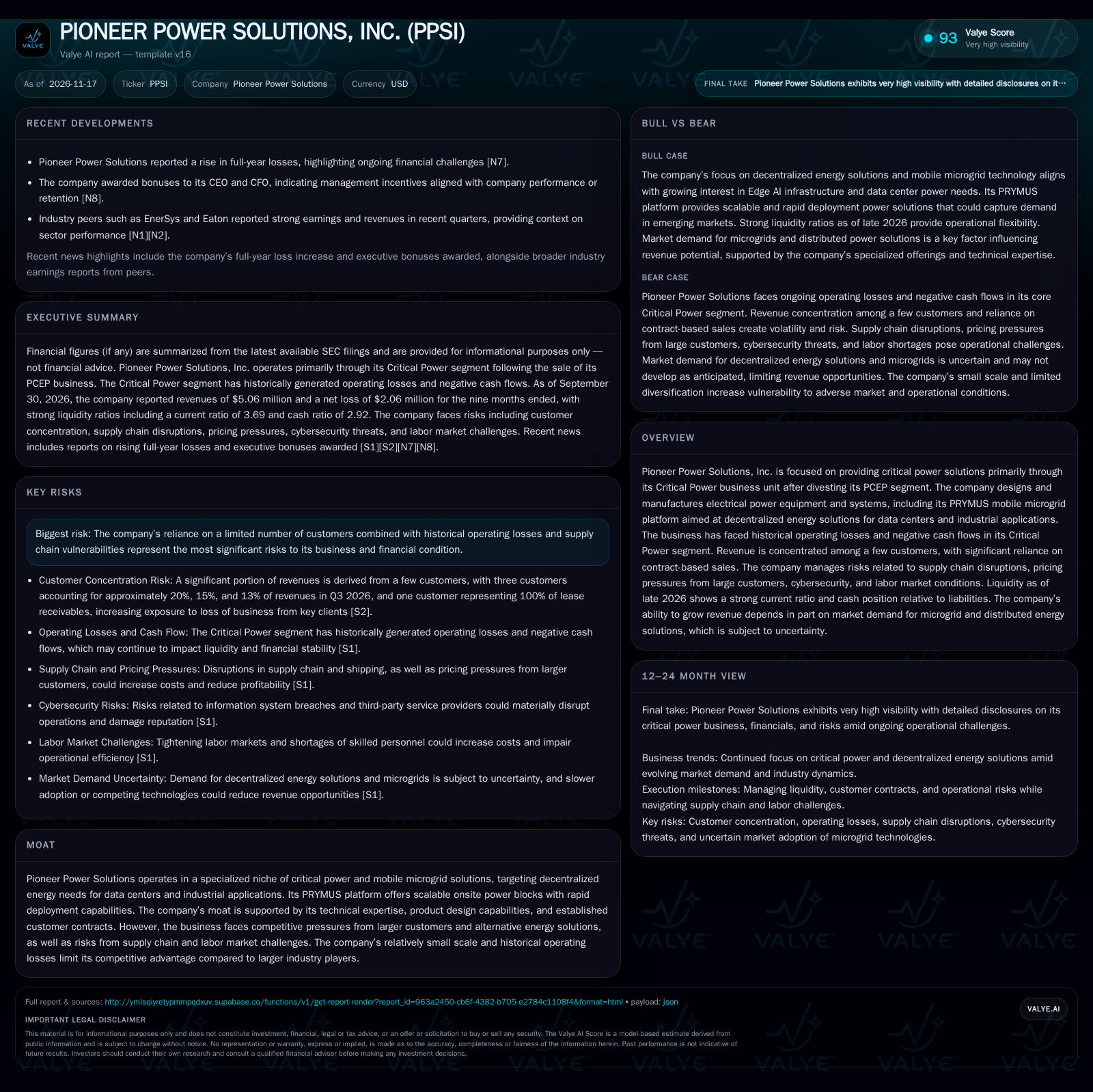
Pioneer Power Solutions is focused on critical power and mobile microgrid solutions after divesting its PCEP business.Despite a late-2026 reported cash balance and reported current ratio, the company continues to post operating losses and faces high customer concentration. The success of its PRYMUS platform depends on uncertain market demand for decentralized energy in sectors like data centers. [S2]
Pioneer Power Solutions stands at a strategic inflection: having narrowed its focus to the Critical Power business and its PRYMUS mobile microgrid platform, the company is seeking growth in the evolving energy infrastructure market. However, the fundamentals reveal a business still struggling to achieve profitability, with high dependence on a few customers and exposure to supply chain and market risks.
Recent Liquidity Gains, Persistent Losses, and Customer Concentration Define 2026 Position
Pioneer Power Solutions reported $17.999 million in cash and cash equivalents and a current ratio of 3.69 as of September 30, 2026, a notable improvement from its year-end 2025 cash balance of just $14,959. This provides a substantial liquidity buffer relative to $6.3 million in current liabilities. However, for the first nine months of 2026, the company generated only $5.06 million in revenue and posted a net loss of $2.06 million, continuing the trend of historical operating losses in its core Critical Power segment. Customer concentration remains acute, with three customers accounting for 20%, 15%, and 13% of Q3 2026 revenues, and a single customer representing 100% of lease receivables. These factors combine to create both a short-term cushion and a long-term fragility for the business. [S1] [S2]
Revenue Structure, Cost Pressures, and the Challenge of Scaling Microgrid Solutions
Pioneer’s revenue model is rooted in contract-based sales and leasing of critical power equipment and systems, including its PRYMUS mobile microgrid platform. The economics of this model are challenged by several factors: low scale, customer concentration, and persistent negative operating leverage. The company faces pricing pressure from larger customers, which can erode margins. Supply chain and shipping disruptions are ongoing risks that could further increase costs and delay project delivery, potentially impairing customer satisfaction and repeat business.
The capital intensity of manufacturing and deploying microgrid systems means that fixed costs are substantial relative to Pioneer’s current revenue base. Unless the company can drive higher sales volumes or secure longer-term, recurring contracts, fixed costs will continue to weigh on profitability. Additionally, the leasing model exposes Pioneer to counterparty risk and ties up capital in assets with uncertain utilization rates. The company’s dependence on key personnel, particularly its principal executive officer, adds another layer of operational risk if retention or succession falters.
Specialization in Mobile Microgrids Amid Larger Competitors and Technology Shifts
Pioneer Power Solutions occupies a specialized niche in the critical power market, focusing on mobile, rapidly deployable microgrid solutions for data centers and industrial clients. The PRYMUS platform is designed to address decentralized energy needs, a segment that is expected to grow in tandem with edge computing and AI-driven data center expansion. However, Pioneer competes against larger, more diversified players in electrical equipment, distributed energy, and backup power systems, many of whom benefit from scale, broader customer bases, and integrated service offerings.
Switching costs in this industry can be moderate, particularly for mission-critical power applications where reliability and technical support are paramount. However, if Pioneer’s solutions are not demonstrably superior in cost, performance, or deployment speed, customers may opt for more established brands or integrated energy service providers. The company’s small scale and customer concentration limit its ability to negotiate favorable terms or absorb project delays relative to larger competitors. Furthermore, ongoing advances in battery storage, distributed generation, and alternative backup power architectures could erode the addressable market for Pioneer’s current offerings if it does not continue to innovate.
If PRYMUS Gains Traction: A Path to Revenue Diversification and Margin Expansion
The most favorable scenario for Pioneer Power Solutions is one where the PRYMUS platform achieves broader adoption among data centers, industrial users, and edge infrastructure developers. This could be catalyzed by rising demand for resilient, decentralized power in the face of grid instability, regulatory incentives for distributed energy, or a surge in AI infrastructure build-out. If Pioneer secures multi-year contracts or framework agreements with larger clients, this could diversify revenue streams, reduce customer concentration, and provide greater visibility into future cash flows.
Confirmation of this scenario would come from a meaningful uptick in reported backlog, a decrease in customer concentration (with no single client accounting for more than 10% of revenues), and evidence of positive operating margins or cash flow from the Critical Power segment. Additional indicators might include new product launches, partnerships with major data center operators, or successful expansion into new verticals such as commercial real estate or public infrastructure.
Navigating Between Liquidity and Losses: The Most Likely Near-Term Trajectory
Absent a dramatic shift in market demand or execution, Pioneer is likely to continue operating with periodic contract wins but at a scale insufficient to meaningfully offset fixed costs or change the narrative of recurring operating losses.
In this scenario, revenues may remain lumpy and customer concentration high, with the company dependent on a handful of significant contracts. Incremental improvements in gross margin or cost control could slow the rate of losses, but without a step-change in sales volume or contract structure (e.g., more recurring revenue), persistent profitability will likely prove elusive. Confirmation would include continued negative operating margins, stable or only modestly growing revenue, and little change in the concentration of top customers.
Revenue Volatility, Customer Loss, and Supply Chain Disruptions Could Accelerate Decline
The adverse scenario for Pioneer Power Solutions is one where one or more key customers reduce orders or switch to competitors, causing a sharp decline in revenue. With three customers accounting for nearly half of recent revenue, the loss of even a single major account could create a disproportionate impact on cash flow and operational viability. Coupled with potential supply chain disruptions or cost overruns, this could further erode margins and exhaust the company’s liquidity buffer.
Additional downside risks include the failure of the PRYMUS platform to gain market traction, either due to technological obsolescence, regulatory setbacks, or competitive displacement. If the company is unable to replace lost business or contain costs, it could be forced to curtail operations, seek additional external financing under unfavorable terms, or consider strategic alternatives. Evidence of this scenario would include a sharp drop in reported revenues, a spike in receivable write-offs, increased reliance on short-term debt, or material restatements of financial guidance.
Milestones That Will Clarify Pioneer’s Ability to Convert Microgrid Potential Into Durable Growth
Quarterly revenue growth and gross margin trends—particularly any sustained improvement in operating margins or a move to positive cash flow, if disclosed, would signal progress toward scale.
Customer concentration metrics—tracking the share of revenue from top three customers and the emergence of new, diversified accounts would help test the company’s resilience.
Backlog and contract pipeline—disclosure of total backlog, new contract wins, or multi-year agreements would provide visibility into future revenue stability.
PRYMUS platform adoption—announcements of large-scale deployments, new verticals, or marquee customer wins for PRYMUS would indicate market acceptance.
Supply chain and cost management—updates on input costs, shipping delays, or inventory management would show the company’s ability to control operational risks.
Executive retention and succession—any changes in key personnel, particularly the principal executive, could materially affect operations.
Cybersecurity incidents—any reported breaches or disruptions could affect customer trust and operational continuity.
Disclaimer: This is research-only, informational analysis and not investment advice. It may include AI-generated interpretation and general industry context. Always verify important details using primary sources.

Comments