
Prelude Therapeutics: Liquidity Buys Time as Clinical Partnerships and Pipeline Execution Take Center Stage
Prelude Therapeutics faces the classic biotech dilemma: substantial liquidity and promising partnerships, but no commercial revenue and an urgent need for clinical validation. The company's near-term prospects hinge on the success of its lead oncology candidate, PRT13722, and the operational leverage of its Eli Lilly collaboration.
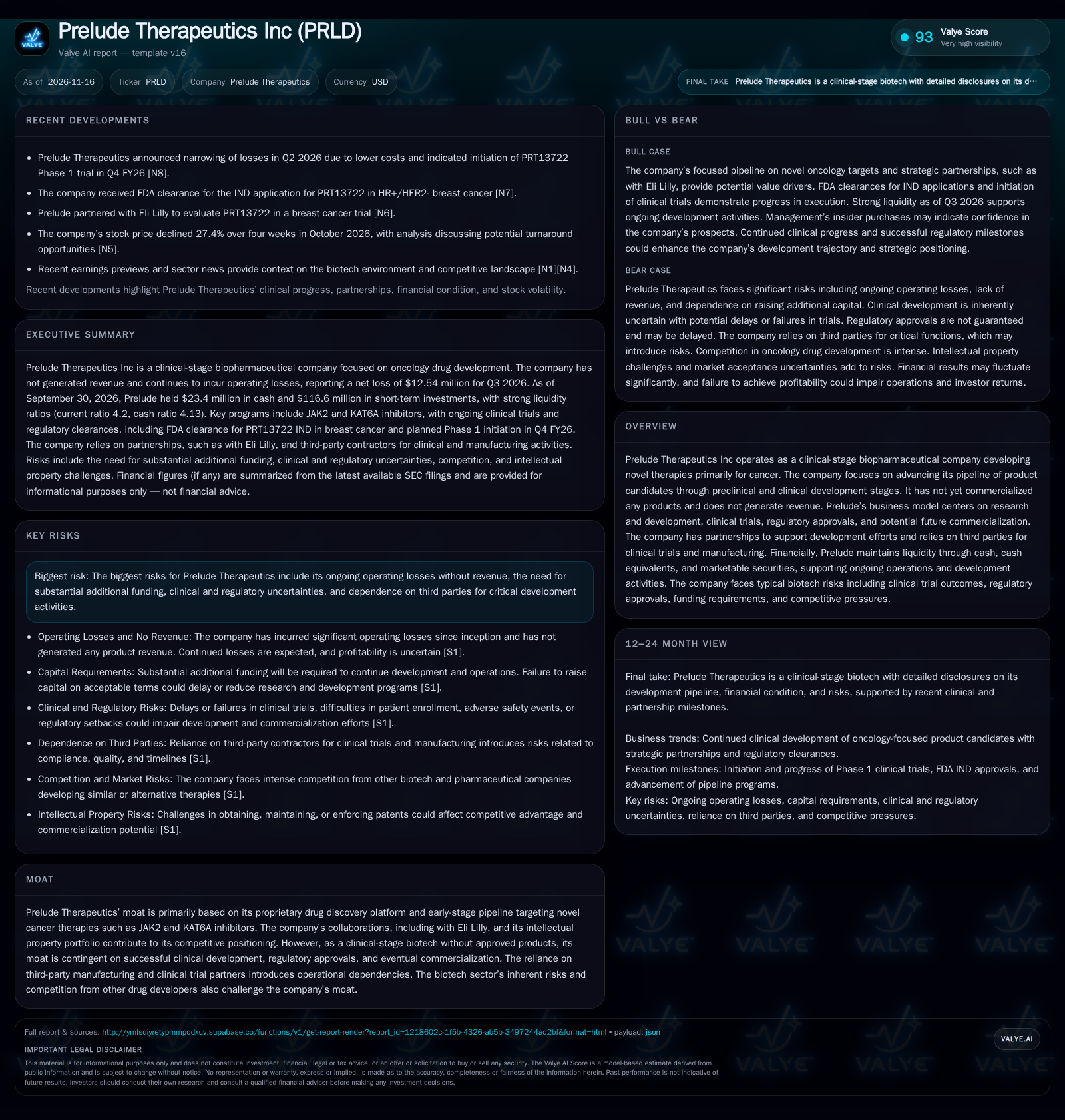
Prelude Therapeutics is a clinical-stage biotech with no product revenue, but reported liquidity position ($23.4M cash, $116.6M short-term investments as of Q3 2026). Recent milestones include FDA clearance and a major partnership with Eli Lilly for its lead program, PRT13722, which enters Phase 1 trials in late 2026. The business remains high-risk: ongoing losses, reliance on external funding, and development uncertainties dominate the outlook. Clinical success and further partnership leverage are essential for value creation, while delays or negative trial outcomes could rapidly erode the company's position. [S2] [N6] [N7] [N8]
Prelude Therapeutics stands at a critical inflection point. Armed with substantial liquidity and a high-profile partnership with Eli Lilly, the company is preparing to initiate Phase 1 trials for its lead oncology program, PRT13722, in HR+/HER2- breast cancer. Despite narrowing losses in recent quarters, Prelude remains pre-revenue and faces the familiar biotech challenge of converting scientific promise into commercial reality. The next 12–24 months will be shaped by the pace and outcome of clinical development, the durability of its financial resources, and its ability to attract further strategic partners or investors.
Recent Milestones Redefine Near-Term Strategic Focus
Prelude Therapeutics has made tangible progress in 2026, most notably through the FDA’s clearance of its IND application for PRT13722, targeting HR+/HER2- breast cancer, and the subsequent initiation of a Phase 1 clinical trial set for Q4 FY26. The company’s partnership with Eli Lilly to evaluate this candidate underscores external validation of its pipeline. Financially, Prelude reported a net loss of $12.54 million for Q3 2026 but retains a reported liquidity position with $23.4 million in cash and $116.6 million in short-term investments. Despite these advances, the company’s stock price dropped 27.4% over four weeks in October 2026, reflecting ongoing market skepticism and the high-risk nature of clinical-stage biotech. [S2] [N5] [N6] [N7] [N8]
The Economics of Drug Development: Cash Burn, Leverage, and Value Creation
Prelude’s business model is built around high-risk, high-reward drug development. With no product revenue to date, all funding is funneled into R&D, clinical trials, and regulatory activities. Operating leverage is negative at this stage—costs are largely fixed or rising as trials advance, while revenue remains hypothetical.
The economics shift dramatically if clinical milestones are achieved. Positive trial data could unlock milestone payments from partners, enable secondary financings at more favorable terms, or set the stage for out-licensing or acquisition. Conversely, failed or delayed trials would exacerbate cash burn and likely force dilutive capital raises or program cuts. The reliance on third-party clinical and manufacturing partners adds variable cost exposure and execution risk, but also limits the need for heavy in-house infrastructure investment.
In addition to the direct costs of clinical trials and regulatory submissions, Prelude’s financial sustainability depends heavily on the timing and structure of its partnership agreements. Milestone payments tied to clinical progress can provide crucial non-dilutive capital inflows, but these are often contingent on stringent endpoints and regulatory approvals, which introduces uncertainty in cash flow projections. Moreover, the economics of out-licensing or co-development deals hinge on the perceived value of the asset at each stage, which is influenced by competitive dynamics and emerging clinical data. Therefore, Prelude’s ability to negotiate favorable terms and maintain operational flexibility will be key to managing its cash runway and maximizing shareholder value.
Another critical economic consideration is the scalability of Prelude’s platform and pipeline beyond the lead asset. If the company can efficiently leverage existing research infrastructure and partnerships to advance multiple candidates, it could achieve economies of scope that reduce average development costs per program. However, expanding the pipeline also risks diluting management focus and increasing capital requirements, especially if early-stage assets require significant preclinical investment before reaching clinical validation. Balancing portfolio breadth with depth, and aligning resource allocation with realistic probability-weighted outcomes, will be essential for sustaining long-term value creation.
Strategic Partnerships and Pipeline Differentiation in a Crowded Oncology Landscape
Prelude’s competitive position is defined by its focus on novel oncology targets and its ability to secure high-profile collaborations. The Eli Lilly partnership for PRT13722 is a critical differentiator, lending external credibility and offering potential access to Lilly’s development and commercialization capabilities. However, the oncology drug development space is intensely competitive, with numerous larger and better-funded players pursuing similar mechanisms and indications. The company’s proprietary platform and intellectual property portfolio may provide some insulation, but the absence of commercialized products means its moat is unproven and contingent on clinical success.
Switching costs and barriers to entry in oncology therapeutics are high due to regulatory, clinical, and intellectual property hurdles. However, once a drug is commercialized, switching frictions can be significant, especially if the therapy demonstrates superior efficacy or safety. Until then, Prelude’s position is precarious, with substantial risk from both direct competitors and emerging modalities (e.g., cell and gene therapies) that could shift the treatment paradigm.
The competitive oncology landscape is not only shaped by the number of players but also by the evolving standards of care and emerging therapeutic modalities. Prelude’s differentiation will depend on its ability to demonstrate clinically meaningful improvements in efficacy, safety, or patient convenience compared to existing treatments. This requires not only robust clinical trial design but also strategic patient selection and biomarker development to identify subpopulations most likely to benefit. Success in these areas can create competitive barriers by establishing niche indications or companion diagnostics that enhance the value proposition and reduce direct competition.
Furthermore, the partnership with a major pharmaceutical company like Eli Lilly offers more than capital; it can provide critical expertise in regulatory strategy, market access, and commercialization capabilities. However, such collaborations also introduce dependencies and potential conflicts regarding decision-making and resource prioritization. Prelude must carefully manage this relationship to preserve strategic autonomy while leveraging partner strengths. The ability to maintain a clear development roadmap and align incentives will influence not only clinical progress but also the company’s attractiveness to future collaborators or acquirers.
Validation Catalysts: How Clinical Success Could Transform Value
The most favorable scenario for Prelude involves rapid and positive clinical readouts from the PRT13722 Phase 1 trial, followed by successful advancement into later-stage studies. If early data demonstrate safety and preliminary efficacy, the Eli Lilly partnership could expand, potentially triggering milestone payments or a broader collaboration. This would improve both Prelude’s financial position and its negotiating leverage for additional partnerships or capital raises.
Confirmation of this scenario would come from positive interim trial updates (if disclosed), new partnership announcements, or the initiation of additional trials for other pipeline assets. Upward stock price momentum and the ability to raise non-dilutive capital would further validate a bullish thesis. Conversely, unexpected safety issues, trial enrollment delays, or lack of efficacy would quickly falsify the upside case.
Pipeline Progression and Capital Management in an Unforgiving Market
The most plausible near-term trajectory is incremental progress: Prelude advances PRT13722 through early clinical stages with mixed but not disqualifying results, while managing its cash burn judiciously. The company continues to report operating losses and remains reliant on its liquidity pool, with further capital raises likely needed before any commercial inflection point. Additional partnerships or out-licensing agreements could provide interim financing or validation but are not guaranteed.
Evidence supporting this scenario would include regular clinical updates, modest cost discipline, and continued engagement with strategic partners.
Liquidity Erosion and Pipeline Setbacks: The Rapid Risks of Clinical Failure
The adverse scenario unfolds if PRT13722 encounters serious clinical setbacks—such as safety concerns, poor efficacy signals, or regulatory delays—leading to suspension or termination of trials. In this case, Prelude’s liquidity would be rapidly consumed by ongoing operations, with few alternatives for near-term value creation. The absence of commercial revenue, paired with an eroding investor base (as reflected in recent share price volatility), would likely force the company into highly dilutive financings, asset sales, or drastic cost reductions.
This scenario would be confirmed by negative clinical news, sharp declines in liquidity, or public disclosures of failed partnership negotiations. If Prelude is unable to pivot its pipeline or attract new capital, it could face strategic review, including potential sale or restructuring.
Milestones and Metrics That Will Determine Prelude’s Clinical and Financial Trajectory
Interim safety and efficacy data from the PRT13722 Phase 1 trial (if disclosed) will be critical for assessing the likelihood of later-stage development and partner engagement.
Updates on the scope, terms, and progress of the Eli Lilly partnership—especially any milestone payments or expanded collaboration—would help clarify Prelude’s near-term value-creation potential.
Announcements of new partnerships, out-licensing deals, or non-dilutive financings would indicate external validation and reduce reliance on dilutive equity raises.
Pipeline diversification—initiation of additional clinical trials or progression of other candidates—would mitigate single-asset risk and broaden future revenue options.
Any regulatory feedback or delays from the FDA or other agencies could impact trial timelines and investor confidence.
Insider transaction activity was reported in the cited source; this activity does not by itself establish insider confidence.
Observed volatility in share price and trading volumes may reflect shifting market sentiment and impact Prelude’s future fundraising capacity.
Disclaimer: This is research-only, informational analysis and not investment advice. It may include AI-generated interpretation and general industry context. Always verify important details using primary sources.

Comments