
ProKidney Advances Kidney Cell Therapy with Pivotal PROACT 1 Trial and FDA Alignment
ProKidney’s Q1 2026 update highlights clinical progress on rilparencel, reinforced by FDA accelerated approval alignment and supported by strong liquidity.
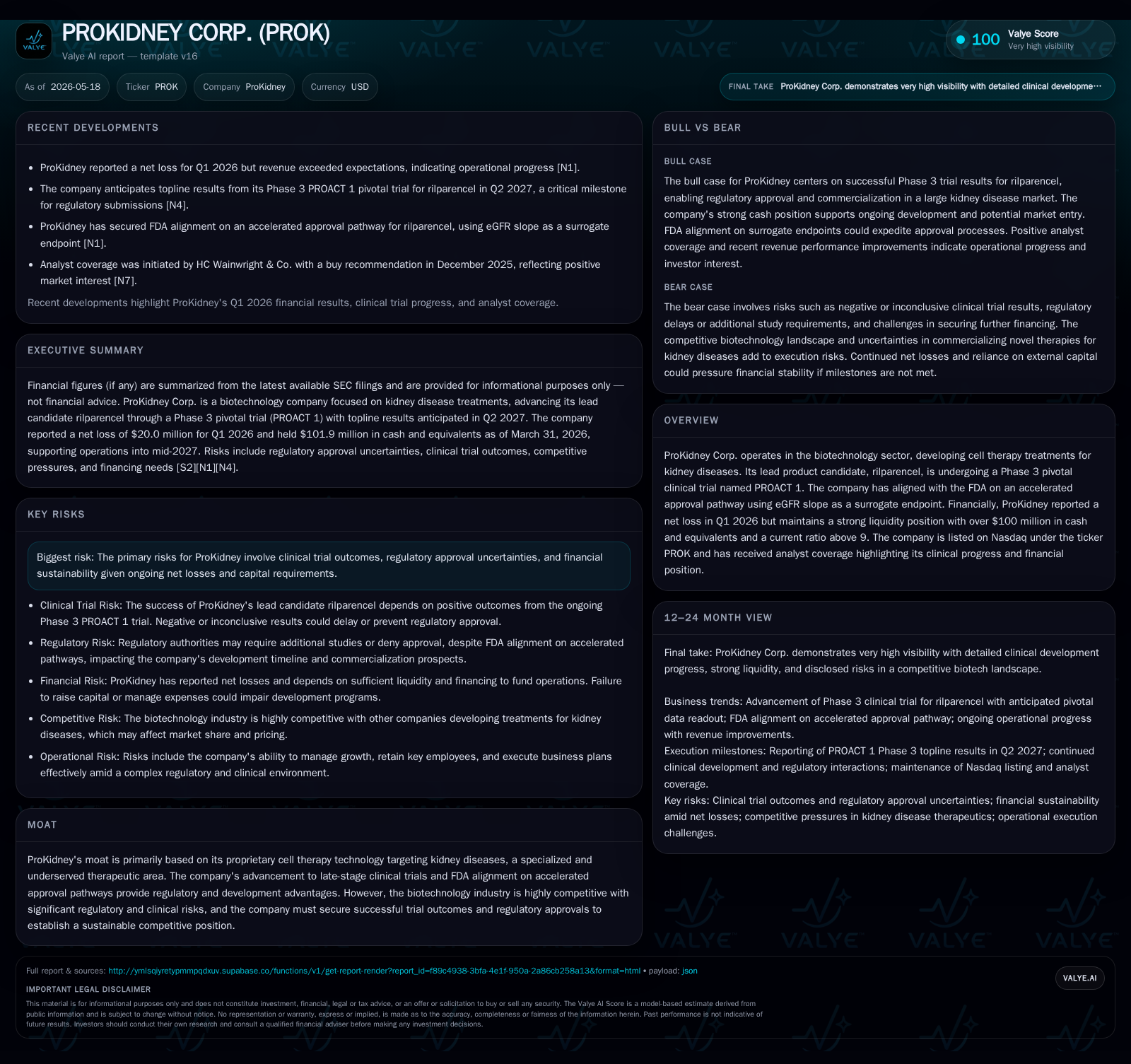
ProKidney Corp. reported continued advancement of its Phase 3 PROACT 1 trial for rilparencel, a cell therapy targeting kidney diseases, with topline pivotal data expected in Q2 2027. The company has secured FDA agreement to pursue accelerated approval leveraging eGFR slope as a surrogate endpoint, underscoring a streamlined regulatory path. Despite posting a net loss for Q1 2026, ProKidney maintains a robust cash position exceeding $100 million and a current ratio above 9, providing operational runway into mid-2027. The company’s proprietary cell therapy platform is strategically focused on an underserved renal disease market with significant unmet needs.
Latest Operating Update: Q1 2026 and PROACT 1 Progress
In its most recent quarterly filing dated May 15, 2026 [S2], ProKidney reaffirmed that enrollment remains on track for the Phase 3 PROACT 1 pivotal trial evaluating rilparencel in patients with chronic kidney diseases. The study targets approximately 470 subjects and aims to deliver topline results in the second quarter of 2027 for the primary surrogate endpoint: annualized estimated glomerular filtration rate (eGFR) slope. This endpoint measures kidney function decline rate and is accepted by the FDA as a meaningful surrogate to expedite approval under an accelerated regulatory pathway.
Concurrent disclosure via an 8-K filing on the same day [S3] detailed the company's ongoing positive interactions with the FDA regarding this surrogate endpoint. Rilparencel holds Regenerative Medicine Advanced Therapy (RMAT) designation, which provides enhanced communication with regulators and accelerated development options. The company updated powering assumptions for statistical analysis aiming for an effect size in annualized eGFR slope reduction of between 1.5 to 1.75 mL/min/1.73m2, aligning expectations with regulatory acceptance.
Despite these operational strides, ProKidney reported a net loss during Q1 2026 as anticipated given its clinical-stage status [N1]. However, the firm maintains financial durability with over $100 million in cash and equivalents at quarter-end March 31, 2026 [F1], alongside a current ratio exceeding nine times based on current assets relative to short-term liabilities [F1].
Business Model: Proprietary Cell Therapy for Kidney Disease
ProKidney generates value primarily through developing allogeneic cell therapies designed to treat chronic kidney disease (CKD), currently an underserved therapeutic space lacking curative options. Its lead candidate rilparencel is engineered to halt or reverse renal decline by delivering regenerative cells directly into kidney tissue.
Revenue generation remains prospective at this stage since products are investigational and not yet commercialized [S1]. Customers will largely be healthcare providers managing CKD patients within specialized nephrology treatment centers once rilparencel achieves approval. Ultimately payors—private insurers, Medicare/Medicaid—will reimburse based on demonstrated clinical benefit and cost-effectiveness profiles.
The company’s platform is differentiated by leveraging proprietary technology enabling durable engraftment and functional recovery capacity of transplanted cells. Such innovation may erect significant switching costs if rilparencel demonstrates superior efficacy compared to alternative potential therapies or standard-of-care agents that only slow progression without reversal potential.
Given specialty biotech dynamics, pricing power will depend critically on clinical outcome strength, payer negotiations informed by economic modeling reflecting avoided dialysis or transplant costs, and managed entry agreements where applicable.
Regulatory Framework and FDA Interaction on Accelerated Approval
A foundational aspect underpinning ProKidney’s development strategy is its constructive dialogue with the FDA [S2][S3]. The agency’s acceptance of annualized eGFR slope as an adequate surrogate endpoint under an accelerated approval pathway streamlines time-to-market compared with requiring hard clinical outcomes such as end-stage renal disease events.
This regulatory endorsement reduces traditional uncertainty around endpoint validity in kidney disease trials, often lengthening trials due to slow disease progression kinetics. RMAT designation confers additional benefits including eligibility for priority review upon submission of a Biologics License Application (BLA).
Consequently, ProKidney can focus resources efficiently toward completing enrollment swiftly while preparing regulatory dossiers anchored on well-defined surrogate data metrics hypothesized to correlate strongly with long-term patient benefits.
This approach contrasts favorably against some biotech peers focusing on novel agents without clear surrogate markers agreed by regulators–a factor inherently augmenting risk–thus potentially accelerating ProKidney’s commercial readiness timeline pending positive data.
Competitive Environment Within Kidney Disease Biotechnology
ProKidney operates in a niche subset of biotechnology dedicated to renal disease therapeutics but distinguishes itself by pursuing cell-based regenerative approaches rather than conventional pharmacologic inhibitors or symptomatic treatments.
The broader biotech industry serving CKD patients includes companies developing small molecules targeting fibrosis pathways or ion transport modulators; however, none match the mechanism-of-action depth nor the transformative potential claimed by ProKidney’s platform [S1].
Barriers to entry remain high given intense upfront research investment required for cell therapy manufacturing consistency, scalability challenges inherent in autologous/allogeneic therapies, and complex regulatory demands surrounding safety profiles.
Intellectual property protection strengthens ProKidney’s positioning given proprietary cell lines and delivery methods critical in avoiding direct replication by competitors.
Nevertheless, as kidney disease prevalence increases globally due to aging demographics and comorbidities like diabetes/hypertension rise structurally, competition may intensify both from emergent biotechs refining related technologies and large pharmaceutical incumbents exploring acquisitions or partnerships.
Growth Drivers: Clinical Milestones and Surrogate Endpoint Validation
The principal growth engine lies in successful achievement of pivotal clinical milestones — specifically completion of PROACT 1 enrollment followed by positive topline results demonstrating statistically meaningful effects on eGFR slope [S2][S5]. Meeting pre-specified criteria will enable submission of a BLA under accelerated approval rules.
Surrogate endpoint validation expedites market access but also predicates commercial success heavily on convincing payors of translational relevance into harder clinical endpoints like dialysis delay or mortality reductions over confirmatory post-marketing trials.
Secondary growth avenues may include pipeline expansion leveraging platform capabilities across related renal indications or broader organ fibrosis domains if technical feasibility materializes.
Market size fundamentals support structural growth opportunities given CKD affects millions worldwide with limited curative options — presenting tangible demand drivers beyond cyclical factors common in biotech sectors reliant on specialty drug launches or rare diseases alone.
Risks and Constraints: Clinical Outcomes, Approval Uncertainties, and Funding
Despite promising progress, substantial risks persist typical to late-stage biotechnology firms [S10][S22]. The binary nature of clinical trial outcomes means failure to meet endpoints could dramatically impair valuation and financing capacity.
Regulatory agencies retain authority to request additional studies particularly post-accelerated approval based on confirmatory survival or composite endpoints expected in later analyses which extend timelines considerably.
Financial sustainability requires maintaining sufficient capital amid ongoing net losses driven by heavy R&D expenditures; although cash reserves appear adequate near term [F1], further financing raises may be necessary depending on trial duration or expanded program investments.
Operational risks include patient recruitment variability impacting enrollment pace within PROACT 1 trial alongside possible supply chain constraints or manufacturing scale-up complications inherent in complex cell therapies.
Competition remains an evolving threat if rival cell technology or pharmacologic competitors achieve comparable efficacy earlier or circumvent current barriers via disruptive innovations.
Outlook: Upcoming Milestones and Key Decision Points
Investors should closely monitor several catalysts that underpin near-term execution credibility:
- Confirmation of completed PROACT 1 enrollment targeted mid-2026 [S2][S3]
- Timely announcement of pivotal topline eGFR slope data expected Q2 2027 elucidating treatment effect magnitude supporting BLA submission plans
- Further FDA communications outlining post-marketing study requirements or labeling frameworks based on confirmatory composite outcomes slated for later readouts (~second half of 2029)
- Updates from management clarifying development timelines or capital adequacy amid evolving external market conditions [S5]
- Observations around patient retention metrics within trials providing surrogates for long-term adherence/effectiveness potential analogous indications offer perspective on commercial viability prospects.
Continuous transparency from ProKidney around these points will be critical for assessing whether strategic inflection points translate into sustainable growth trajectories rather than transient biotech event cycles.
Financial Health Highlights: Cash Position and Runway Analysis
ProKidney's financial footing entering mid-2026 features $101.9 million in cash and equivalents as of March-end [F1], supplemented by total current assets near $235 million against $25.9 million in current liabilities yielding an unusually high current ratio above nine times [F1].
This analysis synthesizes publicly filed SEC disclosures through mid-May 2026 alongside corroborating financial data up to Q1 2026 reporting period. It reflects observed operational advances positioning ProKidney Corp. within its specialized biotech niche targeting chronic kidney diseases via novel cell therapy approaches while highlighting critical risk factors inherent in late-stage clinical development contexts. No investment research views are provided herein; readers are encouraged to perform independent diligence considering evolving trial results and market dynamics.
Disclaimer: This is research-only, informational analysis and not investment advice. It may include AI-generated interpretation and general industry context. Always verify important details using primary sources.

Comments