
Portsmouth Square’s Single-Hotel Focus: Concentration Risks, Contract Timelines, and the Economics of Urban Hospitality
Portsmouth Square Inc. operates the Hilton San Francisco Financial District as its sole asset, with nearly all revenue tied to this single, unionized property. The company faces material risks from geographic and operational concentration, upcoming management and franchise contract renewals, and significant debt to its controlling shareholder. Navigating labor, capital expenditure, and local demand shifts will be critical as the company approaches key inflection points.
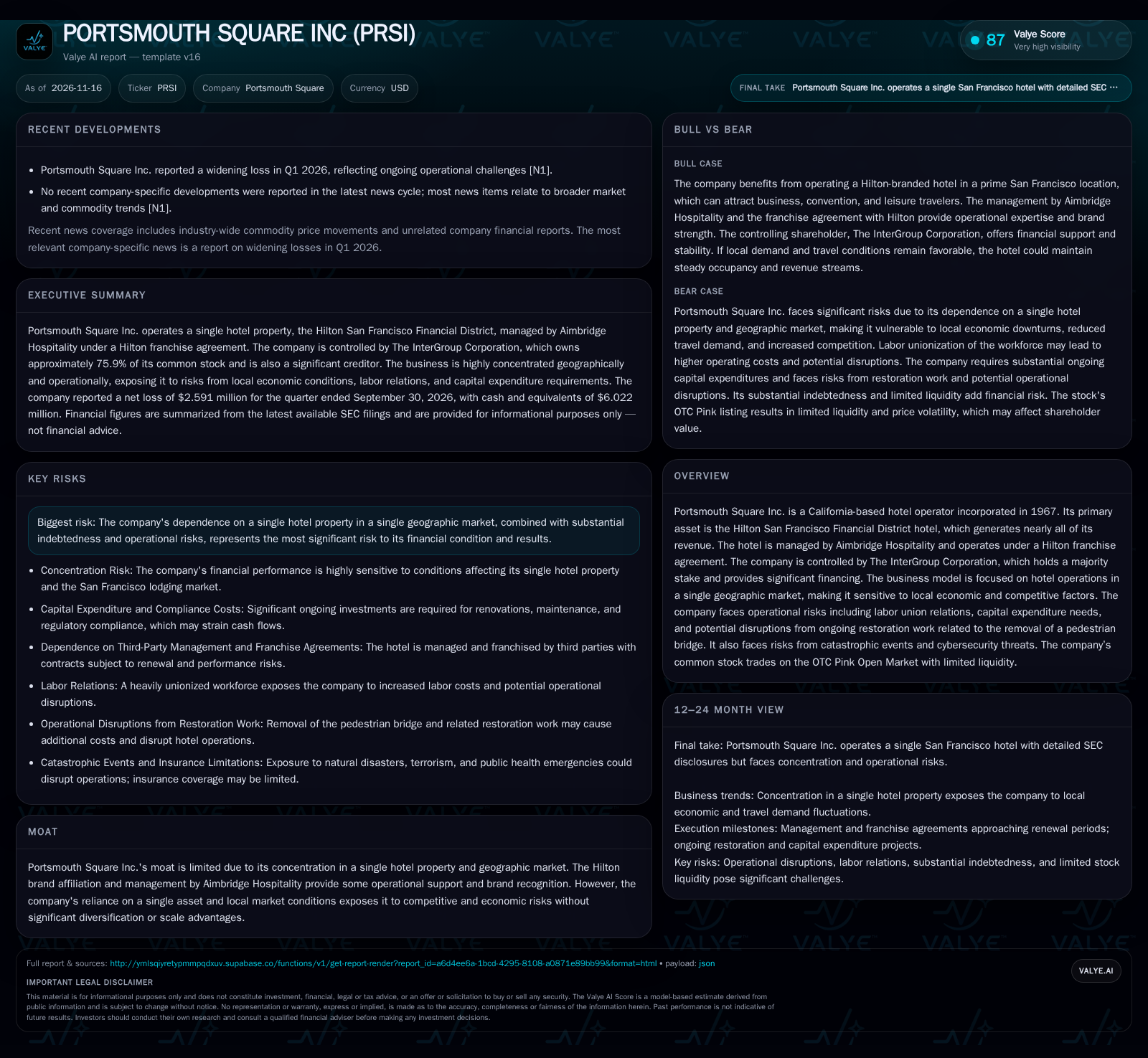
Portsmouth Square Inc. is a highly concentrated hotel operator reliant on a single San Francisco property, facing operational, financial, and contract renewal risks. Key facts include a net loss of $2.591 million for the September 2026 quarter, $6.022 million in cash, and $38.1 million in related-party debt. The business is particularly sensitive to local market conditions and labor costs as it approaches major contract milestones and ongoing restoration projects. [S2]
Portsmouth Square Inc. sits at the intersection of urban hospitality concentration and operational complexity. With the Hilton San Francisco Financial District as its sole revenue-generating asset, the company’s fortunes are intertwined with the city’s business and tourism cycles, as well as the evolving economics of large, unionized hotels. As contract renewals and restoration work loom, Portsmouth’s ability to manage labor costs, maintain property competitiveness, and service its related-party debt will define its near-term trajectory. The company’s concentrated structure amplifies both the upside potential of a market recovery and the downside of local shocks, making execution and external conditions unusually consequential. [S2]
Why Single-Asset Exposure and Contract Renewals Dominate Portsmouth’s Risk Profile
Portsmouth Square Inc. currently operates only the Hilton San Francisco Financial District hotel, with nearly all of its revenue and cash flow dependent on this single property. This acute concentration amplifies the company’s sensitivity to San Francisco-specific economic trends, travel demand, and competitive pressures. [S2]
The company reported a net loss of $2.591 million for the quarter ending September 30, 2026, and had $6.022 million in cash with $38.1 million outstanding under a related-party revolving credit facility. [S2] These figures highlight ongoing financial pressure and reliance on its controlling shareholder for liquidity.
The management agreement with Aimbridge Hospitality expires in February 2027, while the Hilton franchise agreement runs through January 2030. [S2] The approaching end dates for these contracts introduce uncertainty around operational continuity, brand affiliation, and potential changes in cost structure or performance.
Labor dynamics also loom large: approximately 90% of the hotel’s workforce is unionized, creating high fixed labor costs and potential disruption risk, especially as collective bargaining agreements evolve. [S2]
Urban Hotel Economics: Fixed Costs, Capital Demands, and Volume Sensitivity
The economics of Portsmouth Square’s business are fundamentally shaped by high operating leverage and a rigid cost base, typical of large, unionized urban hotels. Labor—representing a major fixed cost due to union contracts—limits the company’s ability to flex expenses downward during periods of soft demand. This structure means that occupancy rates and average daily rates (ADR) have an outsized impact on profitability: incremental revenue converts to operating income at a high rate when the hotel is full, but downturns quickly expose losses.
Significant ongoing capital expenditures are required to maintain Hilton brand standards, ensure regulatory compliance, and address restoration projects such as the pedestrian bridge removal. These costs are not discretionary and may increase over time as the property ages or if local regulations tighten.
The company reported cash and liquidity metrics for the period; these figures do not by themselves establish operating runway, investment capacity, financial flexibility, or financing capacity. While the relationship with InterGroup provides access to credit, it also concentrates risk and limits external financing options. The company’s ability to fund major renovations or weather extended downturns is thus directly tied to its cash flow and the willingness of its controlling shareholder to extend additional support. [S2]
The business model does benefit from the Hilton flag, which can drive occupancy and pricing power in favorable markets, but royalty and management fees reduce margin upside and are contractual obligations regardless of performance.
Brand Strength vs. Local Competition: San Francisco Hotel Dynamics
Affiliation with the Hilton brand and professional management by Aimbridge Hospitality confer operational expertise and some degree of demand insulation—particularly from loyalty program travelers and business accounts. However, Portsmouth’s single-asset focus means it lacks portfolio-level diversification, cross-marketing opportunities, or bargaining leverage with suppliers and OTAs (online travel agencies) that larger peers enjoy.
In San Francisco, the competitive landscape is shaped by a mix of branded and independent hotels, many of which have also faced pandemic recovery challenges, labor pressures, and shifting business travel patterns. The ability to attract convention and leisure travelers is partly a function of citywide events, macro trends in travel, and the property’s physical condition.
Unionization, while a stabilizer for labor relations in some respects, can erode cost competitiveness versus non-union or less heavily unionized properties. Additionally, if the hotel fails to keep up with renovations or if restoration work disrupts guest experience, competitive positioning could erode quickly.
Switching costs for travelers are low—business and leisure guests can easily choose alternate hotels if price, service, or location become less compelling. The main defensible advantage is thus the Hilton brand and the hotel’s central location, but these are not insurmountable barriers for competitors.
Market Recovery and Operational Stability Could Unlock Margin Upside
If San Francisco’s hospitality market rebounds—driven by a resurgence in business travel, conventions, or tourism—the Hilton San Francisco Financial District could see a significant lift in both occupancy and ADR. Operating leverage means that much of the incremental revenue would flow through to the bottom line, potentially reversing recent losses.
The upside scenario is further supported if the company successfully completes restoration work with minimal disruption, and if management and franchise contracts are renewed on favorable terms, preserving brand and operational continuity.
A favorable outcome would be confirmed by rising occupancy and ADR metrics (if disclosed), narrowing net losses or a return to profitability, and evidence that capital expenditures are driving higher guest satisfaction or improved RevPAR (revenue per available room).
Falsification would come from continued or worsening losses despite market recovery, contract non-renewal, or significant operational disruptions from restoration work.
Navigating Status Quo: Modest Recovery, Persistent Constraints
The most plausible outcome is a slow, uneven recovery in San Francisco hotel demand, with Portsmouth Square maintaining occupancy and rates sufficient to cover operating expenses but with limited margin expansion due to high fixed costs and ongoing capital needs.
The company is likely to renew its management and franchise agreements, though possibly at higher cost or with less favorable terms if market conditions remain challenging. Labor costs are expected to remain elevated, and any wage or benefit concessions are unlikely in the near term given the high unionization rate.
Restoration and compliance projects will continue to absorb cash, limiting free cash flow and the ability to reduce related-party debt. The business will remain acutely sensitive to local shocks (e.g., strikes, regulatory changes, major events) and will lack the diversification to offset adverse developments.
Confirmation of this scenario would come from stable but modestly improving financial results, continued reliance on InterGroup for liquidity, and evidence that operational disruptions are being managed but not fully resolved.
Local Disruptions or Contract Friction Could Trigger a Cash Crunch
A plausible adverse scenario involves a negative local shock—such as a major labor dispute, prolonged restoration-related disruption, or a downturn in San Francisco travel—that drives occupancy and rates lower. Given the high fixed cost structure and limited ability to reduce expenses, losses could accelerate quickly.
If management or franchise agreements are not renewed, or are renewed at significantly higher fees, the company could lose brand value or face operational instability. In this scenario, Portsmouth Square’s dependence on InterGroup for liquidity becomes more acute, and the risk of covenant breaches, forced asset sales, or further dilution rises.
Evidence for this downside would include declining occupancy and ADR, widening losses, public labor disputes, or SEC filings disclosing new debt terms, asset impairment, or going concern language.
Falsification would require evidence of stable or improving operations despite local headwinds, successful contract renewals, and effective mitigation of restoration impacts.
Milestones That Will Shape Portsmouth Square’s Operational and Financial Resilience
Renewal or renegotiation of the Aimbridge management agreement (expiration February 2027) and Hilton franchise agreement (expiration January 2030); new terms or non-renewal would be highly material to future operations. [S2]
Occupancy rate and average daily rate (ADR) trends at the Hilton San Francisco Financial District, if disclosed, as primary drivers of revenue and operating leverage.
Updates on restoration work related to the pedestrian bridge removal, including timing, cost overruns, and operational disruption to hotel guests and staff.
Negotiations or changes in collective bargaining agreements with the three labor unions representing 90% of the workforce, including any public disputes or wage/benefit changes.
Capital expenditure levels and their impact on cash flow, property condition, guest satisfaction, and Hilton brand compliance.
Changes in related-party debt levels and terms with InterGroup, including any new financing arrangements, covenant amendments, or repayment schedules.
Any SEC filings or disclosures indicating asset impairments, going concern warnings, or major shifts in liquidity position.
Disclaimer: This is research-only, informational analysis and not investment advice. It may include AI-generated interpretation and general industry context. Always verify important details using primary sources.

Comments