
Palmer Square Capital BDC Struggles with Profitability While Expanding Liquidity and Share Repurchases
PSBD’s recent financials highlight material shifts in earnings, cash flow, and capital allocation amid regulatory and portfolio risks.
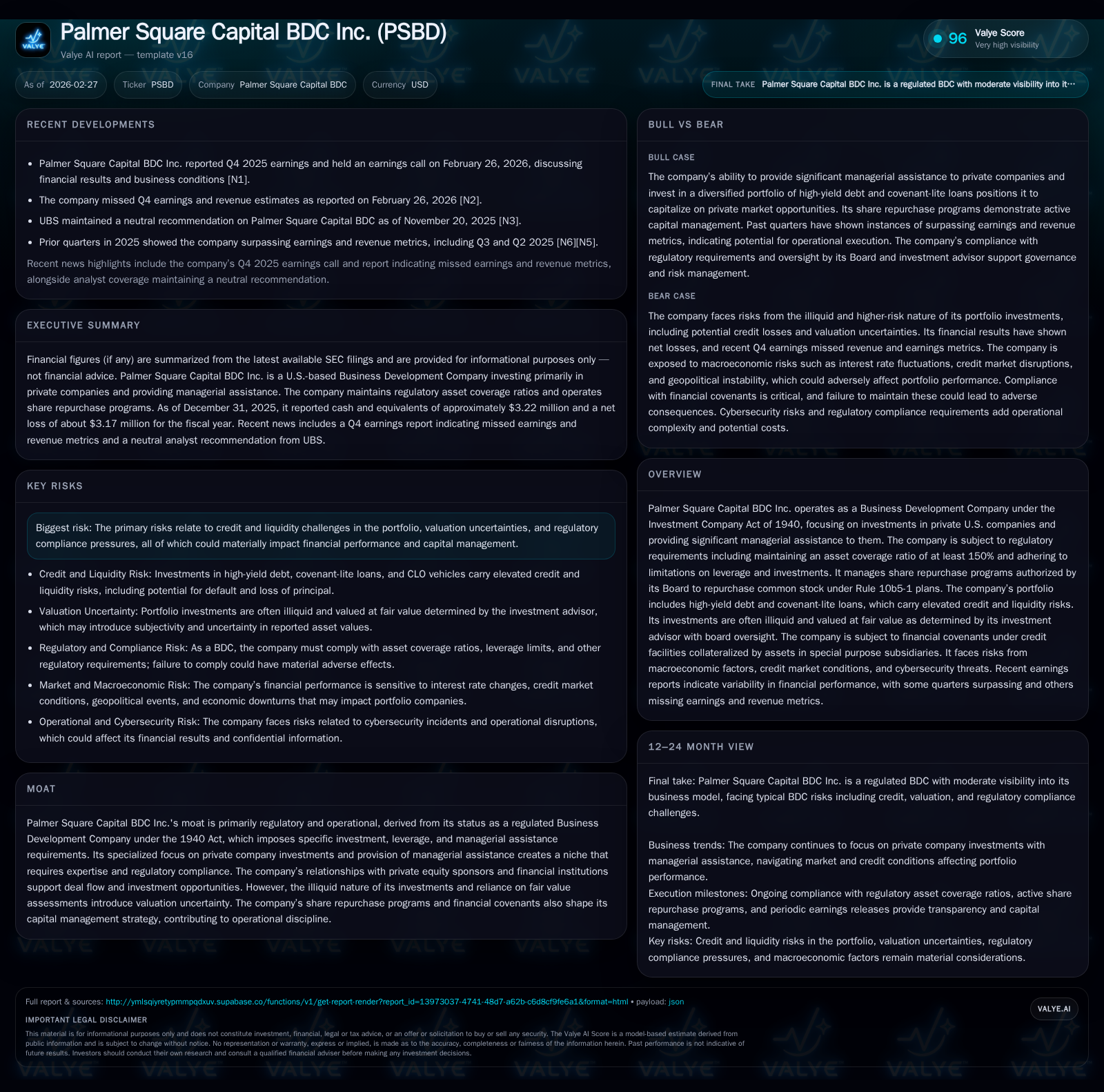
Palmer Square Capital BDC Inc. operates as a regulated Business Development Company (BDC), concentrating on investments in private U.S. companies with a focus on high-yield debt and covenant-lite loans. Despite its growth in operating cash flows and continued share repurchase activity, the company reported a sharp deterioration in net income for 2025 compared to prior years. This profitability challenge coexists with constraints imposed by regulatory coverage ratios and credit facility covenants, while its portfolio’s illiquidity and valuation risks persist. Capital allocation decisions, notably aggressive buybacks and dividend distributions, underline management’s confidence but also present potential risks to financial flexibility. Going forward, watch for portfolio performance stabilization, regulatory compliance, and the impact of macroeconomic variables on cost of capital and credit risk.
Company Overview
Palmer Square Capital BDC Inc. (PSBD) is a Business Development Company operating under the Investment Company Act of 1940. It focuses on investing primarily in private U.S. companies by providing debt financing, particularly high-yield and covenant-lite loans, often coupled with significant managerial assistance to portfolio companies [S1]. Its operations are tightly regulated around leverage limits—specifically an asset coverage ratio of at least 150% must be maintained—and borrowing arrangements that use specialized subsidiaries as collateral [S6], [S9].
The company’s moat largely derives from the regulatory framework applying to BDCs that governs investment terms and leverage [S23] as well as operational expertise in navigating illiquid private credit markets . Moreover, strong relationships with private equity sponsors provide deal flow advantages but competition remains intense among both regulated BDCs and other private debt investors [S15].
Historical Financial Performance
Financially, PSBD presents a mixed picture through the past few fiscal years [F1]: net income has swung notably—from positive $108M in FY2023 down to a loss of $3.17M by FY2025—reflecting fluctuations in underlying portfolio valuations and market risk factors. A more encouraging metric is operating cash flow (CFO), which rebounded sharply from negative $201M in FY2024 to positive $161M in FY2025, indicating improved realized liquidity from its investments.
Equity value increased steadily from about $363M at the end of FY2022 to over $537M at end-FY2024 before moderating slightly back down to $464M at FY2025’s close [F1], likely influenced by share repurchases combined with portfolio valuation changes.
Historical performance (annual)
| FY | Net ($mm) | CFO ($mm) | Net YoY |
|---|---|---|---|
| 2025 | -3 | 161 | -106.6% |
| 2024 | 48 | -201 | -55.8% |
| 2023 | 108 | 20 | |
| 2022 | 25 |
Source: SEC companyfacts cache [F1].
Capital returns and efficiency (annual)
| FY | Buybacks ($mm) | ROE% |
|---|---|---|
| 2025 | 18 | -0.7 |
| 2024 | 1 | 8.9 |
| 2023 | 23.3 | |
| 2022 |
Source: SEC companyfacts cache [F1].
Notably, share repurchases accelerated substantially after IPO-related buyback programs were authorized. The company executed approximately $18 million in open-market repurchases during FY2025 under Rule 10b5-1 plans designed to operate automatically when stock prices dip below NAV per share [S4], [S5].
ROE based on reported net income against equity approximates -0.7% for FY2025 due primarily to losses recorded; however this contrasts prior years’ positive returns [F1]. This volatility underscores sensitivity inherent in portfolios exposed to credit risk and fair value accounting.
Portfolio Composition & Credit Risk
PSBD invests predominantly in high-yield debt instruments including leveraged loans characterized as covenant-lite—a structure providing fewer lender protections via maintenance covenants—and thus heightened credit risk exposure [S12], [S13], [S14]. These investments are typically illiquid and privately negotiated without ready market price discovery.
The company values these positions at fair value through methodologies implemented by the investment advisor under board supervision; however this process introduces valuation uncertainty given limited transparency on underlying asset performance metrics . Furthermore,
- The firm holds interests in CLO tranches which are often highly leveraged junior securities implying sensitive loss profiles [S12].
- Concentration in certain industries or geographic regions adds idiosyncratic risk.
Inflationary pressures may impair portfolio companies’ ability to pass cost increases downstream potentially leading to payment delinquencies or defaults [S10]. Rising interest rates increase borrowing costs affecting PSBD’s net spread income given its leverage structure [S6].
Capital Structure & Leverage Management
As of December 31, 2025, PSBD had total outstanding indebtedness around $717 million bearing an average effective interest rate near 6%. To cover interest expense alone requires the investment portfolio to generate roughly a minimum annual return of approximately 3.56% [S9].
Leverage is subject to strict asset coverage regulatory mandates: the ratio of total assets less liabilities other than senior securities over outstanding senior securities must be above 150%, constraining borrowings post issuance [S7], [S17]. Failure to comply may accelerate debt repayment or impose operational restrictions.
Borrowings are collateralized within special purpose subsidiaries holding portfolio assets under credit agreements that entail various covenants covering collateral security interests and minimum borrowing bases [S6], [S9], [S12].
Macro volatility affecting portfolio valuations or earnings could pressure covenant compliance requiring deleveraging actions potentially adverse for returns.
Capital Allocation Priorities
Management has been active on capital return fronts:
- Following IPO authorization programs totaling up to $20 million initially—with extensions adding another $25 million—PSBD aggressively utilized open-market repurchases when market prices fell below NAV benchmarks according to Rule 10b5-1 plans [S4], [S5], [S18].
- For calendar year-end FY2025 alone nearly $18 million worth of stock was repurchased under these plans combined with affiliate purchases executed pursuant to similar guidelines amounting roughly to an additional $2.5 million shares acquired by PSCM related parties [S8].
- Dividend policies comply with BDC distribution requirements aiming for steady payouts consistent with distributing taxable income; distributions sometimes may constitute return of capital or capital gains deferred via "deemed distribution" provisions affecting tax basis adjustment for shareholders [S16], [S25].
Robust share repurchase programs signal board confidence yet create tension regarding liquidity preservation amidst potential portfolio uncertainties.
Growth Prospects & Constraints
Future growth of Palmer Square Capital BDC depends substantially upon multiple factors:
- Continued access to attractive deal flow sourced primarily through deep relationships with private equity sponsors, placement agents and financial institutions remains critical—the competitive nature of these markets means deal pricing may compress returns or lead to lost opportunities should the company fail to match terms offered by other lenders or funds , [S15], [S22].
- Portfolio yield sustainability driven by credit quality maintenance will influence distributable earnings capacity; worsening economic conditions could strain borrower payment ability especially within leveraged mid-market firms exposed by PSBD loans.
- Regulatory compliance is ongoing: maintaining BDC status entails adherence not only to leverage rules but managerial assistance mandates for qualifying asset status—restricting flexibility if rapid shifts occur in investment strategy or corporate governance frameworks change at PSCM or advisor levels , [S11].
- Potential tightening borrowing conditions could raise cost of capital further impacting net investment income particularly if interest rates trend upward again after reductions experienced recently reversing earlier Federal Reserve cuts during calendar year 2025 [S10], [N1],[N2].
- Inflation-induced operational pressure on portfolio companies could reduce distributions or increase default incidence risking NAV erosion.
Monitoring Forward Indicators & Risks
With explicit guidance lacking beyond share repurchase program authorization extensions through January 22nd, 2027 and commentary during recent earnings calls highlighting missed Q4 estimates for revenues and earnings ([N2]), key metrics warranting observation include:
- Quarterly portfolio yield trends relative to benchmark spreads.
- Asset coverage ratio movement signaling potential headroom contraction.
- Credit quality evolution including delinquency rates within covenant-lite loan exposure.
- Changes in operating cash flow indicative of realized liquidity versus mark-to-market gains/losses.
- Share price dynamics versus NAV per share that influence buyback timing/volume decisions.
- Managerial continuity at PSCM impacting execution capability given reliance on key personnel expertise.[S23]
Risks embedded include substantial exposure to below-investment-grade rated debt instruments carrying heightened credit risk; material valuation uncertainty due to illiquid investment instruments measured using fair value techniques; dependence on capital markets access; sensitivity to macroeconomic swings notably inflation and interest rate regimes; plus legal/regulatory changes impacting operating structure as a public BDC entity.,[S23],[S27]
Conclusion
Palmer Square Capital BDC Inc.'s latest disclosures paint the portrait of a young but actively managed BDC challenging itself amid fluctuating profitability but demonstrating strong cash flow recovery alongside significant capital return activity via stock repurchases. Balance sheet leverage remains material though governed by regulatory thresholds while concentrated exposure to riskier segments like covenant-lite loans demands vigilant monitoring.
Strategic emphasis will need balancing between sustaining shareholder returns through dividends and repurchases versus preserving financial flexibility against uncertain economic conditions that could affect borrowers’ repayment capabilities. Continued scrutiny into operational execution by its investment advisor as well as maintaining robust pipeline access will shape whether PSBD can translate its niche regulatory-driven moat into stable long-term growth amid evolving credit environments.
This report is prepared for informational purposes only; it does not constitute investment advice or recommendations regarding any securities discussed herein.
Disclaimer: This is research-only, informational analysis and not investment advice. It may include AI-generated interpretation and general industry context. Always verify important details using primary sources.

Comments