
Protagonist Therapeutics Advances Peptide Platform While Tackling Profitability and Partner Risks
Protagonist Therapeutics leverages proprietary constrained peptide technology to fuel pipeline growth amid volatile financial results and strategic dependencies on pharma partners.
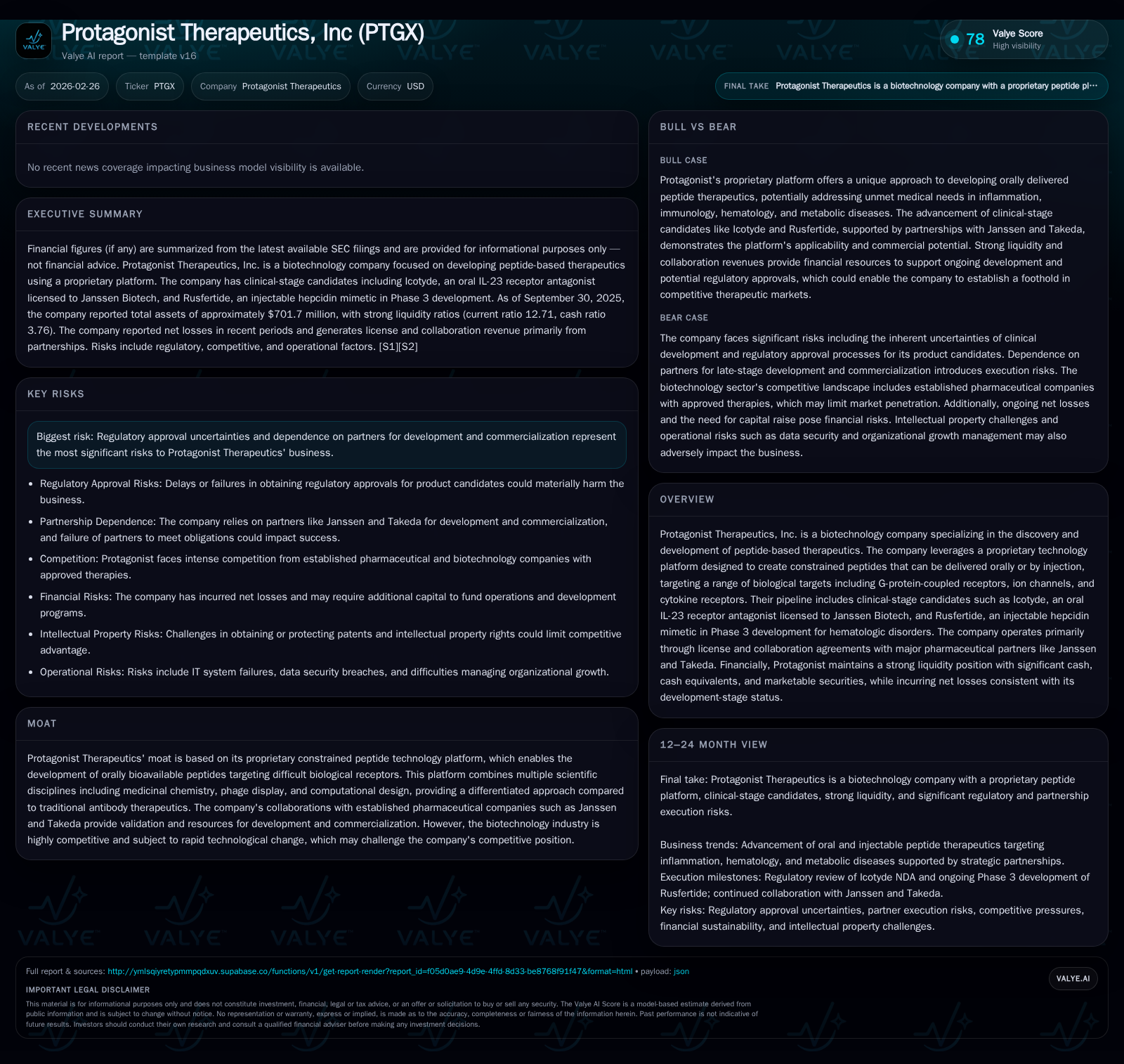
Protagonist Therapeutics, specializing in orally bioavailable constrained peptides, has seen stark swings in financial performance with a significant operating loss in 2025 contrasting prior profitability. Their pipeline, anchored by Phase 3 injectable Rusfertide and licensed oral IL-23 antagonist Icotyde, is supported by collaborations with Janssen Biotech and Takeda. Despite a robust liquidity position reflected in a strong current ratio and positive free cash flow, the company faces risks tied to regulatory approvals and partner reliance. Upcoming clinical milestones could materially impact trajectory but the balance between innovation promises and commercial execution challenges remains delicate.
Innovation in Peptide Therapeutics: Technology and Pipeline Overview
Protagonist Therapeutics anchors its competitive edge on a proprietary constrained peptide platform uniquely engineered to yield peptides capable of binding notoriously hard-to-target receptors such as G-protein-coupled receptors (GPCRs), ion channels, and cytokine receptors. Unlike traditional antibody therapeutics that typically require parenteral administration, Protagonist’s platform emphasizes designs that enable oral bioavailability or injectable delivery of peptides—streamlining patient adherence and expanding therapeutic windows. This reflects integration of medicinal chemistry approaches with phage display and computational modeling that optimize peptide conformation for receptor specificity.
Clinically notable assets include Icotyde, an oral IL-23 receptor antagonist outlicensed to Janssen Biotech targeting inflammatory diseases driven by the IL-23 pathway, and Rusfertide, an injectable hepcidin mimetic advancing through Phase 3 trials aimed at hematologic disorders like polycythemia vera. The dual modality across these lead candidates not only validates the platform’s versatility but also diversifies Protagonist’s clinical risk profile by addressing both autoimmune/inflammatory pathways via oral route and iron metabolism via injection.
This focus situates Protagonist within the convergent biotech trend to move beyond monoclonal antibodies towards peptide-based modalities capable of crossing challenging pharmacokinetic hurdles while maintaining target selectivity—a niche few competitors address effectively.
Financial Transformation: Operating and Net Income Trends Through 2025
The historical financial trajectory of Protagonist reveals pronounced volatility with underlying structural shifts tied closely to R&D intensity associated with moving assets through late-stage development. According to the latest fiscal year-end data (FY2025), Protagonist reported an operating loss of approximately -$158 million, a sharp reversal from an operating income of +$253 million in FY2024 representing a -162.5% year-over-year change [F1][S1].
Net income followed a similar path plunging from +$275 million (FY2024) to -$130 million (FY2025), marking a -147% YoY decline [F1]. This swing predominantly results from heightened expenses linked to Phase 3 trial progression especially for Rusfertide alongside lower milestone recognition or deferred licensing revenues compared to the prior year.
Interestingly, despite these losses at the earnings level, operational cash flow remained robust at +$57.7 million for FY2025—a 68.7% decrease compared to FY2024 but reflecting healthy working capital management amidst scaling costs [F1]. Capital expenditures remain modest (~$1.59 million FY2025), consistent with biotech norms emphasizing lean fixed asset footprints focused on lab infrastructure rather than heavy physical investments.
This dichotomy—large net losses combined with positive cash generation—underscores the company's phase-sensitive burn profile common among biotechs transitioning to pivotal trials while still reliant on partner support for upfront payments.
Historical performance (annual)
| FY | Net ($mm) | CFO ($mm) | OpInc ($mm) | Capex ($) | Net YoY |
|---|---|---|---|---|---|
| 2025 | -130 | 58 | -158 | 1590000 | -147.3% |
| 2024 | 275 | 184 | 253 | 1355000 | +448.5% |
| 2023 | -79 | -70 | -94 | 609000 | +38.0% |
| 2022 | -127 | -108 | -131 | 795000 |
Source: SEC companyfacts cache [F1].
Capital returns and efficiency (annual)
| FY | FCF ($mm) | ROE% |
|---|---|---|
| 2025 | 56 | -21.2 |
| 2024 | 183 | 40.8 |
| 2023 | -71 | -23.5 |
| 2022 | -109 | -59.1 |
Source: SEC companyfacts cache [F1].
Financial figures are sourced from recent annual filings and represent thousands of USD.
Partner Collaborations as Growth Levers and Risk Factors
The strategic collaborations forged between Protagonist and pharmaceutical heavyweights Janssen Biotech (Icotyde) and Takeda Pharmaceuticals (Rusfertide) serve as critical validation nodes for the company’s innovative constrained peptide approach while providing essential capital inflows via license fees and collaborative milestone payments [N1][S21]. These agreements enhance Protagonist’s development capabilities by leveraging partners’ clinical trial infrastructure, regulatory expertise, and commercial reach.
However, such dependence inherently imposes risks—chiefly that shifts in partner priorities or underperformance can delay or derail asset progression. As indicated by recent insider stock sales coinciding with impressive market rallies (+120% stock surge noted) [N1][N2][N3], there is a nuanced investor sentiment oscillating between enthusiasm for clinical progress and caution around exit timing opportunities amid partnership uncertainties.
Industry insiders often view these collaborations as double-edged: while they open low-capital paths to market entry through co-development models, they also expose smaller biotechs like Protagonist to concentration risk if contractual obligations or commercialization commitments falter.
Upcoming Clinical Milestones and Regulatory Expectations
The most imminent clinical focus resides on the late-stage Phase 3 development of Rusfertide for hematologic conditions—an injectable hepcidin mimetic designed to regulate iron homeostasis crucial in diseases like polycythemia vera [N1][S2]. Although explicit regulatory timelines remain undisclosed within available filings, progression through this phase is often the final translational leap preceding NDA filings.
On the other hand, Icotyde exemplifies Protagonist’s capability in developing orally bioavailable peptide antagonists targeting cytokine receptors implicated in inflammatory diseases. The oral IL-23 antagonist distinguishes itself from injectables by potentially offering enhanced patient convenience but faces rigorous FDA scrutiny given oral delivery of biologic-like agents remains relatively nascent.
Analysis: Approval hurdles will likely diverge between these molecules due to different administration routes impacting bioavailability profiles and safety monitoring frameworks required by regulators. Success here depends heavily on establishing convincing pharmacodynamic data paired with manageable safety signals—a known challenge for constrained peptide therapeutics competing against monoclonal antibodies.
Liquidity Position and Capital Structure Insights
At fiscal year-end 2025, Protagonist held approximately $128 million in cash and equivalents supplemented by significant marketable securities positions as detailed across multiple quarterly disclosures ([S4]-[S11]). This abundance underpins an enviable current ratio near 12.7x ([F1]) signaling excellent short-term liquidity well above typical thresholds indicating immediate solvency capacity.
This liquidity cushion affords Protagonist flexibility sustaining costly Phase 3 efforts while preserving runway amidst biotech sector capital raising volatility. The debt load remains minimal without material interest burdens noted—aligning capital structure conservatively ahead of pivotal commercial inflections.
Nonetheless, management must prudently balance leverage optionality against dilution effects given public equity remains primary funding conduit since IPO inception [S15][S26], illustrated by recent gross proceeds of $34 million from warrant exercises adding incremental buffer capital.
Capital Allocation Approach: Cash Flow, ROE, Dividends, and Share Buybacks
Despite consistent net losses reflective of early commercial-stage biotech realities (-21.2% approximate ROE based on net income/equity ratios per [F1]), Protagonist maintains positive operational cash flow generation (+$57.7 million FY2025). After subtracting modest capex outlays ($1.59 million), resultant free cash flow approximates $56 million underscoring effective spending discipline during rapid pipeline expansion phases.
Importantly absent are dividend distributions or share repurchase programs ([S14],[S23]) signaling capital redeployment exclusively aimed at advancing drug candidates internally or via partnerships rather than returning cash directly to shareholders—a common stance among companies emphasizing growth over yield optimization.
From a buy-side perspective this aligns with typical 'cold-start' biotech playbooks where reinvestment into discovery/preclinical assets precedes stable revenue streams enabling future shareholder returns.
Strategic Challenges: Regulatory Approval and Commercialization Dependencies
Protagonist’s risk disclosures underscore acute vulnerabilities inherent in novel drug development including unpredictability around FDA approvals especially given peptide therapeutics’ complex pharmacology ([S21]). The additional dimension arises from reliance on external collaborators whose development/commercial strategies may not always align perfectly leading to potential project delays or resource reallocations.
Recent insider share sell-offs during price surges ([N2],[N3]) hint at nuanced confidence levels internally regarding valuation realizations balancing developmental optimism with prudent liquidity management.
Sector-specific risk modeling suggests that achieving key clinical proofpoints (CPPs) in both oral IL-23 receptor antagonism and injectable hepcidin mimetic domains constitutes critical binary events shaping valuation inflection points going forward.
Overall the strategic path demands agile coordination between scientific innovation execution alongside rigorous milestone achievement management within partnership frameworks bearing shared commercial risks.
Disclaimer: This analysis is prepared solely for informational purposes based on sourced company filings and news data as of February 26, 2026. It does not constitute investment advice nor recommendations regarding any securities mentioned.
Disclaimer: This is research-only, informational analysis and not investment advice. It may include AI-generated interpretation and general industry context. Always verify important details using primary sources.

Comments