
Peloton at a Pivotal Crossroads: Ecosystem Strength Amid Financial and Market Headwinds
Peloton’s tightly integrated fitness ecosystem faces tests from earnings misses, membership challenges, and an evolving competitive landscape.
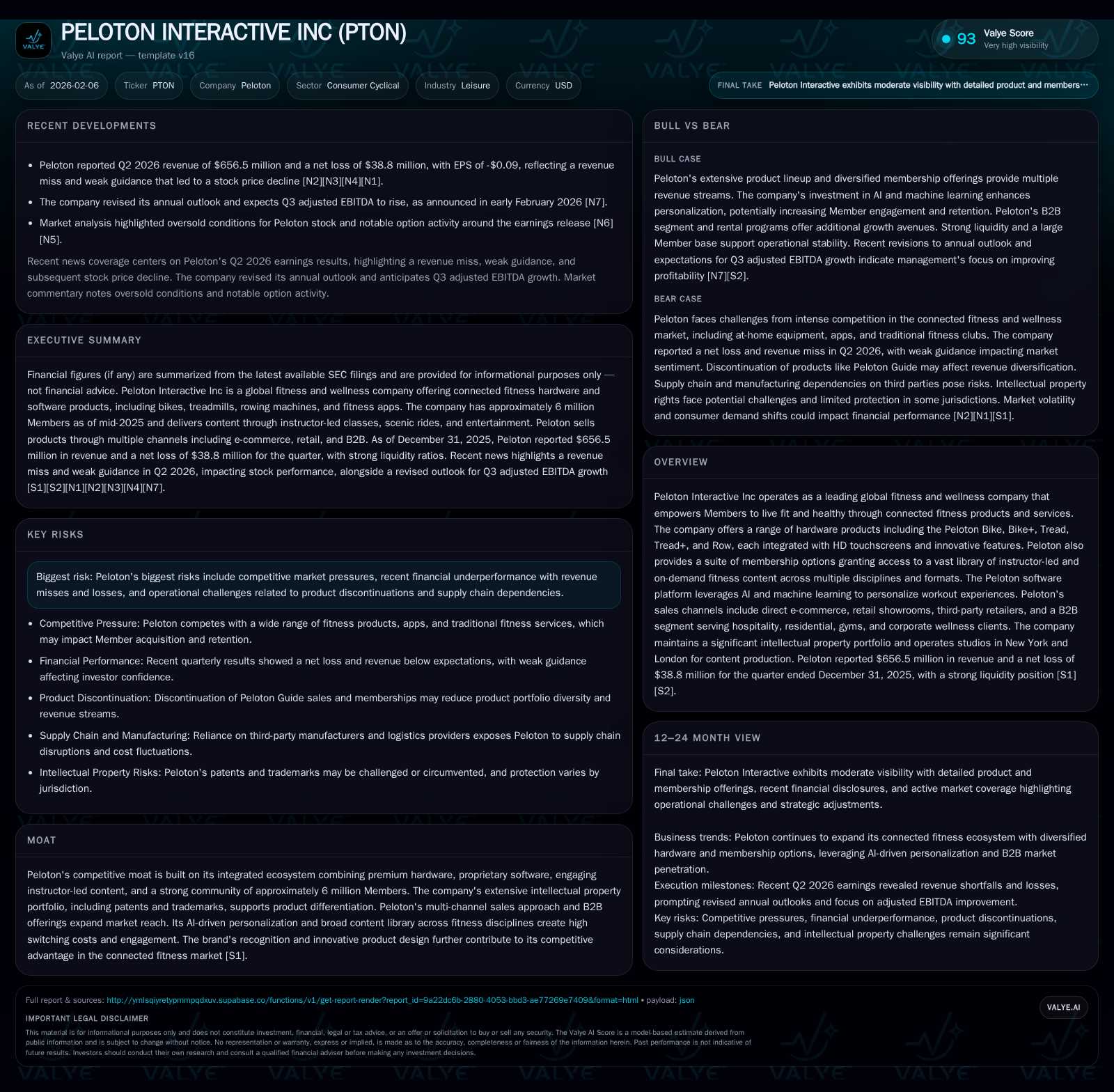
Peloton Interactive Inc remains a standout in connected fitness with a unique fusion of premium hardware, engaging content, and AI-driven personalization, cultivating a community of about 6 million Members. Yet recent financial results revealed notable revenue misses and ongoing losses that spurred sharp stock declines, highlighting operational and market pressure points. The company’s strategy hinges on sustaining member engagement while evolving its product portfolio and expanding B2B channels, amidst intensifying competition and shifting consumer trends. How Peloton navigates these tensions will dictate its path toward durable growth.
Pedaling Through the Integrated Ecosystem That Defines Peloton’s Competitive Edge
Peloton’s ascendancy in the connected fitness arena is no accident. The company has meticulously crafted an interconnected suite of offerings that go beyond mere exercise equipment — weaving together hardware excellence with immersive instructor-driven content and smart software personalization. As of mid-2025, Peloton boasts around 6 million Members spanning key markets including the U.S., U.K., Canada, Germany, Australia, and Austria [S1]. This scale underpins a virtuous circle where premium machines like the Bike+, equipped with HD rotating touchscreens and automatic resistance controls, dovetail seamlessly with bespoke multimedia experiences.
At the core lies the Peloton software platform powered by artificial intelligence (AI) and machine learning algorithms designed to tailor workouts uniquely for each user [S1]. This deep integration yields what management terms “high switching costs”—making it challenging for existing users to migrate elsewhere without sacrificing the curated experience they’ve come to expect. Adding fuel to this moat is a vast intellectual property portfolio encompassing patents not only for hardware design but for interactive media delivery methods as well.
Moreover, Peloton's multifaceted sales approach — spanning direct e-commerce channels, branded retail showrooms, third-party retailers, and an emerging B2B customer base including hospitality and gym operators — broadens access while reinforcing brand visibility. This layered ecosystem simultaneously drives engagement across modalities (cycling, running on Tread+, rowing) and platforms (hardware plus Peloton Apps), ensuring relevance across diverse Member preferences within the wellness spectrum.
The Anatomy of Recent Earnings: Misses Unnerve Markets Despite Strategic Guidance
February 5th delivered sobering news as Peloton reported Q2 FY2026 revenues of $656.5 million -- falling short of analyst estimates [N1][N3]. This topline miss was accompanied by continuing net losses totaling $38.8 million for the period [F1], underscoring ongoing profitability challenges despite narrow improvements in certain cost metrics. Investors responded swiftly; shares tumbled sharply after hours reflecting disappointment over both results and tempered forward guidance [N7].
A breakdown reveals that demand softness manifested across several product categories compounded by shifting consumer patterns. Management commentary acknowledged seasonality effects but also flagged unexpected inventory surpluses tied to optimistic earlier forecasts that failed to materialize fully [S2]. These operational mismatches led to markdowns inflating gross margin pressure—a recurring theme in prior quarters limiting margin expansion potential. Yet there are glimmers of cautious optimism: adjusted EBITDA expectations for Q3 signal a trajectory toward operating leverage gains if execution tightens [N10].
Subscriber Engagement: At Risk in a Saturated Fitness Marketplace
Peloton’s lifeblood is its Subscription base — defined as Members who maintain active paid connections via hardware or apps while engaging regularly [S1]. However, risk factors abound. Beyond macroeconomic uncertainty affecting discretionary spending habits lies internal vulnerability from brand sensitivity surrounding high-profile product safety incidents linked especially with treadmill models [S1]. Such negative publicity can erode trust rapidly in a category where safety assurance is paramount.
Additionally, evolving consumer tastes challenge Peloton’s traditional focus on indoor cycling and running disciplines. Competition from broader fitness ecosystems offering hybrid physical-digital regimes or cheaper alternatives threatens to fragment attention [N6]. While the company strives to counterbalance via fresh content formats (e.g., Strength+ memberships) and gamified engagement features like Lanebreak workouts [S1], sustaining membership growth amid saturation will require relentless innovation coupled with demonstrable value delivery.
Navigating Competitive Waves Amid Connected Fitness Evolution
Post-pandemic connected fitness boomed as home workouts became mainstream; yet emerging dynamics now favor hybrid models blending in-gym access with app-enabled flexibility. Industry stalwarts such as NordicTrack (Icon Health & Fitness), Mirror (acquired by Lululemon), Apple Fitness+, and even traditional gym franchises pivoting digitally intensify competition [N11][N12]. Each brings differentiated pricing models or experiential spins that chip away at Peloton’s market share.
Further complicating matters are macroeconomic pressures leading consumers to limit tech subscription stacking or delay costly hardware upgrades altogether—factors accentuating churn risk. Peloton acknowledges these headwinds openly within risk disclosures as pivotal considerations requiring agile response mechanisms [S1]. This market turbulence demands strategic focus not just on retention mechanics but also on channel expansion to diversify dependency away from purely direct-to-consumer sales.
Strategic Product Mix: Innovation Balanced With Calibration
The breadth of Peloton’s current hardware portfolio — encompassing Bike, Bike+, Tread, Tread+, and Row machines — illustrates intent to surround Members with multiple complementary workout choices while leveraging shared software backends [S1]. The inclusion of entertainment options (such as scenic rides globally filmed) further enhances appeal beyond pure exercise utility.
Crucially, each device integrates tightly with AI-based personalization engines that dynamically adjust workout intensity and recommend new classes based on user progress analytics—a differentiation difficult for competitors lacking proprietary software expertise to match effectively [S1]. Nonetheless, refreshing these offerings entails significant R&D investment, balanced against product discontinuation risks where underperforming SKUs may dilute brand experience if not culled timely.
Inventory Snags Reveal Operational Fragilities Under Demand Flux
Management candidly cited missteps in inventory forecasting contributing materially to suboptimal quarterly results [S2]. Optimal matching of supply versus fluctuating demand remains notoriously challenging given global supply chain volatility amplified by geopolitical tensions beyond company control.
Excess inventory ties up working capital while forcing discounting actions that pressure margins; conversely supply shortages could dampen momentum during demand surges creating frustrated Members. Hence fine-tuned predictive analytics coupled with flexible supplier contracts stand out as critical capabilities for operational resilience moving forward.
Cash Cushion Versus Persistent Losses: Financial Balancing Act
The balance sheet presents mixed signals—solid cash reserves exceeding $1.17 billion build confidence in liquidity management while current ratio near 2 indicates reasonable near-term solvency buffers [F1]. However operating losses remain entrenched near $38.8 million for the latest reported quarter emphasizing ongoing need for cost discipline alongside top-line growth acceleration.
This dynamic underscores investors’ watchfulness around burn rates especially if marketing spend escalates disproportionately amid competitive battles or international expansions necessitate upfront capital deployment without immediate returns [S2]. Navigating this terrain successfully will entail optimized capital allocation ensuring runway longevity without stifling innovation velocity.
B2B Forays: Expansion Opportunities Shadowed by Execution Complexity
Peloton has increasingly looked beyond traditional individual consumers toward business clients—including hotels, residential complexes, gyms, corporate wellness providers—to broaden revenue sources [S1]. Such B2B efforts theoretically offer scale advantages through volume contracts but introduce complexities ranging from customized integration needs to longer sales cycles.
Moreover, geographic expansion amplifies localization challenges involving diverse regulatory regimes or cultural shifts in fitness engagement habits potentially impeding uniform rollout success rates. While filings highlight ambition here as pivotal future growth drivers [S1], risks around overextension or dilution of core customer experience loom large.
Market Sentiment Paints a Picture of Volatility With Flashes of Contrarian Interest
Since earnings release-induced selloffs driving valuations down more than 90% off prior peaks [N11], option market data reflects heightened volatility—a classic hallmark of investor indecision between panic exiting and opportunistic accumulation [N8][N9]. Intriguingly some analysts remain bullish citing robust long-term fundamentals despite near-term adversity predicting rebound upside exceeding twofold gains [N11].
This tug-of-war conveys market skepticism about short-term execution feasibility yet acknowledges Peloton’s latent franchise appeal should strategic imperatives align effectively over coming quarters.
Forward Look: Can Peloton Re-Accelerate Its Growth Trajectory?
Ultimately Peloton stands at a critical inflection point balancing promising innovation-led differentiation against measurable financial headwinds and sector saturation risks. Revised outlook narratives cautiously project adjusted EBITDA improvements hinting at potential profitability pathways if member engagement sustains momentum amidst marketing recalibrations [N10].
Nevertheless unresolved uncertainties persist around subscription renewal durability amid competitive encroachment plus operational agility in inventory management remain decisive factors impacting near-term outcomes [S1][N7]. Success will likely depend on adeptly leveraging technological strengths combined with disciplined cost governance while nurturing the intrinsic community ethos cultivated amongst its Members—the heartbeat behind the brand transcending quarterly earnings fluctuations.
DISCLAIMER: This report provides an analytical overview based solely on publicly available information as of February 2026 including company filings and media coverage; it does not constitute investment advice or recommendations. Readers should perform their own due diligence before making financial decisions related to Peloton Interactive Inc or related securities.
Disclaimer: This is research-only, informational analysis and not investment advice. It may include AI-generated interpretation and general industry context. Always verify important details using primary sources.

Comments