
Powerdyne International Advances Leadership and Operational Focus in Semiconductor Servomotors
Recent leadership changes and operational disclosures underscore Powerdyne’s focused strategy to grow its niche servomotor business amid industry and financial challenges.
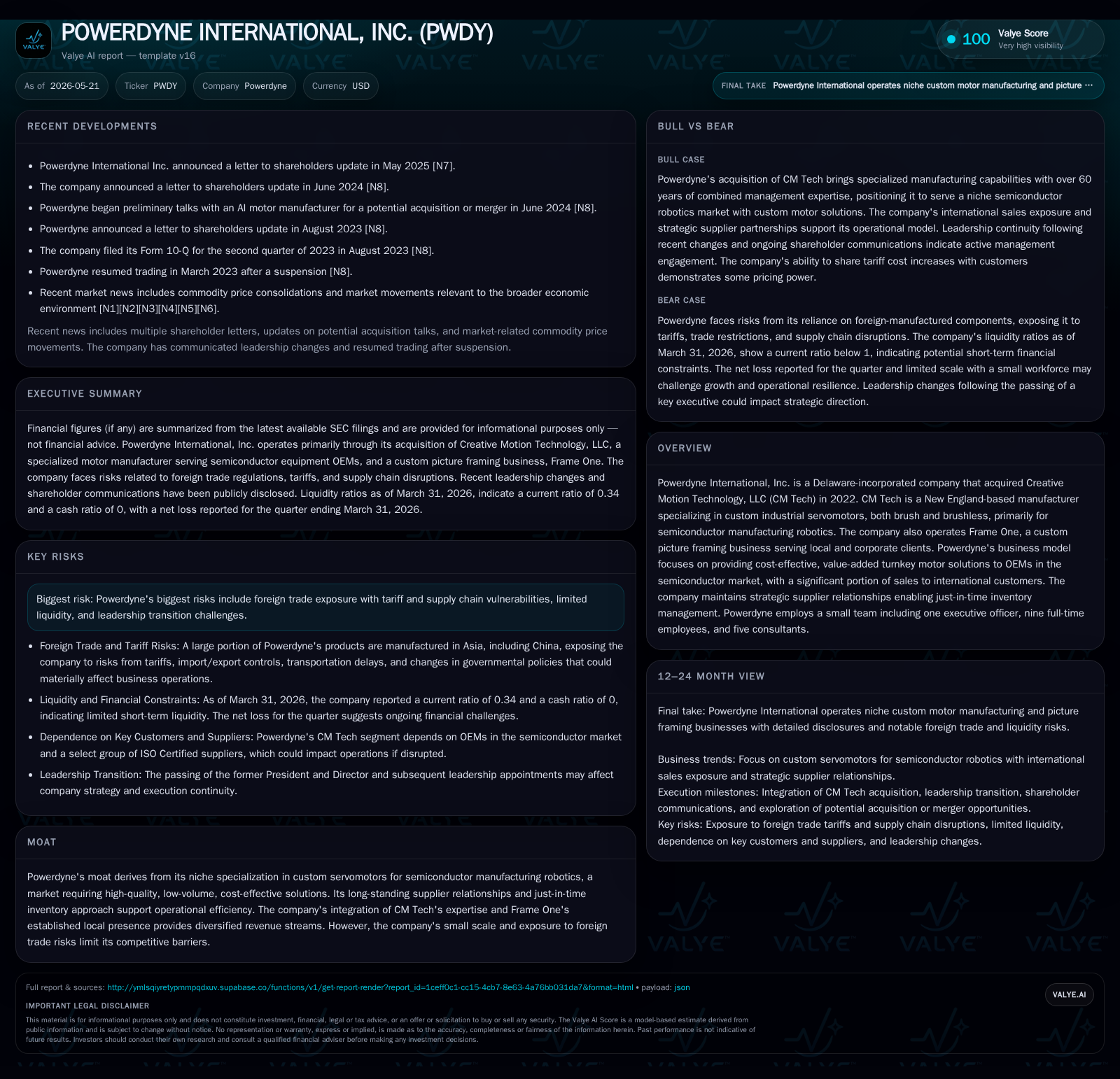
Powerdyne International’s latest 10-Q filing highlights continuity and transition as new leadership takes the helm following the passing of its long-time president. The company’s core business centers on custom servomotors for semiconductor robotics via its Creative Motion Technology subsidiary, supported by a secondary picture framing segment. Strategic supplier relationships enable just-in-time production amid exposure to trade tariffs and supply chain vulnerabilities. Liquidity constraints and leadership succession represent key risks, while growth depends on expanding international OEM penetration and operational efficiencies.
Recent Operational Update and Leadership Transition
Powerdyne International's May 20, 2026, 10-Q filing provides the latest operational disclosure affirming ongoing business continuity through a significant leadership transition [S2]. On May 12, 2026, the board formally appointed Anthony Carchide as President and Chief Financial Officer alongside Maryellen Emerson as Vice-President and Secretary [S3][S8]. This shift follows the passing of founder and previous President James O’Rourke earlier in 2026 who had led Powerdyne and its subsidiaries for over a decade [S8].
Carchide brings over two decades of outside sales experience with a commercial background primarily in telecommunications but has transitioned since March 2025 into the specialized motor manufacturing sector at CM Technology LLC. His tenure has focused on expanding the customer base internationally while modernizing sales and marketing approaches, signaling a strategic push toward professionalizing commercial operations [S3][S8]. Emerson offers institutional continuity, managing operations for more than 20 years at both CM Technology and Frame One framing services, combining deep operational knowledge with local client relationships [S8]. Together, these appointments reflect an effort to stabilize executive leadership while driving growth through enhanced market outreach and efficiency.
Business Model and Product Segment Overview
Powerdyne International derives most of its revenues from its wholly owned subsidiary Creative Motion Technology (CM Tech), a New England-based manufacturer specializing in custom-designed industrial servomotors—including both brush and brushless variants—which are critical components in semiconductor manufacturing robotics [S1]. These motors primarily serve as actuators for X, Y, and Z axis movement in factory automation machinery used by original equipment manufacturers (OEMs). The motors are tailored to be low volume but high quality with a focus on cost-effective turnkey solutions [S1].
CM Tech leverages long-established strategic relationships with ISO-certified component suppliers domiciled both domestically and in Asia to maintain consistent quality while operating under just-in-time inventory principles that minimize overhead costs [S1]. This supply model is essential given the bespoke nature of motor designs demanded by semiconductor clients requiring precision and reliability.
Complementing this industrial focus is Powerdyne's Frame One business segment—a custom picture framing operation servicing local schools, galleries, artists, corporate clients, and interior decorators primarily within Massachusetts. Although materially smaller than CM Tech’s industrial motors operation, Frame One provides diversified cash flow stability rooted in longstanding community presence [S1]
The company’s revenue mechanics involve OEMs paying for specialized motor units based on contracted orders or recurring needs. Volume depends on semiconductor equipment manufacturers' factory automation installation cycles. Pricing benefits somewhat from customized product complexity but is constrained by competitive pressures typical in component manufacturing. Margins can improve via process discipline enabled by supplier relationships and production efficiencies promoted through inventory management.
Industry Context: Market Niches, Competition, and Supply Chain
Powerdyne operates within a highly specialized niche of custom servomotor manufacturing focused on semiconductor robotics—an industry segment characterized by exacting quality standards but relatively low production volumes compared to mass-market motor manufacturers [S1]. This niche demands engineering sophistication to tailor motors for complex motion control in semiconductor equipment.
Competition arises mainly from other boutique manufacturers or divisions within larger industrial automation suppliers capable of engineering similar products. However, Powerdyne’s moat stems from decades-long supplier relationships that ensure component integrity coupled with bespoke manufacturing flexibility—enabling it to maintain effective responsiveness to fluctuating OEM demand despite scale limitations [S1].
Supply chain risks remain prominent given reliance on ISO-certified suppliers located partially abroad (primarily Asia) where geopolitical tensions or trade policy shifts introduce uncertainty. Tariffs imposed on components imported since mid-2018 have continued through recent years impacting cost structures unpredictably [S1]. The company's just-in-time inventory approach offers some mitigation by reducing stockpiles but exposes vulnerability if disruptions occur.
Growth Drivers Amid Specialized Semiconductor Robotics Demand
Growth propositions for Powerdyne align with accelerating demand trends in semiconductor factory automation—a sector seeking increasingly precise robotic motion control driven by complex chip manufacturing processes requiring miniaturization and higher throughput efficiency. This structural demand supports continued need for customized servomotors [S3][S8].
New leadership under Carchide focuses on expanding international OEM penetration through improved sales-and-marketing professionalism introduced since early 2025 [S3][S8]. Execution milestones related to pipeline development or contract wins have not been explicitly disclosed but remain key indicators to observe.
Operational improvements aimed at internal process streamlining offer margin expansion potential essential to offsetting tariff-related cost pressures. Additionally, Frame One’s established corporate client relationships potentially allow cross-segment marketing synergies enhancing overall revenue diversification.
Risks and Constraints: Trade Exposure and Liquidity Challenges
Notable risks detailed in filings include foreign trade exposure manifesting as increased input costs due to tariffs applied to Chinese-sourced components since July 2018—a dynamic still impacting Powerdyne's cost basis [S1]. Further regulatory uncertainty around future customs restrictions could exacerbate these pressures.
Liquidity constraints present a pressing challenge; the March 31 balance sheet reveals current assets of approximately $264K against current liabilities exceeding $771K resulting in a current ratio near 0.34—signaling potential short-term solvency tension without corrective capital measures or improved working capital management [F1][S2]. Total debt stands near $87K net of minimal cash reserves underscoring leverage concerns relative to asset base size [F1].
The small operational scale compounds these vulnerabilities—limited financial reserves restrict flexibility while concentrated customer dependencies heighten sensitivity to cyclical downturns particularly within semiconductors whose capital intensity varies with broader economic cycles [S1]. Lastly, the recent leadership succession following founder O’Rourke’s death introduces execution risk as new management assumes control amid these structural challenges [S3][S8].
Key Watchpoints: Execution of New Leadership Strategy and Sales Expansion
Stakeholders should closely monitor forthcoming quarterly reports for revenue trajectory shifts reflecting new commercial efforts instigated by Carchide since early 2025 targeting international OEM growth via refined outreach and marketing modernization [S2][S3]. Tracking pipeline developments or contract announcements will provide tangible evidence of effectiveness.
Supply chain dynamics warrant continuous surveillance given tariff environments influence raw material costs directly affecting margin profiles. Any reported progress towards mitigating these via alternative sourcing or renegotiated supplier terms would be materially positive.
Operational integration between CM Tech’s motor manufacturing unit and Frame One’s corporate clientele may yield incremental opportunities; updates here could signal incremental diversification or resilience improvements.
Capital access communications including debt refinancing or equity fundraises would substantially impact liquidity outlooks given prevailing current ratio stress points [F1].[S2]
Financial Health Summary and Implications
As reported at March 31, 2026, Powerdyne maintains current assets totaling roughly $264K against current liabilities towering around $771K yielding a markedly depressed current ratio of approximately 0.34—indicative of significant liquidity strain absent immediate capital injections or improved receivables conversion cycles [F1][S2]
Total recorded debt aggregates around $87K netting close to $0 given negligible cash levels last reported at $344 (as of mid-2017 but presumably unchanged materially) underscoring reliance on external liquidity sources for operations beyond working capital optimizations [F1]
No material legal proceedings were noted as ongoing per the latest filings providing some operational stability contextually [S1]. The financial posture implies that near-term execution success in revenue growth combined with stronger working capital controls will be crucial to sustaining operational viability without resorting to dilutive financing or asset sales.
This analysis is strictly informational based upon publicly filed regulatory documents as stated; it does not constitute investment advice nor an endorsement of any securities. Users should conduct further due diligence before making economic decisions related to Powerdyne International Inc. or its industry sector.
Disclaimer: This is research-only, informational analysis and not investment advice. It may include AI-generated interpretation and general industry context. Always verify important details using primary sources.

Comments