
Q/C Technologies: Early-Stage Silicon Photonics, Strategic Reset, and the Stakes of Surviving to Demonstration
Q/C Technologies, Inc. has pivoted sharply from pharmaceutical ambitions to a high-risk, high-reward bet on proprietary silicon photonic computing for AI inference.
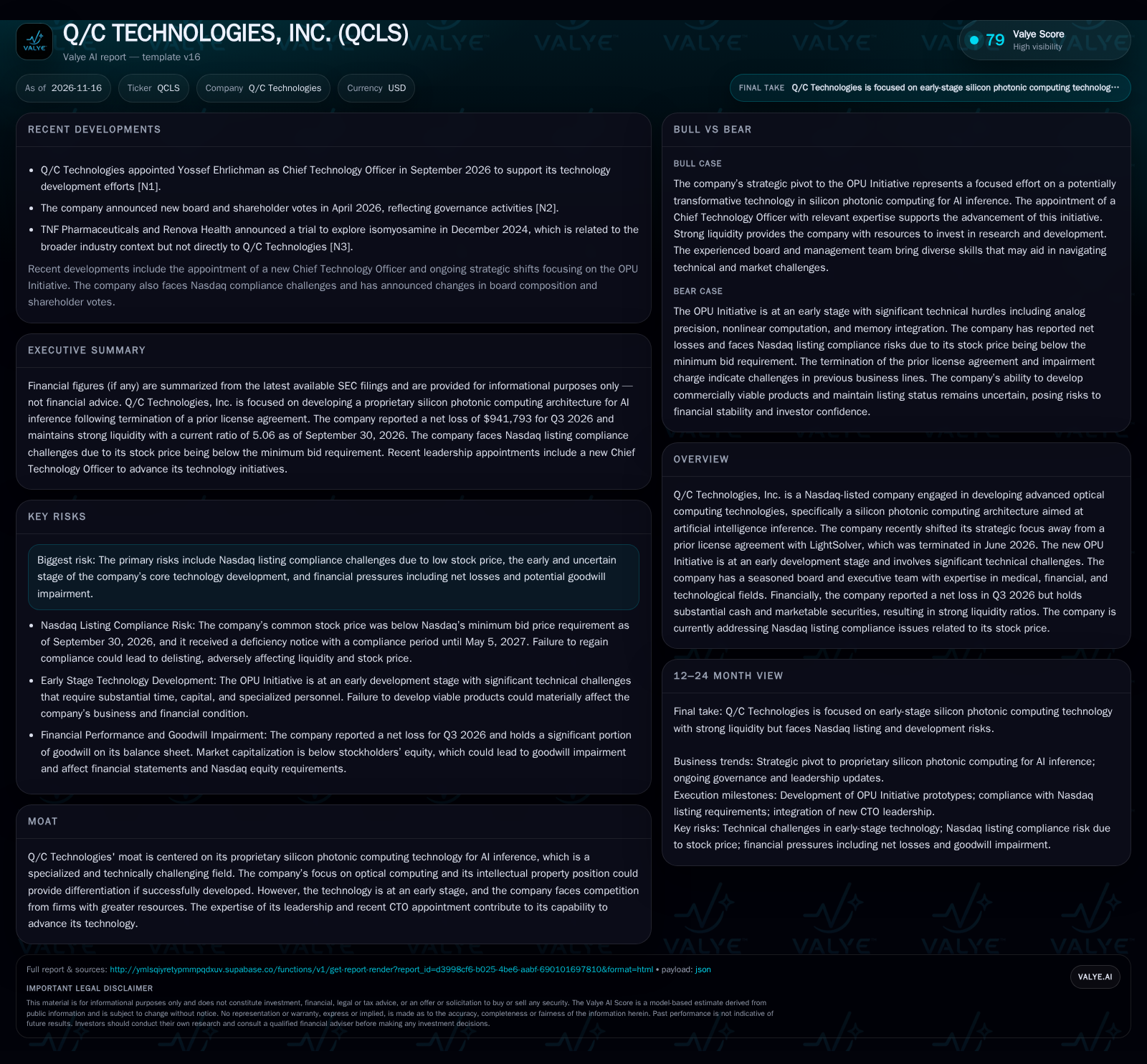
Q/C Technologies is now focused on developing its own silicon photonic computing architecture for AI, following the termination of a major license and a costly impairment. Despite strong current liquidity, the company faces persistent net losses, a Nasdaq compliance deadline, and must prove its OPU Initiative’s technical and commercial feasibility. Success depends on near-term R&D execution and navigating capital market constraints.
Q/C Technologies, Inc. has undergone a radical transformation, abandoning its prior pharmaceutical platforms to pursue a proprietary silicon photonic computing architecture—an area with immense technical promise but equally daunting execution risk. With its OPU Initiative barely out of the gate and a new CTO just installed, Q/C Technologies’ next chapters will be defined by its ability to demonstrate technical progress, attract capital, and carve a place in the fiercely competitive AI hardware landscape.
Strategic Reset: From Licensing Setbacks to Proprietary Optical Computing
Q/C Technologies entered Q4 2026 with $10.2 million in current assets and a current ratio of 5.06, reflecting a reported liquidity position snapshot for an early-stage technology company [S2]. However, the company posted a net loss of $941,793 for the third quarter, continuing a trend of negative earnings [S2]. The most consequential recent development is the June 2026 termination of the LightSolver license, which led to a $3.18 million impairment charge and signaled a decisive pivot towards developing the proprietary OPU Initiative—a silicon photonic architecture aimed at AI inference workloads [S2]. This shift is not merely strategic rhetoric: Q/C’s entire near-term value proposition now rests on the OPU’s technical and commercial viability. The appointment of Yossef Ehrlichman as CTO in September 2026 underscores the urgency to build in-house engineering depth for this effort [N1]. Meanwhile, the company’s stock price remains below the Nasdaq’s $1 minimum bid, triggering a compliance deadline of May 2027 [S2]. Nearly half of Q/C’s assets are classified as goodwill, magnifying the risk of further impairments if the new initiative fails to deliver tangible progress [S2].
How Optical AI Hardware Could (Eventually) Make Money
The OPU Initiative’s proposed business model is likely to depend on the commercialization of proprietary silicon photonic chips or modules designed for AI inference acceleration. In the optical computing value chain, revenue could potentially flow from the sale or licensing of hardware, bundled software, or intellectual property, as well as from integration services for hyperscalers or OEM partners. Margins in photonic hardware are typically pressured by high upfront R&D and fabrication costs, but could expand if the technology achieves performance or energy-efficiency advantages over incumbent electronic solutions.
At this early stage, Q/C Technologies’ economics are dominated by fixed R&D and personnel costs, with no evidence yet of commercial revenue or recurring customer contracts [S2]. The company’s 2026 net loss and negative operating cash flow are consistent with this profile. Capital needs are likely to remain high as the OPU Initiative progresses toward prototype development, tape-out, and initial demonstrations. If Q/C can demonstrate a working prototype with clear benchmarks that outperform traditional silicon, it might attract non-dilutive funding, partnerships, or early customer commitments. However, the economic model remains entirely theoretical until technical feasibility and market demand are validated.
The company’s high goodwill percentage reflects acquisitions and strategic pivots rather than organic asset growth, which could result in further write-downs if future cash flows do not materialize. Access to capital markets is uncertain, especially if the company loses its Nasdaq listing or fails to generate meaningful technical milestones.
Can Q/C Carve a Niche in a Crowded AI Hardware Race?
Q/C Technologies is entering a brutally competitive landscape. The AI acceleration market is dominated by established players in both traditional electronics (such as GPU and ASIC vendors) and emerging photonics startups. Major technology companies and well-funded startups are investing heavily in photonic and hybrid architectures, and incumbents benefit from scale, channel access, and deep R&D benches.
Q/C’s potential advantage lies in its proprietary architecture and the promise of silicon photonics to deliver higher speed and lower power consumption for AI inference. If the company can solve key technical challenges—such as reliable analog precision, nonlinearity, and integration of photonic memory—it could deliver differentiated performance. However, these are precisely the hurdles that have stymied many optical computing efforts to date.
Switching frictions for potential customers are high: hyperscalers and enterprise buyers require robust, validated, and easily integrated solutions. Without a track record or reference customers, Q/C will face skepticism. Barriers to entry are significant, but so is the risk of being leapfrogged by better-resourced competitors or alternative AI acceleration paradigms (e.g., neuromorphic chips, quantum accelerators).
Early Technical Breakthroughs Could Attract Partners and Capital
The bull case for Q/C Technologies rests on the company’s ability to rapidly demonstrate a prototype OPU device that delivers verifiable performance or efficiency gains for AI inference versus incumbent hardware. If the new CTO and engineering team can overcome key optical computing hurdles and publicize credible benchmarks, Q/C could attract the attention of strategic partners, early-adopter customers, or even acquirers seeking novel AI acceleration technologies.
Confirmation of this scenario would come in the form of published technical milestones, joint development agreements, or non-dilutive funding from government or industry sources. Early-stage memoranda of understanding or pilot deployments with hyperscalers or cloud providers would also validate technical and commercial traction. In this scenario, Q/C could access additional capital on more favorable terms and move toward revenue-generating relationships, shifting the narrative from survival to growth.
A Race Against Time: Surviving to Prototype and Maintaining Listing
The most plausible near-term path is that Q/C Technologies continues to burn cash as it develops its OPU Initiative, with the pace of technical progress and the Nasdaq compliance clock running in parallel. The company may succeed in producing early lab results or proof-of-concept demonstrations, but not yet at the scale or maturity to secure major commercial partnerships or revenue.
The company’s stock price may continue to fluctuate below $1, requiring a reverse split or other measures to regain compliance. The risk of goodwill impairment remains elevated if no tangible progress is made. Evidence supporting this scenario would include regular but incremental technical updates, modest hiring in R&D, and the absence of material revenue or major partnerships. Falsification would come from either a technical breakthrough (moving toward the upside case) or clear evidence of funding shortfalls, delisting, or abandonment of the OPU project (moving toward the downside).
Capital Runs Out Before Technical Validation
The bear case materializes if Q/C Technologies fails to demonstrate meaningful technical progress on its OPU Initiative before its liquidity buffer is exhausted or before delisting from Nasdaq impairs its capital access. Without demonstrable prototypes, the company may struggle to attract further investment or partnerships, forcing it to drastically scale back operations, pursue a distressed sale, or wind down the business.
Evidence for this scenario would include continued net losses without offsetting technical achievements, inability to raise new capital, further impairment charges (particularly of goodwill), and failure to meet Nasdaq listing requirements. A lack of hiring or attrition in the engineering team, as well as silence on technical milestones, would also signal increased risk. This scenario could also be triggered by a broader tightening of capital markets or negative shifts in investor sentiment toward deep-tech hardware startups.
Milestones That Will Define Q/C Technologies’ Trajectory
Progress reports on the OPU Initiative, including technical white papers, prototype demonstrations, or benchmark results—these will clarify if the company is overcoming core photonic computing hurdles.
Announcements of partnerships, joint development agreements, or memoranda of understanding with strategic customers or technology integrators would indicate early market validation.
Updates on Nasdaq compliance, including stock price recovery, planned reverse splits, or waiver requests, will determine continued access to capital markets.
Any changes to the size or composition of the engineering team, including key hires or departures, would signal internal momentum or setbacks.
Goodwill impairment charges or significant balance sheet write-downs would increase pressure on the company’s equity and future capital-raising ability.
If disclosed, early customer feedback or pilot deployment results would help test the commercial viability of the OPU architecture.
Capital markets activity, such as new equity or debt raises, and the terms on which capital is raised, will indicate investor confidence and the company’s ability to sustain operations.
Disclaimer: This is research-only, informational analysis and not investment advice. It may include AI-generated interpretation and general industry context. Always verify important details using primary sources.

Comments