
Quetta Acquisition's Strategic Reset Following Nasdaq Delisting Notice
Nasdaq’s delisting warning intensifies pressure on Quetta Acquisition Corp to finalize its Asian-focused business combination amid liquidity and compliance challenges.
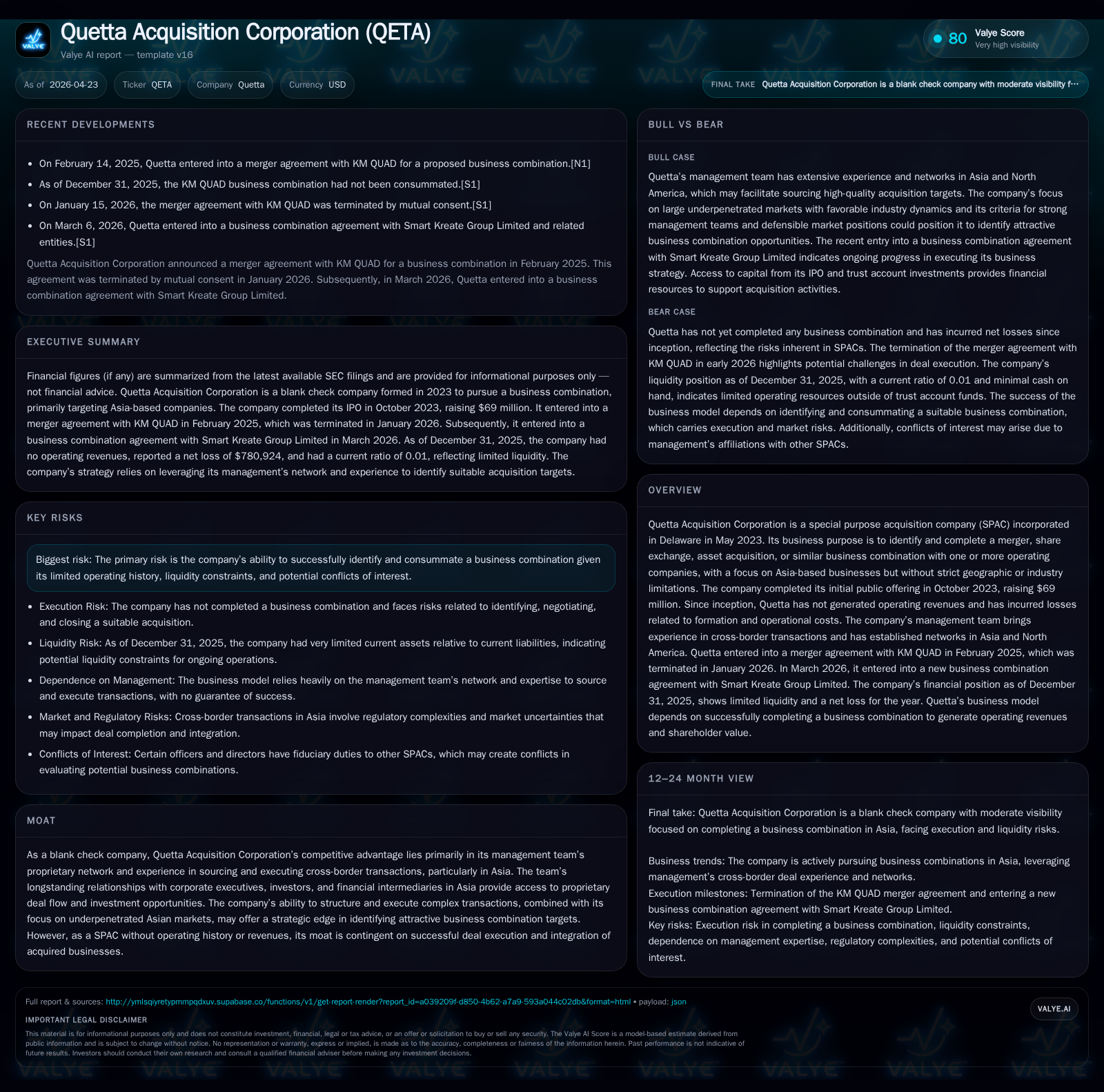
Quetta Acquisition Corporation, a SPAC targeting Asia-based companies, faces a critical inflection after receiving a Nasdaq delisting notice in April 2026 due to non-compliance with minimum market value requirements. The termination of its previous KM QUAD merger and the recent agreement with Smart Kreate Group Limited underscore both the challenges and renewed opportunity to consummate a business combination. However, severe liquidity constraints, ongoing losses, and shareholder approval risks complicate its path forward. The upcoming Nasdaq hearing and anticipated transaction milestones will be pivotal for Quetta’s survival and execution of its strategic reset.
Nasdaq Delisting Threat and Regulatory Urgency
On April 21, 2026, Quetta Acquisition Corporation received a formal delisting notice from The Nasdaq Stock Market LLC for failing to meet the Minimum Market Value of Listed Securities (MVLS) requirement [S3]. This development exposes Quetta to an imminent suspension of trading unless it convinces the Nasdaq Hearings Panel by April 27, 2026 that it intends to sufficiently remedy compliance by the scheduled hearing on May 14, 2026. The timing creates acute regulatory pressure on Quetta to accelerate its business combination efforts or face forced liquidation.
This notice highlights how SPACs like Quetta operate under tight capital market constraints where inability to deliver transactions or maintain market capitalization can severely limit access to public equity markets and investor confidence. The risk of trading suspension raises the stakes for shareholders who must judge whether the company can fulfill its stated purpose or find alternative liquidity events.
Quetta's SPAC Model and Business Combination Framework
Founded in May 2023 and completing its IPO in October 2023 which raised approximately $69 million [S1], Quetta operates as a blank check company with no operating revenues or commercial activity prior to an initial business combination. Its strategy centers on acquiring or merging with one or more Asian-based operating companies but maintains flexibility on geography and industry [S1].
The company’s formation costs, operational expenses, and eventual losses are typical of the SPAC model prior to closing transactions. From inception through December 31, 2025, activities were limited to target identification, due diligence preparations, legal compliance, and maintaining public listing status [S1]. A failed merger arrangement with KM QUAD (valued at $300 million) was terminated by mutual consent in January 2026 after protracted delays [S1]. In March 2026, Quetta pivoted toward a new business combination agreement valuing Smart Kreate Group Limited at an enterprise value of $200 million [S1], signaling an important strategic reset.
Management Team’s Network and Deal-Sourcing Edge
Quetta relies heavily on its management team’s extensive experience in cross-border transactions between Asia and North America along with proprietary networks among corporate executives, private equity funds, family offices, investment banks, and industry consultants within Asia [S1].
This relational capital forms the core competitive advantage enabling access to proprietary deal flow that other SPACs may lack. Such networks are crucial given regulatory complexities in Asian jurisdictions and heightened competition among SPACs for promising middle-market targets. While not an operating moat per se—given Quetta’s pre-revenue status—this expertise underpins its differentiated sourcing capability and transaction structuring skillset.
Industry Context: SPAC Competition and Asian Market Focus
The SPAC market targeting emerging Asian companies has become increasingly competitive yet remains challenged by regulatory headwinds in regions such as China where oversight complicates cross-border listings . Quetta’s focus addresses underpenetrated sectors but also exposes it to geopolitical risks distinct from domestic U.S.-centric SPACs.
Further pressures arise from market appetite shifts post-deal regarding valuation sustainability of Asian growth companies listed via SPAC vehicles. These forces compound risks related to transaction timing—evidenced by KM QUAD's termination—and necessitate agile deal structuring plus sponsor commitment to navigate delays without exhausting liquidity [S9].
Growth Drivers: Smart Kreate Business Combination Prospects
The March 2026 Business Combination Agreement with Smart Kreate Group Limited represents Quetta’s principal growth lever going forward. Structured as a two-step merger involving subsidiaries incorporated in the Cayman Islands and British Virgin Islands respectively [S1], this arrangement effectively integrates SKG into the post-transaction public entity with an enterprise value pegged at $200 million.
This deal departs from KM QUAD’s larger valuation yet could reflect more prudent structuring amid market conditions. If completed successfully, Smart Kreate would provide Quetta with operating revenues post-closing transforming it from a pure acquisition vehicle into an operating company [S1]. The transaction thus refocuses investor expectations from speculative search mode toward tangible asset-backed growth.
Constraints: Liquidity, Market Compliance, and Execution Risks
Despite strategic optimism around Smart Kreate, Quetta faces substantial financial fragility prior to consummation. As of December 31, 2025, cash on hand was nominal ($1,195), accompanied by a significant working capital deficit exceeding $2.6 million reflected in current liabilities of over $2.65 million versus current assets near $22 thousand [F1]. Operating income was negative $1.47 million in FY2025 as losses deepened compared to prior years [F1]. Operating cash flow deteriorated further to negative $1.83 million representing accelerating cash burn tied mainly to general & administrative expenses and transactional outlays [F1].
Temporary equity classification of common stock subject to redemption rights adds complexity; approximately 1.7 million shares were classified outside stockholders’ equity at redemption value as of FY2025 end given uncertainties around shareholder redemption actions [S4][S5]. This introduces dilution risk if additional financing is required or shareholders elect redemption upon deal closure.
Potential conflicts of interest embedded in sponsor agreements warrant close scrutiny since they may bias transaction terms favoring sponsor economics over minority shareholders [S9]. Sponsor Support Agreement commitments restrict sponsor share transfers pending closing but also commit sponsor votes unequivocally toward approving the business combination [S7], indicating alignment but also limiting dissent channels.
Upcoming Milestones and Key Event Timeline
Critical near-term dates shape the company’s trajectory: By April 27, Quetta must inform Nasdaq’s Hearing Panel of its intent to contest suspension due at the hearing set for May 14 [S3]. Failure likely triggers delisting culminating in liquidation per predecessor rules supporting redeeming stockholders.
Monthly extension fees ($60k each) have been paid through April 2026 extending completion deadline initially from January 10 up to May 10, allowing limited runway for final approvals [S25][S26]. Additionally, shareholder vote schedules pertaining to Smart Kreate combined proxy solicitations will determine closing viability.
Watching these milestones closely will reveal whether Quetta completes its business transformation or faces enforced wind-down due to regulatory non-compliance.
Financial Health: Losses, Capital Structure, and Outlook
Historical performance (annual)
| FY | Net ($mm) | CFO ($) | OpInc ($) | Net YoY |
|---|---|---|---|---|
| 2025 | -1 | -1828787 | -1467731 | -137.3% |
| 2024 | 2 | -584488 | -810534 | +291.3% |
| 2023 | 1 | -157536 | -121133 |
Source: SEC companyfacts cache [F1].
Capital returns and efficiency (annual)
| FY | ROE% |
|---|---|
| 2025 | 15.3 |
| 2024 | -84.9 |
| 2023 | -30.7 |
Source: SEC companyfacts cache [F1].
(Figures sourced from company financial statements ending FY December annually unless specified) [F1]
Quetta’s deteriorating loss profile alongside severely negative equity underscores profound financial stress typical of pre-combination SPACs but aggravated here by delayed deals and rising operational costs including administrative service fees owed though deferred by sponsors [S5][S16]. Zero cash reported as recent as Q3 2024 further emphasizes critical liquidity dependence on trust account funds released only after successful combination closure [F1].
The full valuation allowance against deferred tax assets signals management’s assessment of uncertain profitability prospects absent transformative deal success [S18]. The presence of unsecured interest-free promissory notes from related parties including sponsors totaling over $486k provides needed bridge funding but elevates contingent liabilities prior to closing [S8][S17].
Ultimately fiscal viability hinges on closing Smart Kreate deal timely while navigating Nasdaq compliance hurdles—failure would prompt liquidation proceedings adversely impacting existing shareholders.
This analysis is intended solely for informational purposes reflecting data reported through April 23rd filings identified above. It does not constitute investment advice.
Disclaimer: This is research-only, informational analysis and not investment advice. It may include AI-generated interpretation and general industry context. Always verify important details using primary sources.

Comments