
Tancheng Group's Cultural Tourism Ambitions Collide with Revenue Gaps and Supply Chain Concentration
Tancheng Group's zero revenue in Q3 2026, heavy reliance on a single supplier and customer, and reported liquidity position highlight significant operational and financial vulnerabilities.
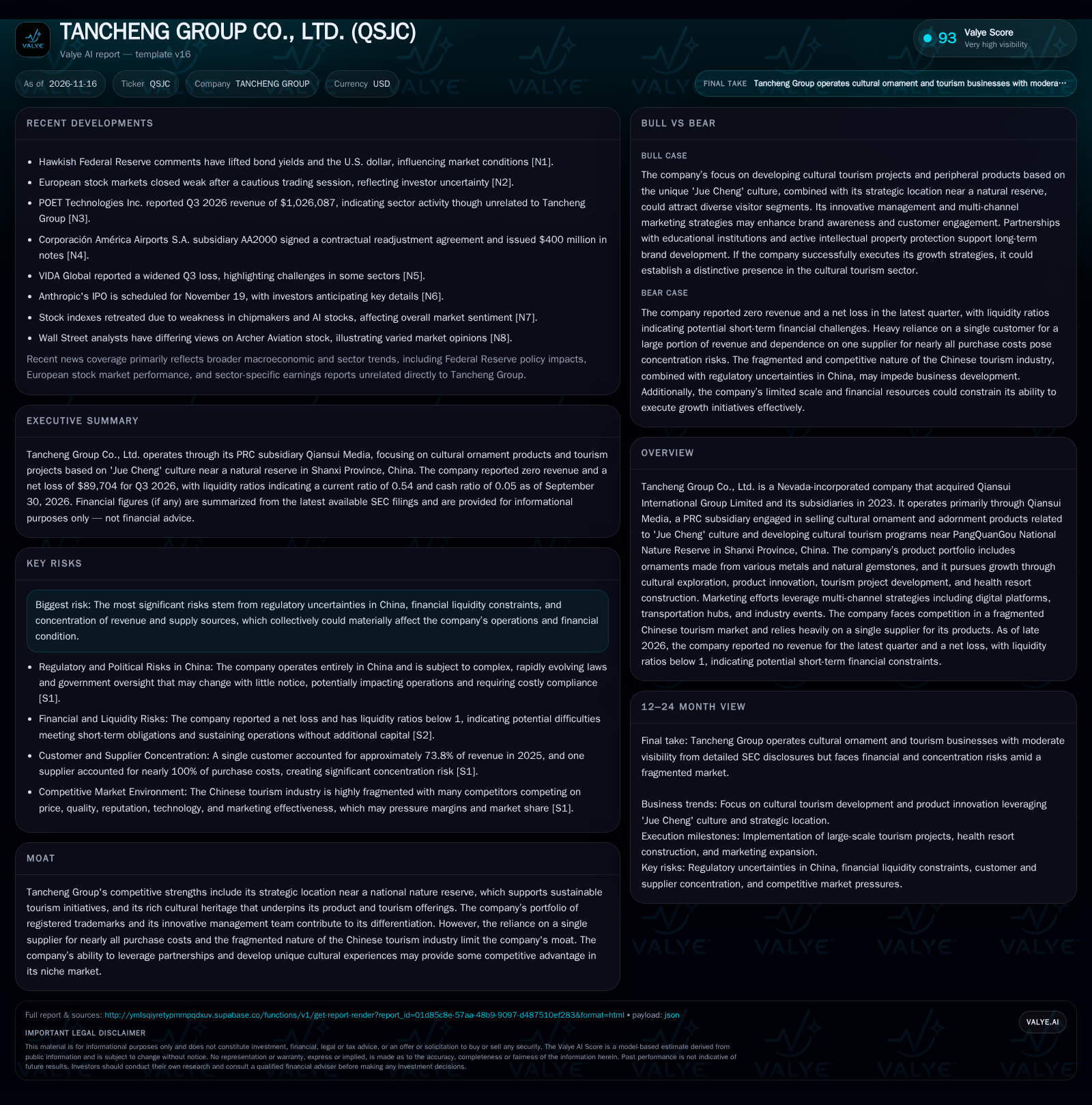
Tancheng Group's zero revenue in Q3 2026, heavy reliance on a single supplier and customer, and reported liquidity position highlight significant operational and financial vulnerabilities. While its strategy to build a cultural tourism ecosystem near a national reserve could create a differentiated niche, execution risks are amplified by its current lack of commercial traction and dependence on concentrated counterparties. The path to sustainable growth requires evidence of diversified revenue streams, reduced concentration risks, and tangible progress on tourism project development. [S1] [S2]
Tancheng Group Co., Ltd. aims to carve out a niche in China's competitive cultural tourism and ornament market by leveraging the unique heritage of 'Jue Cheng' culture and proximity to the PangQuanGou National Nature Reserve. However, the company is currently in a precarious position: it reported zero revenue in its most recent quarter, remains highly dependent on a single supplier and customer, and faces liquidity ratios far below typical operating thresholds. While its strategic vision aligns with rising domestic interest in experiential and cultural travel, Tancheng must overcome acute concentration and execution risks before its ambitions can translate into sustainable business results.
Revenue Absence, Concentration Risks, and Liquidity Shortfalls Define Tancheng’s Present
As of the quarter ended September 30, 2026, Tancheng Group reported zero revenue and a net loss of $89,704, with basic and diluted EPS of -$0.02. The company’s balance sheet shows cash and equivalents of just $274,387 against current liabilities of $5,040,065, yielding a current ratio of 0.54 and cash ratio of 0.05—well below levels typically considered comfortable for ongoing operations. In 2025, a single customer controlled by the CEO accounted for 73.8% of revenue, while a single supplier provided nearly all of the company’s purchase requirements for jewelry design and manufacturing. These facts underscore a business facing both acute liquidity pressure and extreme revenue and supply chain concentration. [S1] [S2]
How Tancheng’s Economics Could Evolve: Margins, Scale, and Capital Needs
Tancheng’s intended business model blends product sales (ornaments and cultural goods) with tourism development (recreational projects and a health resort town), both tied to the 'Jue Cheng' cultural brand. In theory, this hybrid approach could offer multiple revenue streams—high-margin, branded merchandise and recurring tourism income—if executed at scale. However, the absence of revenue in the latest quarter suggests that neither product nor tourism operations have yet gained commercial traction.
Variable costs are likely dominated by the supplier relationship, given that nearly all purchase costs are attributed to a single vendor. This creates minimal bargaining power and exposes Tancheng to margin compression if supplier terms worsen. Fixed costs are modest (16 full-time employees), but capital requirements could escalate rapidly if the company moves forward with large-scale tourism infrastructure or health resort construction.
Operating leverage could become significant if tourism projects succeed, but the current lack of revenue means high fixed costs would amplify losses in the near term.
The capital intensity of tourism development projects inherently demands phased investment and careful cash flow management. Should Tancheng pursue large-scale infrastructure or resort construction, the timing and scale of capital expenditures will critically influence financial sustainability. Delays or cost overruns could exacerbate liquidity pressures, especially given the current reported cash balance. Conversely, staged project rollouts aligned with measurable demand indicators could mitigate risk and allow for incremental revenue recognition. Additionally, the interplay between product sales and tourism offerings suggests potential cross-selling synergies; however, these require effective coordination and marketing to convert cultural interest into monetizable transactions.
Differentiation vs. Industry Fragmentation: Tancheng’s Competitive Chessboard
Tancheng’s differentiation rests on its unique 'Jue Cheng' cultural theme, proprietary product designs (supported by 33 registered trademarks), and a strategic location adjacent to the PangQuanGou National Nature Reserve. In principle, these assets could create a defensible niche attractive to cultural tourists and collectors seeking authentic experiences or products.
However, China’s tourism and ornament markets are highly fragmented, with intense competition based on price, quality, brand reputation, and sales channel effectiveness. Larger incumbents and regional players may have established distribution, deeper resources, and broader customer bases. Tancheng’s heavy reliance on a single supplier and concentration of sales in one CEO-controlled customer further weakens its competitive position, as it has yet to demonstrate the ability to attract a diverse customer base or negotiate favorable supply terms.
Technology substitution (e.g., digital tourism, e-commerce platforms) could both enable broader reach and introduce new competitors. The company’s multi-channel marketing—leveraging digital, transportation hubs, and expositions—offers optionality, but commercial effectiveness remains unproven.
In addition to traditional competitive factors, Tancheng’s reliance on a single supplier and customer introduces strategic vulnerabilities that competitors with diversified supply chains and broader customer portfolios are less exposed to. This concentration limits negotiating leverage and increases exposure to operational disruptions or shifts in partner priorities. Moreover, the company’s niche cultural branding must balance authenticity with scalability; overly localized appeal may restrict market size, while broadening the brand risks diluting its unique value proposition. The evolving digital landscape also presents both opportunities and threats, as competitors may leverage advanced e-commerce platforms or virtual tourism experiences to capture market share, challenging Tancheng to innovate continuously.
Unlocking Growth Through Diversification and Execution: What Success Would Require
A favorable outcome for Tancheng would involve successfully launching and monetizing its cultural tourism projects—attracting visitors to its health resort and recreational offerings while simultaneously growing direct-to-consumer sales of branded ornaments and cultural products. This scenario would likely require a diversified customer base, reduced reliance on the CEO-linked buyer, and establishment of additional supplier relationships to mitigate concentration risk.
Execution milestones would include securing permits and funding for tourism projects, demonstrating rising visitor numbers, and achieving positive unit economics on both product and tourism lines. Confirmation would come from sequential revenue growth, improved gross margins (if disclosed), and a rising proportion of sales from non-insider customers. Evidence of diversified, recurring revenue streams and product launches resonating with target segments would further validate the upside thesis.
Plausible Near-Term Trajectory: Tancheng Stays Subscale Amid Execution Gaps
The most likely near-term outcome is that Tancheng continues to operate at subscale, with limited revenue generation and ongoing reliance on a narrow customer and supplier base. The company may make incremental progress in product development or local marketing but struggle to gain meaningful market share in a crowded, price-competitive landscape.
Execution risks—such as delays in tourism project approvals, inability to secure funding, or failure to attract a broader customer base—could keep the business in a loss-making position. Confirmation would come from continued zero or low revenues, persistent customer/supplier concentration, and ongoing net losses. Partial falsification would require meaningful diversification of both revenue sources and suppliers, alongside evidence of actual tourism activity or product uptake.
If Tancheng remains subscale, the company may face a strategic inflection point where incremental investments yield diminishing returns. Without critical mass in either product sales or tourism visitation, fixed costs and capital commitments could outweigh incremental revenue gains, pressuring profitability further. The company’s ability to build operational capabilities—such as supply chain management, marketing effectiveness, and customer relationship development—will be pivotal in breaking this cycle. In this scenario, external factors like shifts in consumer preferences toward experiential travel or government support for cultural tourism could provide tailwinds, but absent internal execution improvements, these may prove insufficient to alter the trajectory.
Liquidity Strain and Concentration Risks Escalate: Adverse Outcomes if Gaps Persist
If Tancheng fails to secure new customers or suppliers and cannot generate revenue from its tourism or product initiatives, ongoing operating losses and subpar liquidity ratios could force the company toward restructuring, asset sales, or even insolvency. Dependence on a single supplier and customer magnifies vulnerability: disruptions or loss of these relationships could quickly eliminate the company’s ability to operate.
Downside confirmation would include cash depletion, further deterioration in liquidity ratios, inability to pay suppliers or employees, and the absence of new commercial agreements or revenue streams. Regulatory complications, supply chain shocks, or adverse macroeconomic conditions in China’s tourism sector could accelerate this scenario.
Evidence That Would Test Tancheng’s Cultural Tourism Thesis
Quarterly revenue generation from both ornament sales and tourism activities—any sequential growth would be a leading indicator of commercial traction if disclosed.
Customer concentration: tracking the proportion of revenue from non-CEO-linked customers would signal diversification progress.
Supplier concentration: evidence of secondary or alternative suppliers entering the procurement mix would reduce operational risk.
Gross margin trends (if disclosed): improvement would suggest higher pricing power or better cost control.
Tourism project milestones: announcements or regulatory approvals for health resort or recreational infrastructure buildout.
Cash flow from operations: positive inflection would indicate business model viability.
Changes in employee count or functional distribution—hiring in sales, marketing, or operations could precede commercial expansion.
New partnerships or joint ventures with local governments, travel platforms, or cultural institutions that could drive visibility and scale.
Disclaimer: This is research-only, informational analysis and not investment advice. It may include AI-generated interpretation and general industry context. Always verify important details using primary sources.

Comments